

Elon Musk x Nikhil Kamath: 7 Hard Truths For Wanna be Indian Entrepreneurs 🚀
Lessons on AI, money, work, and value creation from “Elon Musk: A Different Conversation” for India’s next generation of founders
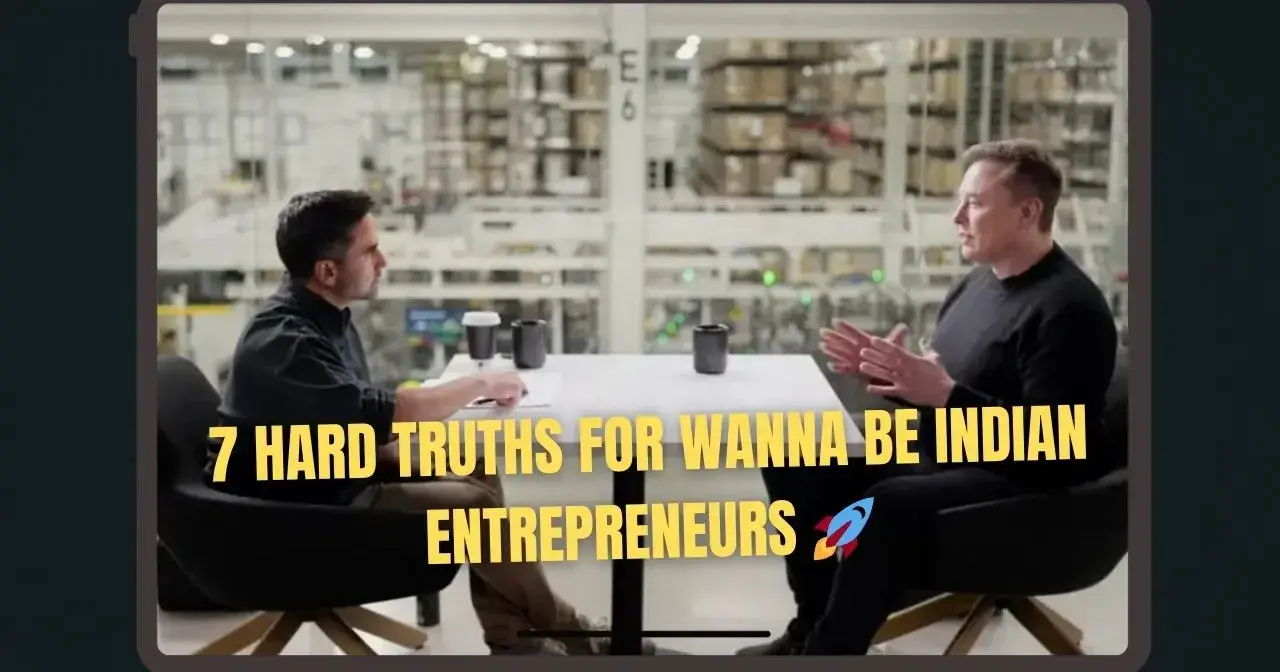
When Elon Musk sits down with Nikhil Kamath for a two‑hour, no‑script conversation aimed at wannabe entrepreneurs in India, you don’t just “watch a podcast”. You hold up a mirror to the way you’re building, dreaming, and delaying gratification.
This episode isn’t really about rockets, robots, or stock tips. It’s about a few brutally simple ideas: create more value than you consume, work on useful things, and prepare for a world where AI makes “having a job” optional.
Below are the key ideas from the conversation, retold in a simple, human way, with examples grounded in the life of an Indian founder or aspiring one.
1. “Make more than you take” — the one line every Indian founder should remember 💡
Elon’s core advice in this conversation is almost boringly simple:
“Be a net contributor to society. Make more than you take.”
Think of it like this:
A good business is one where your output is greater than your input: output>input.
You leave the world slightly better than you found it — for your users, employees, and ecosystem.
In India’s startup scene, it’s very easy to confuse funding with value. Unicorns, term sheets, Twitter followers — all of that can feel like progress. But Musk keeps dragging the conversation back to one question:
“Are you making something useful?”
Example:
Food delivery is useful. But:
If your app makes food slightly faster but burns insane cash, underpays delivery partners, and depends purely on discounts that’s not “making more than you take”.
If your platform helps small restaurants grow, pays fairly, and becomes operationally efficient over time that’s value creation.
For an Indian founder, this metric is more brutal than any valuation:
👉 If investors disappeared tomorrow, would your users still miss you?
If the answer is “yes”, you’re making more than you take.
2. What makes a company worth investing in (according to Elon) 📈
Nikhil introduces the audience clearly: mostly wannabe entrepreneurs in India ambitious, hungry, willing to take risk. Elon’s answer is surprisingly old-school.
He looks for three things in a company:
Products and services people genuinely like
If users don’t love what you build, nothing else matters. Not your pitch deck, not your TAM slide.A strong product roadmap
Does the company know what it’s building next — and why that matters?A talented, hardworking, still‑motivated team
He cares less about fancy resumes and more about whether the team can ship hard things, again and again.
Example (India context):
A SaaS tool that helps Indian MSMEs automate GST filings and inventory:
If shopkeepers actually use it daily and recommend it to friends, that beats a “cool” consumer social app with no retention.
If the roadmap shows how it will expand into lending, analytics, and procurement, that’s long‑term thinking.
If the team is still grinding on customer support calls at 11 pm because “customers in Tier‑3 towns have questions after closing the shop” — that’s skin in the game.
For anyone building in India, the filter becomes clear:
👉 Would Elon invest in your company if he only saw your product and your team no pitch deck, no buzz, no headlines?
3. Working will be “optional” in 10–20 years — so what are you really building? 🤖
One of the wildest predictions from the episode:
In less than 20 years, working will be optional. Not because governments are generous, but because AI and robotics will produce more than humans can consume.
Musk talks about a future of Universal High Income (UHI) — not handouts, but a world where abundance makes basic needs cheap and accessible.
Imagine:
AI systems doing most of the boring work.
Robots manufacturing, delivering, even cooking.
Software agents negotiating prices, scheduling, and logistics on your behalf.
In that world, a job becomes closer to a hobby than a necessity.
So what does that mean for a young Indian founder today?
It means building another clone app that does nothing new is the riskiest thing you can do. If AI will make most simple, repetitive work free or nearly free, the safe zone is:
Tools that leverage AI, not compete with it
Products that unlock human potential — creativity, relationships, learning, trust
Systems that help millions of people use AI without needing to understand it deeply
👉 Don’t build something that AI will replace. Build the thing that makes AI useful to ordinary people.
4. Deflation, debt, and why AI changes the money game 🪙
Elon gets into macroeconomics in a very simple way:
Inflation happens when money supply grows faster than goods and services.
Deflation happens when goods and services grow faster than money supply.
AI plus robotics massively boosts the output side — more goods, more services, faster and cheaper.
So over time, prices of many things should either:
Stop rising
Or even fall
He argues that this is probably the only realistic way out of insane levels of government debt (like in the US) — grow real productivity so fast that the old rules about scarcity break.
He even goes further: in the far future, money itself loses meaning and energy becomes the real “currency” because it’s the fundamental input behind everything.
What does this mean for an Indian entrepreneur right now?
Don’t build fragile models that only work in an “easy money, high inflation” world.
Build things that will still matter when:
Capital is more disciplined
Users are less tolerant of nonsense
AI‑driven productivity makes many existing industries cheaper or obsolete
👉 Think beyond flipping a startup. Ask: will this still be valuable in a world where energy is abundant and software does most of the work?
5. X, collective consciousness, and the opportunity in language 🌏🗣️
One of Elon’s more philosophical ideas is turning X into a kind of “global town square” a platform for collective consciousness where people across languages can interact in real time.
He talks about:
Real‑time translation across languages
Text, audio, and video all flowing into one system
AI understanding and generating content, not just serving it
For Indian founders, this is a massive signal:
India is already a country of:
Dozens of major languages
Hundreds of millions of smartphone users
Huge creator bases in Hindi, Tamil, Telugu, Bengali, Marathi and beyond
Concrete opportunities:
Tools that instantly translate local language videos into other Indian languages (and English) with good lip sync and cultural nuance
Platforms where a Gujarati trader, a Tamil student, and a German investor can talk business with AI helping them understand each other
Vertical “town squares” — focused communities for farmers, small traders, students, or founders, layered with AI translation and summarization
Elon’s vision of collective consciousness isn’t just sci‑fi philosophy. It’s basically a product roadmap hint for anyone building communication, content, or community products in India.
👉 Think beyond “one language, one app”. The future is multilingual, real‑time, and AI‑assisted.
6. Starlink, cities vs villages, and India’s map of opportunity 🛰️
When Starlink comes up, Elon explains it very clearly:
Thousands of satellites in low Earth orbit
Low‑latency, high‑speed internet
Especially powerful in rural and remote areas where fibre and towers are expensive
He’s very honest about its limitation:
It will never beat a cell tower that’s 1 km away in a dense city, simply because of physics.
It shines where ground infrastructure is weak — villages, highways, disaster zones.
For India, that’s a huge clue. If Starlink (or similar tech) becomes mainstream here:
The urban vs rural digital gap shrinks dramatically.
A founder in a small town gets the same quality of connectivity as someone in Bangalore.
Entire categories open up: rural telemedicine, remote work hubs, agri‑data platforms, vernacular education at scale.
Example:
A doctor in a Tier‑2 city runs remote clinics for nearby villages on Starlink‑backed connections.
An edtech startup streams immersive STEM classes to government schools in the hills.
👉 Don’t only think “how do I build for Bangalore and Mumbai?” Think: “What happens when every serious village has world‑class internet?”
7. Delayed gratification, hard work, and the unsexy truth about building ⏳💪
Nikhil literally has “delay gratification” tattooed on his arm. The two of them laugh about the famous marshmallow test — but the point is serious:
Great companies are built by people who can say no to the easy marshmallow now.
Elon is very clear: if you’re trying to make a hard company succeed, serious hours are non‑negotiable.
In a world where everyone posts “founder lifestyle” content, this conversation quietly reminds:
The boring nights matter more than the conference selfies.
The 100th product iteration matters more than the first launch video.
The companies that endure are built by people who keep going long after the buzz fades.
Litmus test:
If the choice is between “Netflix + chill” and fixing that one annoying bug 10 customers complained about…
The path to building something meaningful is often choosing the bug. Again. And again.
👉 Ambition is cheap. Delayed gratification is rare. That’s exactly why it compounds.
Bringing it all together: what should a wannabe Indian entrepreneur actually do now? 🎯
After two hours of talk about AI, debt, satellites, simulation theory, and the meaning of life, the advice ends up surprisingly practical:
Pick a real problem, not a glamorous one.
Something people in India actually struggle with credit access, logistics, healthcare, language, education, compliance.Build something genuinely useful.
If your product vanished tomorrow, would anyone outside your friend circle care?Use AI as a force multiplier.
Don’t compete with AI on repetitive work. Use it to automate boring tasks for your users — and for yourself.Think long‑term — as if work really might become optional.
Design your company for a world of abundance, not scarcity.Make more than you take.
Aim to be a net contributor — to your customers, team, and country. Money then becomes a by‑product, not the only scoreboard.Out‑work and out‑wait.
Delayed gratification isn’t a quote on Instagram. It’s saying no to the marshmallow today so you can own the factory tomorrow.
In the end, this conversation is not two billionaires telling everyone “anyone can do it”. It’s closer to two builders quietly saying:
“It’s hard.”
“It takes time.”
“But if you focus on usefulness, truth, and hard work, India is one of the best places on earth to build right now.”
And for a wannabe entrepreneur in India, that’s not just motivation — it’s a roadmap. 🚀
A Note From the Author
Thank you so much for taking the time to read the story. If you found my article helpful and interesting, please share your thoughts in the comment section, and don’t forget to share and clap 😊

Join Gajanan on Peerlist!
Join amazing folks like Gajanan and thousands of other builders on Peerlist.
0
1
0