

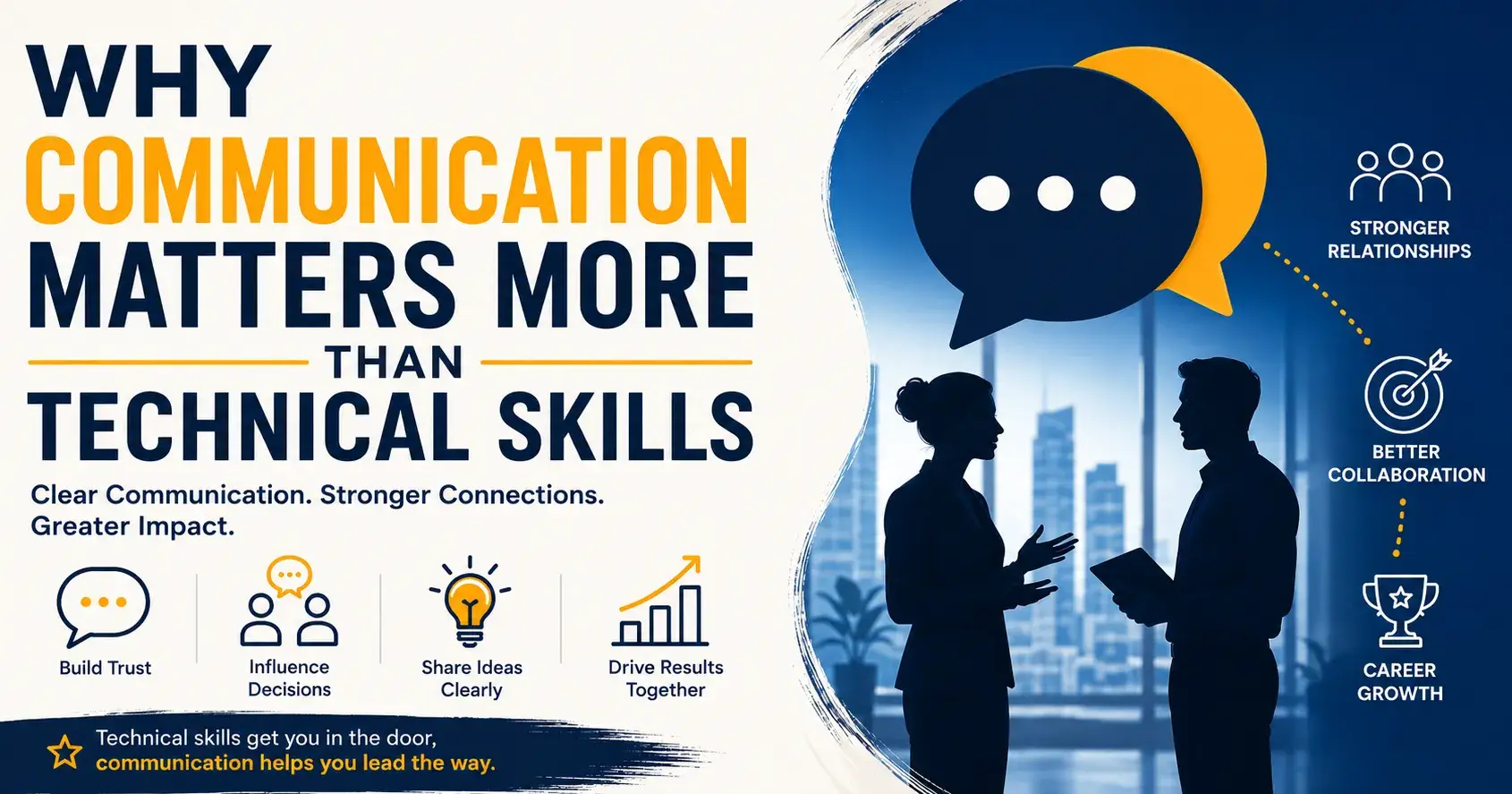
Why Communication Matters More Than Technical Skills
In a World of Experts, the Best Communicators Stand Out
Imagine two professionals with identical technical knowledge.
Both understand the technology.
Both solve complex problems.
Both have impressive certifications.
Yet, one becomes a respected team leader, wins client trust, and consistently receives career opportunities, while the other remains unnoticed despite being equally talented.
What makes the difference?
More often than not, it's communication.
Technical skills may help you get the job, but communication skills determine how far you grow within it. Whether you're a software developer, cybersecurity analyst, data scientist, designer, marketer, or entrepreneur, your ability to express ideas clearly often has a greater impact on your career than your technical expertise alone.
In today's workplace, knowing what to do is important. Knowing how to explain it is invaluable.
Technical Skills Open Doors
Every profession requires technical competence.
Developers write code.
Engineers design systems.
Analysts interpret data.
Designers create user experiences.
Accountants manage finances.
Without technical knowledge, it becomes difficult to perform the job effectively.
However, technical skills have become increasingly accessible.
Thousands of online courses, certifications, AI-powered learning tools, and open-source communities make it easier than ever to learn almost any technical skill.
As technology evolves, today's cutting-edge expertise may become tomorrow's basic requirement.
That means technical knowledge alone is no longer enough to distinguish yourself.
Communication Creates Influence
Communication is what transforms knowledge into impact.
You might build an incredible product, but if you cannot explain its value, others may never understand why it matters.
You might identify a critical security risk, but if executives cannot understand your explanation, the issue may remain unresolved.
You might have an innovative idea, but unless you communicate it effectively, it may never receive support.
Communication bridges the gap between expertise and action.
It allows people to understand your thinking, trust your judgment, and confidently make decisions based on your recommendations.
Great Ideas Need Great Storytelling
People rarely remember complex technical explanations.
They remember stories.
Instead of explaining how an algorithm processes data, explain how it saves customers hours of manual work.
Instead of describing server architecture, explain how it keeps businesses running even during unexpected failures.
Instead of discussing machine learning models, explain how they help doctors detect diseases earlier.
When you connect technical concepts to real-world outcomes, people become engaged.
Storytelling isn't about simplifying your intelligence.
It's about making your expertise accessible.
Leadership Depends on Communication
Many professionals assume promotions come solely from technical excellence.
In reality, leadership requires much more.
Leaders spend less time solving problems themselves and more time helping others solve them.
That involves:
Giving constructive feedback
Leading meetings
Presenting strategies
Resolving conflicts
Motivating teams
Building stakeholder confidence
Negotiating priorities
None of these responsibilities rely primarily on technical ability.
They rely on communication.
As careers progress, communication becomes increasingly valuable while purely technical work often becomes a smaller part of daily responsibilities.
Remote Work Changed Everything
The rise of remote and hybrid work has made communication even more important.
Without face-to-face conversations, professionals rely heavily on:
Emails
Documentation
Chat platforms
Video meetings
Project updates
Knowledge sharing
Poor communication creates confusion.
Clear communication creates alignment.
A well-written document can save hours of unnecessary meetings.
A concise project update can prevent misunderstandings.
An effective presentation can secure funding for an important initiative.
In distributed teams, communication often becomes the foundation of productivity.
Clients Buy Confidence
Clients rarely evaluate only technical expertise.
They also evaluate confidence, clarity, responsiveness, and professionalism.
Imagine hiring two consultants.
One uses complicated jargon and lengthy explanations.
The other explains complex issues using simple language that builds trust and confidence.
Most clients will choose the second consultant.
Not because they're more knowledgeable.
Because they make expertise understandable.
Clear communication reduces uncertainty, and people naturally trust professionals who help them understand difficult topics.
Communication Prevents Expensive Mistakes
Many workplace failures aren't caused by poor technical work.
They're caused by poor communication.
Requirements are misunderstood.
Deadlines aren't clarified.
Assumptions go unspoken.
Documentation is incomplete.
Critical information isn't shared.
Small misunderstandings eventually become expensive problems.
Organizations spend countless hours correcting issues that could have been prevented through better communication.
Speaking clearly.
Listening carefully.
Asking thoughtful questions.
Confirming expectations.
These habits often save more time than any technical shortcut.
Listening Is Part of Communication
Strong communication isn't just about speaking.
It's also about listening.
Exceptional professionals ask questions before offering solutions.
They seek to understand the problem completely.
They encourage others to share ideas.
They pay attention to concerns that may otherwise remain hidden.
Listening improves collaboration, strengthens relationships, and leads to better decisions.
People appreciate being heard.
And teams perform better when everyone feels understood.
AI Makes Human Communication Even More Valuable
Artificial Intelligence is rapidly automating technical tasks.
Code generation.
Data analysis.
Content summarization.
Documentation.
Testing.
These capabilities continue to improve.
However, AI cannot fully replace human empathy, emotional intelligence, persuasion, leadership, trust-building, or meaningful conversations.
As automation increases, uniquely human communication skills become even more valuable.
The professionals who combine technical expertise with exceptional communication will remain highly sought after.
Technology changes.
Human connection remains essential.
How to Become a Better Communicator
Like technical skills, communication improves with consistent practice.
Some practical habits include:
Explain technical concepts in simple language.
Write concise emails with clear action items.
Practice active listening during meetings.
Present ideas using real-world examples.
Ask for feedback on presentations and documentation.
Read regularly to improve vocabulary and writing style.
Participate in discussions rather than remaining silent.
Focus on clarity instead of sounding overly technical.
Small improvements made consistently can produce remarkable long-term results.
The Most Valuable Professional Is Both Technical and Understandable
The workplace doesn't reward knowledge alone.
It rewards knowledge that creates results.
Technical skills help you solve problems.
Communication helps people recognize the value of those solutions.
One without the other limits your potential.
The most respected professionals are rarely those who know the most.
They're the ones who help others understand, collaborate, and move forward with confidence.
If you're investing time in learning new technologies, dedicate equal effort to improving how you communicate.
Your future career may depend on it.
Final Thoughts
Technical expertise will always be essential, but communication is the skill that amplifies every other ability you possess. It helps you build trust, influence decisions, strengthen relationships, and create opportunities that technical knowledge alone cannot.
Whether you're starting your career or leading a global team, remember this simple principle:
People don't just remember what you know but they remember how clearly you helped them understand it.
Invest in your communication skills, and you'll discover that they become the multiplier for every technical skill you acquire.

Join Govind on Peerlist!
Join amazing folks like Govind and thousands of other builders on Peerlist.
0
0
0