

The 2026 Attention Crisis
Your 40-Page PDF is Where Knowledge Goes to Die
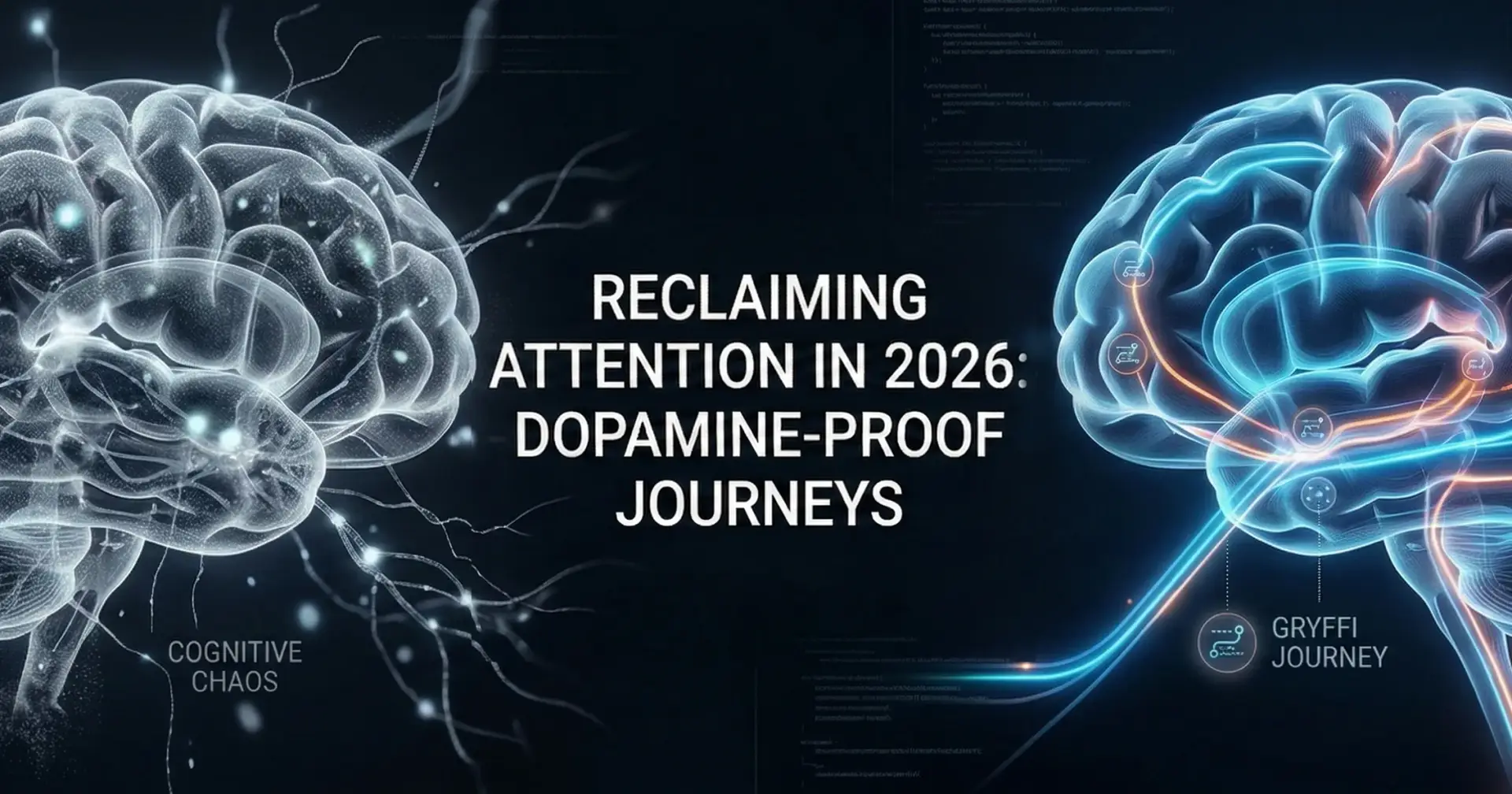
Be honest. When was the last time you actually read a 40-page PDF from start to finish? Not skimmed. Not searched for one keyword. Actually read it, page by page.
Exactly. And yet, this is still how most organizations communicate their most important information to new employees. A dense document, a few wiki links, and a welcome email long enough to qualify as a short story. We all know what happens next. It gets opened, scrolled through in seconds, and never opened again.
The attention problem nobody wants to talk about
Here is the uncomfortable truth. The average attention span on a screen has dropped to 47 seconds. In 2004, it was 2.5 minutes. That is not a small decline. That is a collapse.
Your employees are not lazy. Their brains have adapted to a different environment. The average professional now checks their phone 205 times a day. Knowledge workers toggle between apps roughly 1,200 times per day. That is one switch every 24 seconds during an 8-hour workday. And after every single interruption, it takes between 9 and 23 minutes to fully refocus.
Think about what this means for your onboarding manual. Or your compliance training document. Or that important process update you emailed to the whole company last Tuesday. 79% of workers get distracted within the first hour of starting a task. 59% cannot maintain focus for even 30 minutes.
These are not bad employees. These are normal humans with brains that have been reshaped by a decade of infinite scrolling.
The dopamine wall
Social media platforms figured out something powerful about the human brain: unpredictable rewards generate more dopamine than predictable ones. Every scroll through a feed works like a slot machine. You never know what comes next, so your brain keeps pulling the lever, releasing small bursts of dopamine with every swipe.
This is not a metaphor. Neuroimaging studies show that heavy social media users have measurable changes in their prefrontal cortex (impulse control), their anterior cingulate cortex (self-regulation), and their basal ganglia (reward-seeking behavior). The brain literally prunes neurons to create faster reward pathways. Over time, people become more responsive to quick stimuli and less patient with slow, static content.
Now consider what happens when that same brain opens a dense PDF or a long-form training module. There is no variable reward. No surprise around the corner. No small win to keep going. The brain hits what you could call a "dopamine wall." It is not that people refuse to read your content. It is that the content creates so much mental friction that the brain skips over most of it. Research shows that frequent social media users retain 15-20% less from traditional learning materials.
The information is not just ignored. It never reaches long-term memory in the first place.
So what actually works?
If the problem is that brains now expect variety, small wins, and frequent stimulation, then the solution is obvious: give them exactly that, but fill it with the content that matters.
This is what we call a "segmented journey." Instead of one large document, you break the experience into a series of short, varied checkpoints. Each step is different from the last. Each step is easy to start and satisfying to complete.
The science backs this up. 94% of employees say that breaking content into smaller segments helps them retain information better. Microlearning approaches reduce training time by 40% while increasing engagement by 86%. These are not marginal improvements. This is a fundamentally different way of communicating with the modern brain.
Here is what the variety looks like in practice:
Show, don't tell. Instead of describing the office layout in paragraph three of your handbook, drop someone into a 360-degree panorama. Let them look around. Spatial memory is one of the strongest memory systems we have. When someone physically explores a space (even virtually), they remember it far better than when they read about it.
Let them ask, instead of making them search. Nobody reads a FAQ document from top to bottom. People have specific questions at specific moments. An AI assistant that is grounded in your actual knowledge base (your documents, your policies, your processes) lets employees get answers in a conversation, not a treasure hunt through 14 nested folders on SharePoint.
Give them a small win. A quick three-question quiz after a learning module does something powerful. It activates the same reward circuitry that social media exploits, but for your benefit. Getting an answer right feels good. That small dopamine hit connects positive emotion to the information you need people to remember. Suddenly, your compliance training is not a chore. It is a challenge.
The key is rotation. When the brain knows what is coming next, it starts to tune out. But when each step brings a different type of interaction (a visual space, then a conversation, then a short quiz, then a video) the brain stays alert because it cannot predict the next stimulus.
This is bigger than "better onboarding"
Let me be direct about the real stakes. Only 12% of employees say their company does onboarding well. 20% of new hire turnover happens in the first 45 days. Organizations that structure their onboarding properly see 82% better retention and 70% higher productivity.
But this goes beyond onboarding. Think about what happens when your most experienced engineer retires next year. Or when your best project manager switches to a competitor. All that knowledge they carry, the processes, the shortcuts, the lessons learned over 15 years, where does it go?
If it lives in a document that nobody reads, it goes nowhere.
The real opportunity is turning tacit knowledge into something people actually engage with. Not a static file that sits on a server. An interactive experience that walks someone through the same decisions, the same environments, the same thinking that your expert developed over years.
A visual builder that lets subject matter experts create these paths as fast as they can think of them makes this practical, not theoretical. You do not need an instructional designer. You do not need a developer. You need the person who holds the knowledge and 30 minutes of their time.
Build for the brain you have
Organizations that keep relying on long-form documents and one-size-fits-all training programs will slowly fall behind. Not because the content is wrong, but because it never reaches the people who need it. Your workforce will be less skilled and less informed than you think, simply because the delivery method does not match how their brains process information anymore.
The shift is clear. HR needs to move from being content distributors to experience architects. The information has not changed. The human brain has.
One challenge for you
Pick one training document in your organization. Just one. The one that everybody gets but nobody reads. The safety manual. The IT onboarding guide. The new hire checklist.
Now ask yourself: what would this look like if it were built for a brain that runs on variety, interaction, and small wins?
If you are curious what that transformation looks like in practice, we would be happy to show you. No pitch, just a quick look at how your existing content could work as a 2026-ready interactive journey.

Join Erik on Peerlist!
Join amazing folks like Erik and thousands of other builders on Peerlist.
0
3
0