

Agent Communication Protocol (ACP): The Open Standard for AI Agent Interoperability 🚀
ACP is to AI agents what HTTP was to the web—an open standard for interoperability.
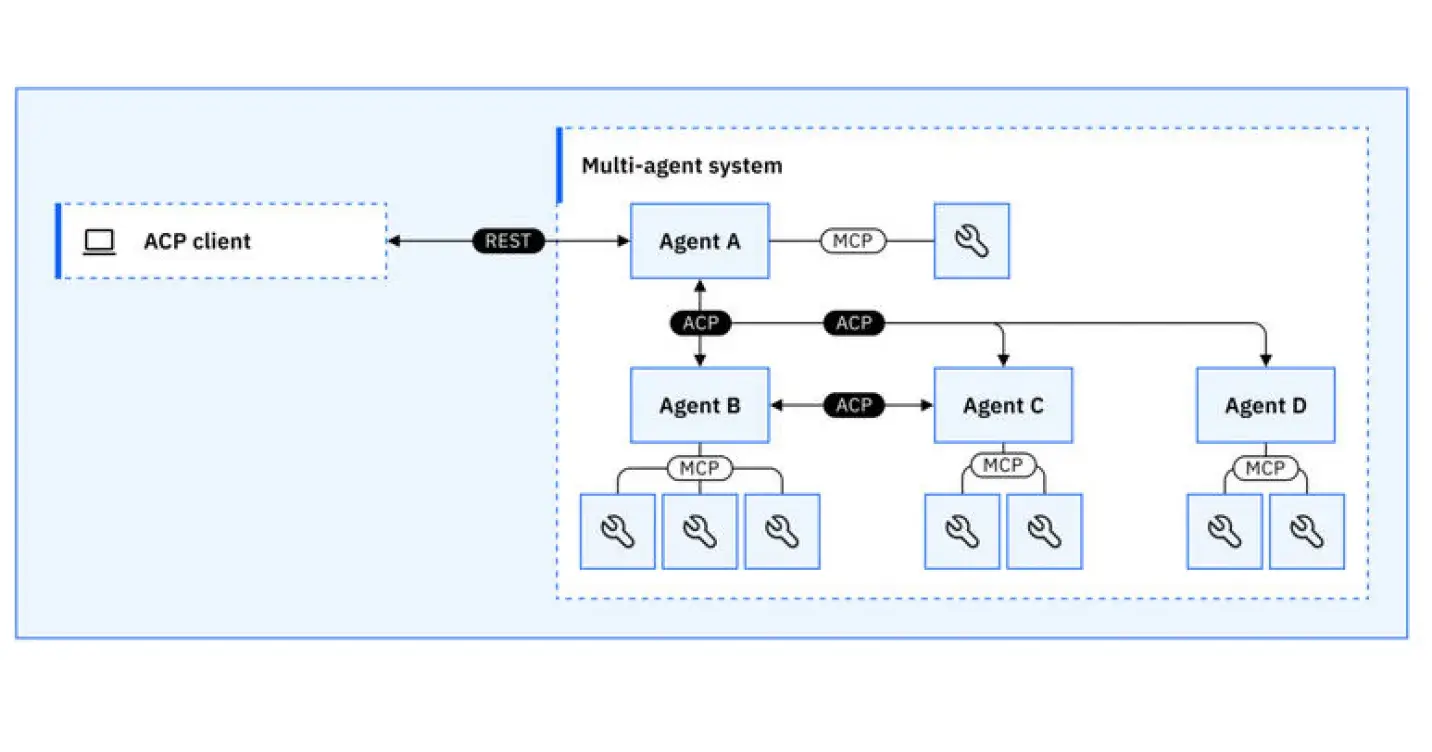
Artificial intelligence is evolving faster than ever, but one thing has been holding it back: agents don’t talk to each other very well. Every framework—LangChain, AutoGen, CrewAI, BeeAI—tends to operate in its own silo. That means duplication of effort, isolated systems, and integrations that rarely scale.
That’s exactly the problem the Agent Communication Protocol (ACP) is designed to solve. ACP was open-sourced by IBM Research and is now being developed under the Linux Foundation.
🔗 Project Overview: https://research.ibm.com/projects/agent-communication-protocol
Think of ACP as the HTTP for AI agents—a universal language that allows agents, regardless of framework, runtime, or programming language, to communicate seamlessly.
Why ACP?
The AI ecosystem is becoming more fragmented by the day. Specialized agents are powerful, but they often get locked inside proprietary ecosystems, making it harder to reuse or integrate them elsewhere.
ACP fixes this by creating a lightweight, REST-based, HTTP-native standard that ensures any agent can talk to any other agent with minimal setup.
Instead of reinventing the wheel, developers can now:
Plug and play agents across frameworks
Build reusable, discoverable agents
Enable cross-team and even cross-company workflows
📖 Learn more here: https://agentcommunicationprotocol.dev
Core Features
ACP is designed with practicality at its core:
REST-based design – Exposes clear HTTP endpoints. Works with cURL, Postman, or any HTTP client.
Ref: https://research.ibm.com/projects/agent-communication-protocolSDK optional – Use ACP directly with HTTP, or streamline development with SDKs in Python and TypeScript.
Ref: https://adasci.org/a-practitioners-guide-to-agent-communication-protocol-acp/Multimodal messaging – Exchange text, code, embeddings, files, and images.
Asynchronous by default – Great for long-running tasks, with support for synchronous and streaming via SSE.
Agent discovery – Metadata-based discovery of agents—even offline.
Shared state management – Supports workflows that require maintaining context.
📖 IBM Research Blog: https://research.ibm.com/blog/agent-communication-protocol-ai
Governance & BeeAI Ecosystem
ACP is developed under open governance at the Linux Foundation. Its primary implementation comes through the BeeAI ecosystem.
BeeAI Framework (ACP-compliant agents): https://beeai.dev
This makes ACP not just a specification, but a working ecosystem for production-grade AI agents.
How ACP Works
The workflow is simple and elegant:
Wrap your agent as an ACP server that exposes REST endpoints.
Send requests through an ACP client, which routes tasks to the right agent.
Let the client act as an agent itself, intelligently forwarding tasks when needed.
📖 IBM Think Overview: https://www.ibm.com/think/topics/agent-communication-protocol
Use Cases
ACP unlocks new possibilities:
Dynamic updating – Replace or upgrade agents without breaking integrations. Docs: https://agentcommunicationprotocol.dev
Specialized teamwork – A research agent, a visualization agent, and a finance agent can work together like a human project team.
Cross-system workflows – Imagine a customer support agent seamlessly calling an inventory agent, which then queries an HR system agent—without custom code.
Inter-organizational collaboration – Securely connect agents across companies for supply chains, finance, or healthcare.
Practical guide: https://adasci.org/a-practitioners-guide-to-agent-communication-protocol-acp/
ACP vs MCP vs A2A
It’s easy to confuse ACP with other emerging protocols like MCP (Model Context Protocol by Anthropic) and A2A (Agent-to-Agent by Google). Each has its sweet spot:
MCP – enriches a single agent with tools and context.
A2A – connects agents across the cloud and across vendors.
ACP – focuses on low-latency, RESTful, local-first interoperability—ideal for enterprise, team, and edge setups.
📖 Everest Group Analysis: https://www.everestgrp.com/uncategorized/the-rise-of-agent-protocols-exploring-mcp-a2a-and-acp-blog.html
📖 WorkOS Blog: https://workos.com/blog/ibm-agent-communication-protocol-acp
Resources & Talks
IBM Research – ACP Project Overview: https://research.ibm.com/projects/agent-communication-protocol
IBM Blog – Simplest Protocol for AI Agents: https://research.ibm.com/blog/agent-communication-protocol-ai
ACP Official Website & Docs: https://agentcommunicationprotocol.dev
Everest Group Report: https://www.everestgrp.com/uncategorized/the-rise-of-agent-protocols-exploring-mcp-a2a-and-acp-blog.html
WorkOS Blog: https://workos.com/blog/ibm-agent-communication-protocol-acp
ADaSci Guide: https://adasci.org/a-practitioners-guide-to-agent-communication-protocol-acp/
Medium (Akanksha Sinha) – ACP Insights: https://medium.com/@akankshasinha247/agent-communication-protocol-acp-the-emerging-language-of-interoperable-ai-agents-9b074325930e
DeepLearning.AI Free ACP Course: https://www.deeplearning.ai/short-courses/acp-agent-communication-protocol/
arXiv Survey on MCP, A2A, ACP: https://arxiv.org/abs/2505.02279
(YouTube talks coming soon — final links pending)
Final Thoughts
The Agent Communication Protocol is to AI agents what HTTP was to the early internet: a universal, open standard that enables communication, discovery, and collaboration—across frameworks, teams, and even companies.
By adopting ACP, organizations can stop rebuilding integrations over and over and start building agent ecosystems that are flexible, scalable, and collaborative.
This is more than just a protocol—it’s a foundation for the future of networked intelligence.
♻️ If you found this useful, share it with your network.
Follow me (Hardik Sankhla) for more deep dives into AI agents, interoperability standards, and ML innovations.

Join Hardik on Peerlist!
Join amazing folks like Hardik and thousands of other builders on Peerlist.
0
7
0