

The 7 Best AI for Academic Writing Tools You Need in 2026
Review of 7 Tools That Assist with Writing

Academic writing has always been a meticulous, often time-consuming process. From drafting essays and research papers to properly formatting references, students and researchers constantly juggle multiple tasks that can slow down productivity. But 2026 has brought a remarkable shift with AI-powered writing tools stepping in as indispensable assistants. Using the best AI for academic writing can not only save time but also improve the clarity, structure, and impact of your work.
Whether you are a university student, graduate researcher, or professional academic, integrating AI into your writing workflow can transform the way you approach complex assignments. From generating first drafts to polishing the final version, AI is revolutionizing academic writing.
Introduction: Why AI Matters for Academic Writing in 2026
The rise of AI in education is undeniable. Advanced algorithms and natural language processing now allow tools to understand context, improve grammar, suggest better sentence structures, and even detect inconsistencies in your argumentation. Academic writing no longer has to be a solitary and stressful task. Instead, it can be a collaborative experience with AI serving as a co-writer and guide.
Using AI for academic writing helps you tackle common challenges: writer’s block, unclear thesis statements, disorganized arguments, and even improper citations. By automating repetitive tasks, these AI tools free you to focus on critical thinking, research synthesis, and creativity. But with countless AI options available, identifying the top-performing tools is crucial.
Key Features to Look for in AI Academic Writing Tools
Not all AI writing assistants are created equal. When evaluating AI tools for academic writing, it’s important to consider several core features that directly impact the quality and efficiency of your work.
Draft Generation and Editing Assistance
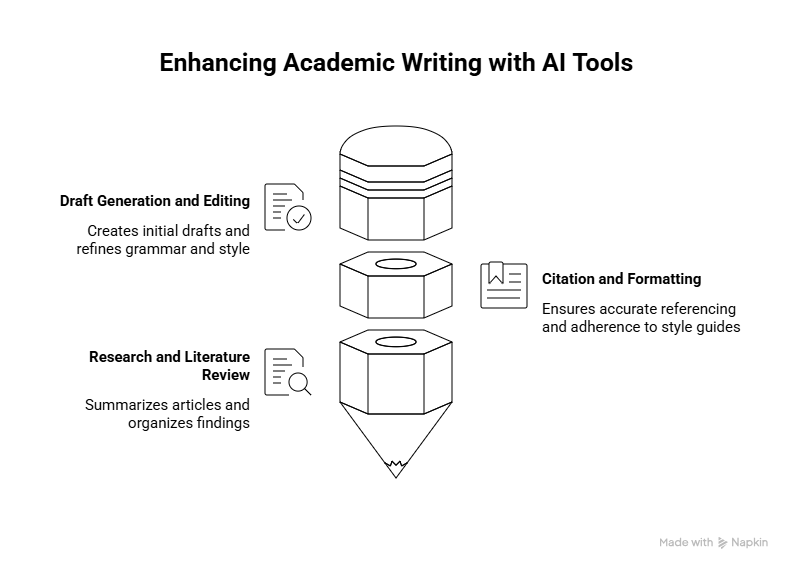
One of the most valuable features of AI for academic writing is draft generation. Top tools can take a prompt, outline, or research notes and produce coherent paragraphs or full essays. They often come with built-in editing capabilities, helping refine grammar, sentence flow, and style while maintaining an academic tone. This makes the writing process faster, especially for longer papers.
Citation, Referencing, and Formatting Support
Accurate citations are the backbone of credible academic writing. High-quality AI tools can automatically format references in APA, MLA, Chicago, or other academic styles, and even suggest proper in-text citations. This reduces the risk of plagiarism and ensures your work adheres to institutional guidelines.
Research and Literature Review Capabilities
Some advanced AI tools go beyond writing—they help summarize articles, extract key points, and even organize research findings. These features make literature reviews significantly more manageable, allowing writers to focus on analysis rather than tedious note-taking.
The 7 Best AI for Academic Writing Tools You Need in 2026
Writing academic papers can be overwhelming, whether you’re a student juggling multiple assignments or a researcher managing long-form articles. The right AI tools can turn hours of work into a smoother, more efficient process. Here’s a detailed look at the top seven AI for academic writing tools in 2026, including practical use cases and workflow tips.
1. NoteGPT – AI Essay Writer
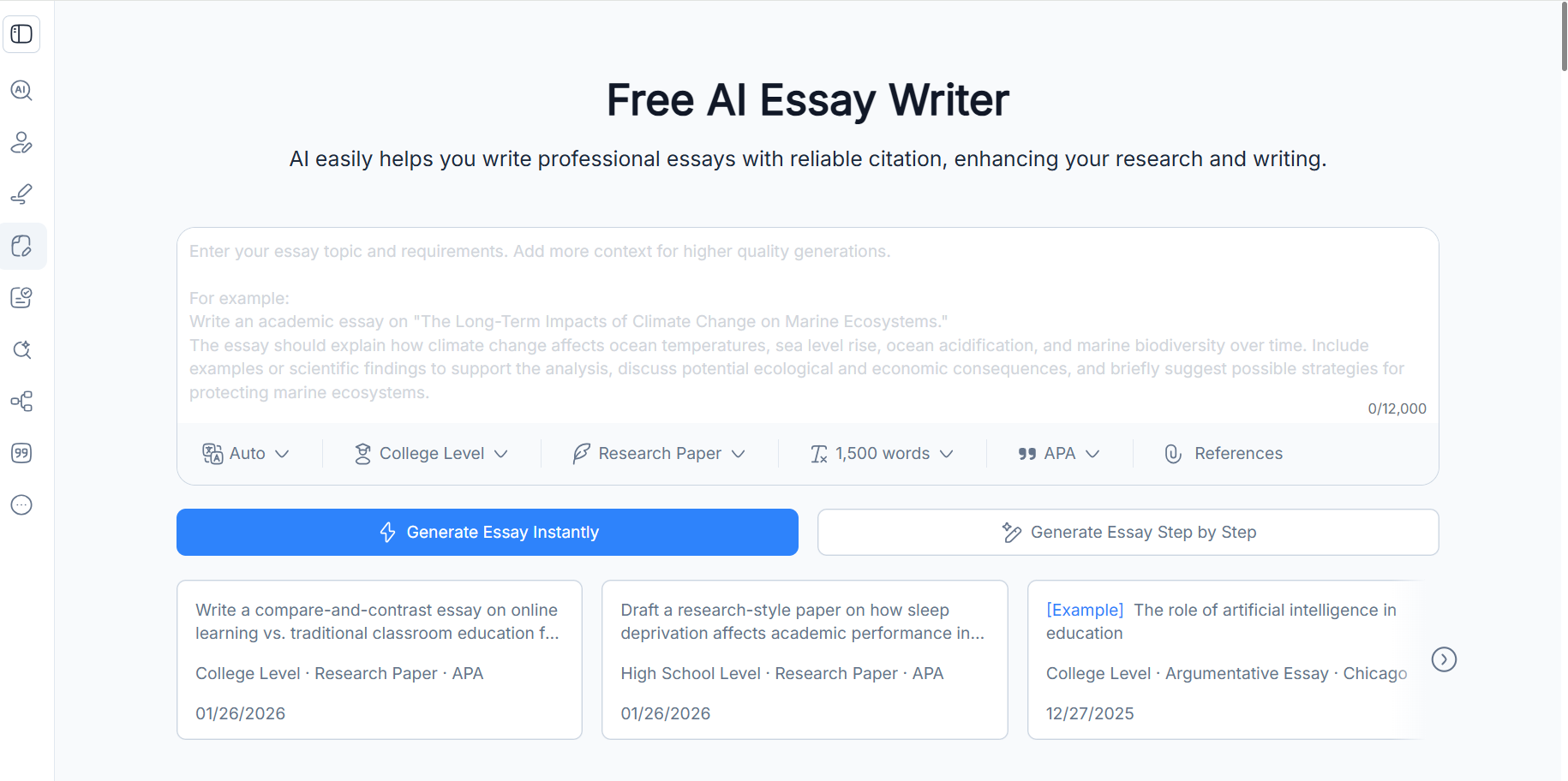
Why it stands out: NoteGPT is built specifically for academic writing, making it the most versatile and user-friendly AI Essay Writer on the market.
Key Features:
One-click draft generation: Transform outlines, research notes, or a simple topic into a fully structured essay in seconds. No more staring at a blank page.
Structured step-by-step outputs: Breaks down essays into logical sections—introduction, literature review, analysis, conclusion—so your drafts are already organized and easier to edit.
Direct citation integration: Pulls references directly from uploaded papers, Zotero, or other sources, embedding accurate citations in APA, MLA, Chicago, or Harvard styles.
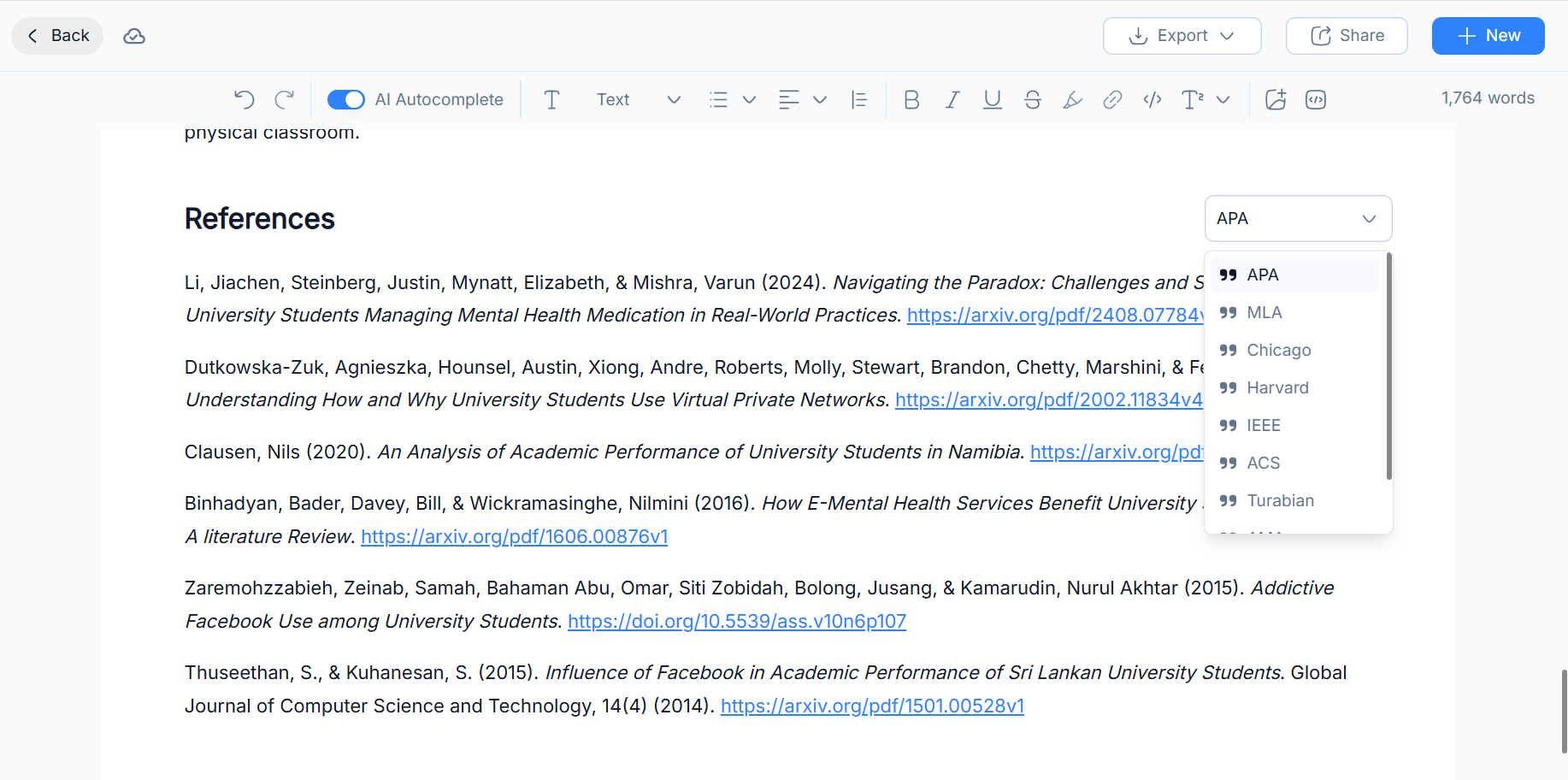
AI-assisted editing: Offers grammar, style, and clarity suggestions while maintaining a formal academic tone.
Workflow-friendly: Works alongside other tools like Grammarly or Quillbot for paraphrasing, giving you a complete end-to-end solution.
User scenario: Imagine you have 5 research articles and a 10-page essay due tomorrow. Instead of manually summarizing and structuring, you can upload your PDFs to NoteGPT, generate a draft in minutes, and have properly cited, structured paragraphs ready for refinement.
2. Grammarly
Why it stands out: Grammarly is a go-to tool for refining language and improving clarity.
Key Features:
Real-time grammar and spelling corrections
Suggestions for sentence flow, readability, and conciseness
Plagiarism detection to ensure originality
User scenario: Perfect for finalizing drafts. After generating a first draft with NoteGPT, Grammarly ensures that your language is polished and professional, suitable for submission.
3. Quillbot
Why it stands out: Quillbot focuses on paraphrasing and summarizing, helping to condense complex research into clear, readable content.
Key Features:
Paraphrase content while preserving meaning
Summarize lengthy sections for literature reviews
Tone adjustment for formal academic style
User scenario: Use Quillbot to rework dense paragraphs or rephrase research notes before feeding them into NoteGPT for a coherent draft.
4. Scholarcy
Why it stands out: Scholarcy accelerates research by summarizing and organizing key points from articles, PDFs, and reports.
Key Features:
Extracts essential information and findings from papers
Highlights tables, figures, and key results
Generates structured summaries ready for citations
User scenario: When starting a literature review, Scholarcy can condense 20+ papers into manageable summaries that NoteGPT can then turn into a cohesive essay section.
5. Writefull
Why it stands out: Writefull ensures that your writing meets academic standards, especially for non-native English speakers.
Key Features:
Provides real-time feedback on sentence correctness and appropriateness
Suggests alternative phrasing for clarity and conciseness
Checks terminology consistency across your paper
User scenario: Ideal for refining drafts from NoteGPT, particularly if your field has strict language expectations or journal submission standards.
6. Jasper AI
Why it stands out: Jasper AI blends structured academic writing with creative AI support, offering flexibility when standard tools feel rigid.
Key Features:
Generates paragraphs with coherent logical flow
Offers content expansion without losing context
Supports multiple writing tones, including formal academic style
User scenario: Useful for exploratory sections of papers, such as discussion or analysis, where you want AI to suggest interpretations or synthesize ideas from research notes.
7. Scribbr AI
Why it stands out: Scribbr AI emphasizes academic integrity and accuracy.
Key Features:
Plagiarism check with extensive database coverage
Automatic reference formatting in APA, MLA, Chicago, and Harvard
Proofreading suggestions to improve clarity and structure
User scenario: After drafting and editing with NoteGPT and Grammarly, Scribbr AI ensures your work is citation-compliant, plagiarism-free, and polished for submission.
Other Notable AI Tools for Academic Writing
Beyond the top 7 AI for academic writing tools, there are several other platforms that can enhance productivity and streamline the writing process. Tools like Zotero and Mendeley are excellent for reference management, allowing you to collect, organize, and cite sources effortlessly. EndNote also offers similar capabilities, integrating with AI-powered writing assistants to maintain accurate bibliographies.
For collaborative writing, platforms like Google Docs with AI extensions and Notion AI help teams co-author, edit, and structure papers efficiently. These tools may not replace NoteGPT or the top 7 AI writing assistants, but when combined, they create a robust, AI-driven academic workflow that saves hours of repetitive work.
How to Build an Efficient AI-Powered Academic Writing Workflow
Creating a smooth academic writing workflow using AI involves combining the strengths of multiple tools to cover all stages of writing—from research and drafting to editing and final review. Here’s an example workflow for 2026:
Research and Notes Collection: Start with Scholarcy or AI-powered search assistants to summarize papers and extract key points.
Draft Generation: Move your notes into NoteGPT to produce structured essay drafts quickly. The AI Essay Writer can maintain formal academic tone while expanding your ideas into coherent paragraphs.
Language and Style Enhancement: Use Grammarly or Writefull to refine grammar, sentence flow, and academic language.
Paraphrasing and Summarization: Tools like Quillbot help reword complex passages and condense information for literature reviews.
Plagiarism and Citation Check: Apply Scribbr AI to ensure originality and correct formatting for references.
Final Review and Polishing: Review the final draft manually, but rely on AI suggestions to strengthen clarity, cohesion, and structure.
This integrated approach maximizes efficiency while maintaining academic rigor. NoteGPT plays a central role, serving as the primary drafting and idea-expansion tool, with other AI assistants enhancing specific aspects of the workflow.
Ethical Considerations and Best Practices
While AI can drastically improve academic writing, responsible usage is key. Over-reliance on AI without critical engagement can lead to generic or inaccurate content. Always verify AI-generated suggestions and ensure that your arguments are well-supported by credible sources.
Maintaining originality is crucial. Use AI for drafting, summarizing, and refining ideas, but not for substituting your own analysis or critical thinking. Always disclose the use of AI tools if your institution requires it. By combining AI assistance with ethical practices, you can boost productivity without compromising integrity.
Additionally, using AI for paraphrasing or summarizing does not eliminate the need for thorough understanding of the subject. Think of AI as a co-writer or assistant—it amplifies your capabilities rather than replacing your intellectual work.
FAQs: Choosing the Right AI Tool for Your Needs
Which AI tool is best for first drafts?
NoteGPT is specifically designed for essay and academic drafting, making it ideal for generating coherent paragraphs from outlines or research notes.
Can AI tools handle citations automatically?
Yes. Tools like NoteGPT, Scribbr AI, and Zotero can automate citation formatting and generate bibliographies in APA, MLA, Chicago, and other styles.
Is AI useful for literature reviews?
Absolutely. Scholarcy and Quillbot excel in summarizing research papers, extracting key points, and condensing information for review sections.
Do I need multiple AI tools?
It depends on your workflow. The top 7 AI for academic writing tools each have unique strengths. Combining NoteGPT with Grammarly, Quillbot, and Scribbr AI usually covers all stages of writing efficiently.
Conclusion: Start Writing Smarter in 2026
The landscape of academic writing is evolving rapidly. AI tools are no longer optional—they are becoming essential for anyone seeking to produce high-quality research papers efficiently. The 7 best AI for academic writing tools, led by NoteGPT, offer comprehensive solutions for drafting, editing, citing, and polishing essays.
By integrating AI into your workflow, you can focus more on research, analysis, and creative problem-solving while leaving repetitive or technical writing tasks to the AI. NoteGPT, in particular, provides a unique combination of drafting, editing, and citation support, making it a go-to AI Essay Writer for students and academics alike.
As you explore these tools, remember that AI works best as an assistant. It amplifies your skills, helps you overcome writing challenges, and ensures that your academic output is both efficient and high-quality. In 2026, embracing AI for academic writing isn’t just a convenience—it’s a strategic advantage for anyone serious about research and scholarly success.

Join Hazel on Peerlist!
Join amazing folks like Hazel and thousands of other builders on Peerlist.
0
4
0