

Why Human-Centered Design Matters More in the Age of AI
Discover why human-centered UX is becoming more critical as AI transforms digital products, customer expectations, and user trust.
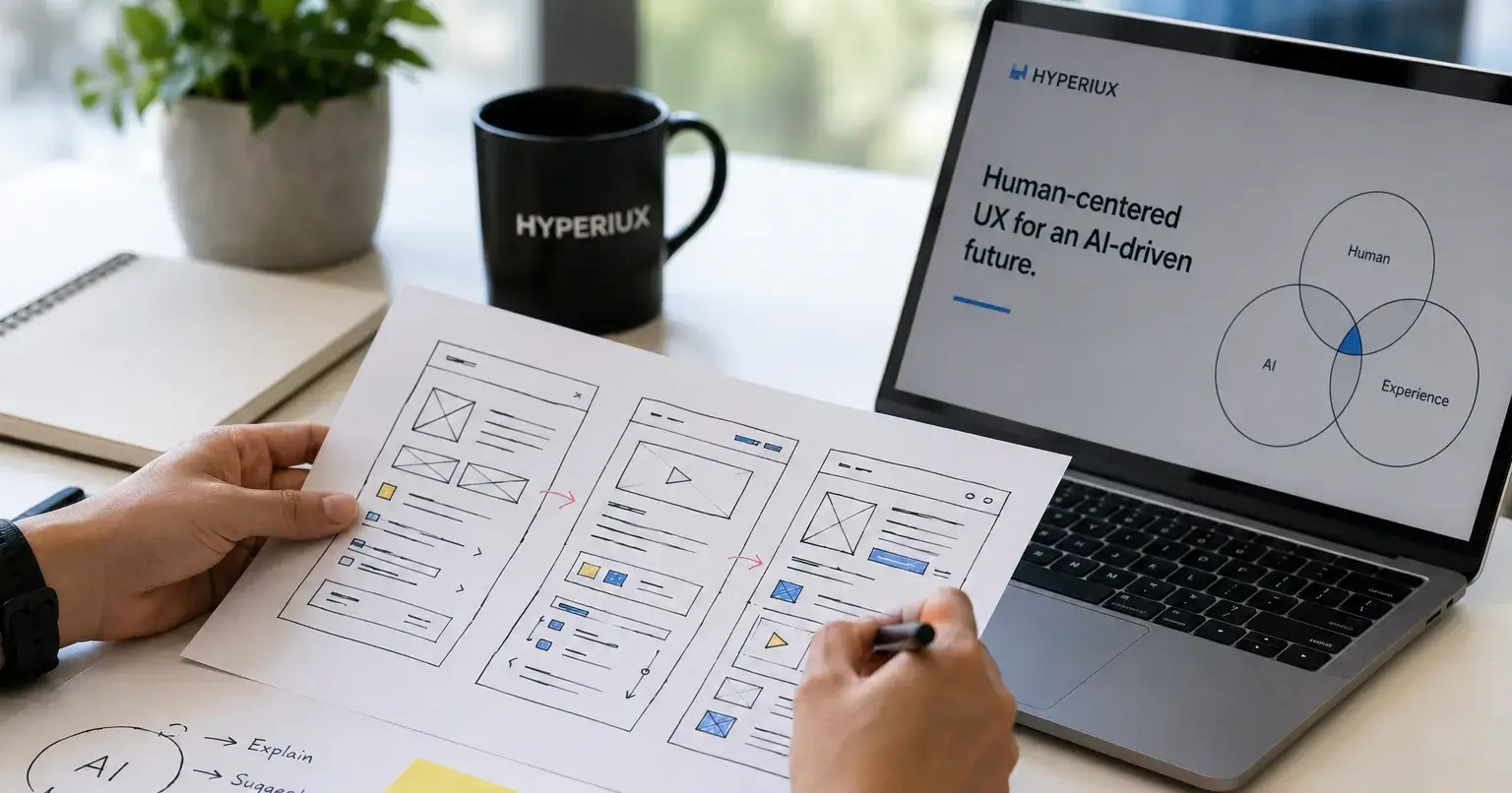
AI products are becoming smarter. Users are not becoming more patient. That tension is shaping the next era of digital experience design.

Across SaaS, fintech, and enterprise platforms, companies are deploying increasingly powerful AI capabilities into products that users still struggle to trust, understand, or adopt confidently. The technology advances quickly. Human behavior does not.
That is why human-centered design in the age of AI is becoming more important, not less. As interfaces become more intelligent, the burden on UX increases. Users need clarity when systems behave probabilistically. They need confidence when outputs feel uncertain. They need control when automation influences decisions.
Intelligence alone does not create a great product experience. Human comprehension does. The companies that succeed in AI will not simply build advanced systems. They will design AI experiences that feel understandable, predictable, emotionally safe, and operationally trustworthy.
Key Takeaways
AI increases the importance of UX because users need trust and clarity in intelligent systems.
Human-centered design improves AI adoption, retention, and onboarding performance.
AI products fail when intelligence outpaces usability.
Trust will become one of the most important UX metrics in AI-driven products.
Users need explainability, predictability, emotional confidence, and control.
Businesses that humanize AI experiences will outperform products focused only on capability.
AI Is Changing Products Faster Than Users Can Adapt
Most AI discussions focus on what the technology can do. Far fewer focus on how humans experience that technology. That gap matters because adoption friction is increasingly behavioral, not technical.
AI systems are evolving faster than user expectations, organizational processes, and trust frameworks can keep pace with. The result is a growing disconnect between product capability and user confidence.
AI Adoption Is Often a UX Problem
Many AI-powered products struggle not because the underlying technology is weak, but because the experience surrounding it creates anxiety, confusion, or unpredictability. Common symptoms include:
Low AI feature adoption
Enterprise resistance to workflow changes
Weak onboarding completion
User distrust of generated outputs
Excessive support dependency
Product abandonment despite technical sophistication
The engineering succeeds. The experience fails. That distinction is becoming increasingly common in AI-native products.
Users Need Stability During Technological Change
Humans adapt to behavioral change gradually. AI changes interaction models rapidly. That creates tension inside digital products where users suddenly encounter:
Non-deterministic outputs
Adaptive interfaces
Autonomous recommendations
Conversational workflows
Context-aware automation
Without strong UX guidance, those experiences feel unstable. And instability reduces trust quickly. Especially in enterprise environments where operational predictability matters more than novelty.
If your AI product feels technically advanced but difficult for users to adopt confidently, an AI UX Strategy Session at Hyperiux can uncover where trust friction enters the experience.
Why Intelligence Alone Does Not Create Great Experiences

Many AI products make the same mistake: They assume capability automatically creates value. It does not. Outputs only matter if users understand, trust, and know how to act on them. A powerful AI system that feels confusing will underperform a simpler system users trust. That is not a technical limitation. It is a design limitation.
AI Without UX Creates Cognitive Overload
AI systems often increase complexity unintentionally. Users must now evaluate:
Whether outputs are accurate
Why recommendations appear
How much confidence to place in automation
What actions remain reversible
Whether the system behaves consistently
That creates cognitive strain quickly. Particularly when interfaces provide little explanation or guidance. Most AI friction comes from uncertainty. Not lack of functionality.
Human Confidence Becomes the Product
As AI capabilities commoditize, user confidence becomes a differentiator. Two AI products with similar underlying intelligence can produce dramatically different business outcomes depending on experience quality. Users remain loyal to products that feel:
Understandable
Predictable
Recoverable
Guided
Transparent
This is why human-centered AI design increasingly influences:
Product adoption
Retention
Expansion revenue
Enterprise trust
Customer satisfaction
The strongest AI products reduce psychological friction before users consciously recognize it.
The Core Human Needs AI Products Must Support
Human-centered design in the age of AI requires a deeper understanding of behavioral UX. Users interacting with intelligent systems consistently seek five things.
Clarity
Users need to understand:
What the AI is doing
Why outputs appear
What actions are possible
What happens next
Ambiguity creates hesitation. Clear systems build confidence. This becomes especially important in generative AI workflows where outputs may vary significantly between interactions.
Predictability
AI products cannot feel random. Even probabilistic systems need interaction consistency. Users should develop reliable expectations around:
Workflow behavior
Output structure
System tone
Recovery mechanisms
Interaction patterns
Predictability reduces anxiety. Especially in enterprise software environments.
Emotional Confidence
AI introduces psychological uncertainty into digital experiences. Users often worry about:
Making mistakes
Trusting incorrect outputs
Losing control
Automation replacing judgment
Operational reliability
Human-centered UX reduces that anxiety through reassurance, guidance, and transparency. Emotional safety becomes part of usability.
User Control
Users need agency. Strong AI experiences reinforce collaboration instead of complete automation. Examples include:
Editable outputs
Approval checkpoints
Reversible actions
Adjustable AI settings
Transparent permissions
Explainability
Users need contextual understanding. Explainability helps users interpret:
AI recommendations
Decision logic
Confidence levels
System limitations
Data usage
Without explainability, AI systems appear opaque. Opaque systems struggle to earn long-term trust.
The Hidden UX Problems Most AI Products Ignore

Many AI products are built engineering-first. The product works technically, but the surrounding experience creates friction.
AI Complexity Scales Faster Than Usability
As AI products expand capabilities rapidly, usability often degrades simultaneously. Features multiply faster than experience systems evolve. That creates products that feel increasingly difficult to navigate, understand, or trust. Many AI startups mistake capability density for product maturity. Users often experience the opposite.
Users do not abandon AI products because they dislike intelligence. They abandon products that make them feel uncertain. That distinction matters operationally.
Why Trust Will Become the Defining UX Metric
In traditional software, usability often determined product success. In AI-native products, trust may become even more important. Because AI systems influence decisions, recommendations, automation, and operational workflows directly.
Users need confidence before adoption scales.
The Hyperiux Human-AI Trust Framework
At Hyperiux, we approach AI UX through five trust-building principles designed to improve usability, adoption, and long-term retention.
1. Explainability
AI interactions should feel understandable. Users need visibility into why outputs, recommendations, or automations occur. Explainability reduces ambiguity.
2. Predictability
Behavioral consistency matters more than novelty. AI systems should reinforce stable interaction patterns even when outputs remain dynamic. Predictability creates operational confidence.
3. Emotional Safety
Users need reassurance during AI interactions. Error recovery, guidance systems, and transparent communication reduce stress and hesitation. Human-centered UX acknowledges emotional context.
4. Guided Interaction
Open-ended AI systems require structured guidance. Strong UX helps users:
Frame requests
Refine interactions
Recover from errors
Navigate workflows progressively
Without guidance, flexibility becomes overwhelming.
5. Human Override
Users need final authority. Human override systems reinforce agency and reduce automation anxiety. Especially in enterprise environments involving high-stakes workflows.
An honest admission: fully autonomous AI experiences still create resistance for many users and organizations. That hesitation will shape adoption patterns for years.
Before vs After: Humanizing an AI Product Experience
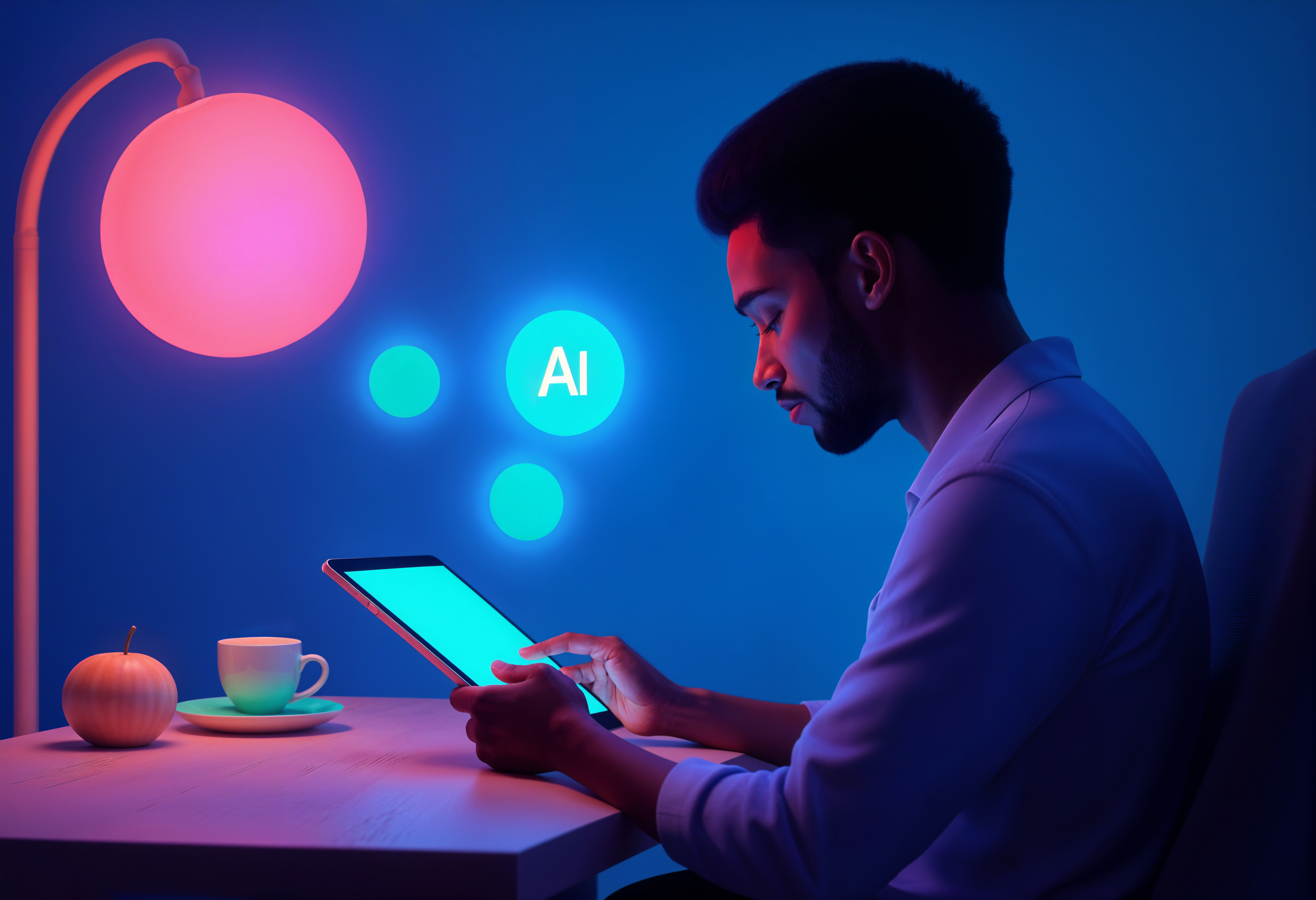
Consider an illustrative AI SaaS platform struggling with adoption despite strong technical capabilities.
Before
The platform included:
Advanced generative workflow
Minimal onboarding support
Weak explainability
Dense interface complexity
Inconsistent AI responses
Results included:
Low feature adoption
User hesitation
Increased support tickets
Weak enterprise confidence
After
The redesigned experience prioritized:
Structured onboarding guidance
Transparent AI interaction cues
Predictable workflow sequencing
Human approval checkpoints
Simplified interface architecture
Post-redesign outcomes included:
Higher AI feature adoption
Reduced onboarding friction
Lower support dependency
Improved enterprise trust
The intelligence engine remained largely unchanged. The human experience changed significantly. That difference increasingly defines successful AI products.
AI UX Trust Checklist
Businesses integrating AI into products should audit these areas immediately:
Quick AI UX Audit
Can users understand why outputs appear?
Are AI limitations communicated clearly?
Do workflows feel predictable?
Is onboarding progressive instead of overwhelming?
Can users override automation?
Are recovery paths obvious?
Does the interface reduce cognitive load?
Are trust signals visible?
Is personalization transparent?
Do users feel in control?
Most AI teams optimize for system intelligence. Very few optimize for human confidence. That imbalance creates adoption problems faster than most companies expect.
Checkout the AI UX Trust Checklist at Hyperiux for Product Teams to identify usability and trust gaps before they affect retention.
What Businesses Should Do Next

Businesses should stop treating AI UX as a visual layer added after engineering decisions. Human-centered AI design must shape the product architecture itself. That means:
Designing onboarding around confidence-building
Embedding explainability into workflows
Reducing cognitive overload
Reinforcing human agency
Improving trust signaling
Structuring adaptive guidance intentionally
Fear of Inaction
As AI products become more common, users will increasingly choose experiences that feel safer, clearer, and easier to trust. Products that neglect human-centered design risk becoming technically capable but behaviorally rejected. That gap will become expensive.
Conclusion
Why human-centered design matters more in the age of AI comes down to one reality: Intelligence increases complexity. And complexity increases the need for trust, clarity, guidance, and emotional confidence.
The future of successful AI products will not be defined solely by model sophistication or feature quantity. It will be defined by how effectively businesses help humans interact with intelligent systems confidently and predictably. Because users do not adopt AI simply because it is powerful.
They adopt it when it feels usable, understandable, and trustworthy. That is what human-centered AI design actually delivers.
Book an AI UX Strategy Session at Hyperiux to design AI experiences users trust, adopt, and return to.
FAQs
What is human-centered AI design?
Human-centered AI design focuses on creating AI-powered experiences that prioritize usability, trust, clarity, and human control. It combines behavioral UX principles with intelligent systems to ensure users can understand, navigate, and confidently interact with AI-driven products and workflows.
Why is UX important for AI products?
UX is critical for AI products because intelligent systems often introduce uncertainty, complexity, and unpredictable behaviors. Strong UX reduces cognitive load, improves onboarding, reinforces trust, and helps users understand how AI systems function. Without effective UX, even technically advanced AI products struggle with adoption and retention.
How can AI products build user trust?
AI products build user trust through explainability, predictable workflows, transparent communication, human override controls, and structured onboarding experiences. Users feel more confident when systems clearly communicate limitations, provide guidance, and allow human oversight during important interactions or automated decisions.
Will AI replace UX designers?
AI is unlikely to replace UX designers entirely. Instead, it increases demand for designers who can create human-centered, trustworthy, and explainable AI experiences. As intelligent systems become more complex, strategic UX design becomes increasingly important for adoption, usability, and long-term customer confidence.
About the Author
Bhaskar Varshney is the Founder & CEO of Hyperiux, formerly Enigma Digital. He is a behaviour-driven design and digital experience strategist with over 15 years of experience across UI/UX, digital marketing, consumer psychology, client consulting, and conversion-focused digital experiences. Through Hyperiux, he helps ambitious brands build frictionless websites, products, and interactive digital experiences that resonate with users and drive business outcomes.

Join Bhaskar on Peerlist!
Join amazing folks like Bhaskar and thousands of other builders on Peerlist.
0
0
0