

SEO Isn't Dying, It's Splitting Into Three Jobs.
You are no longer just optimizing for Google. Here is the hybrid playbook for winning over search algorithms, answer boxes, and AI models.
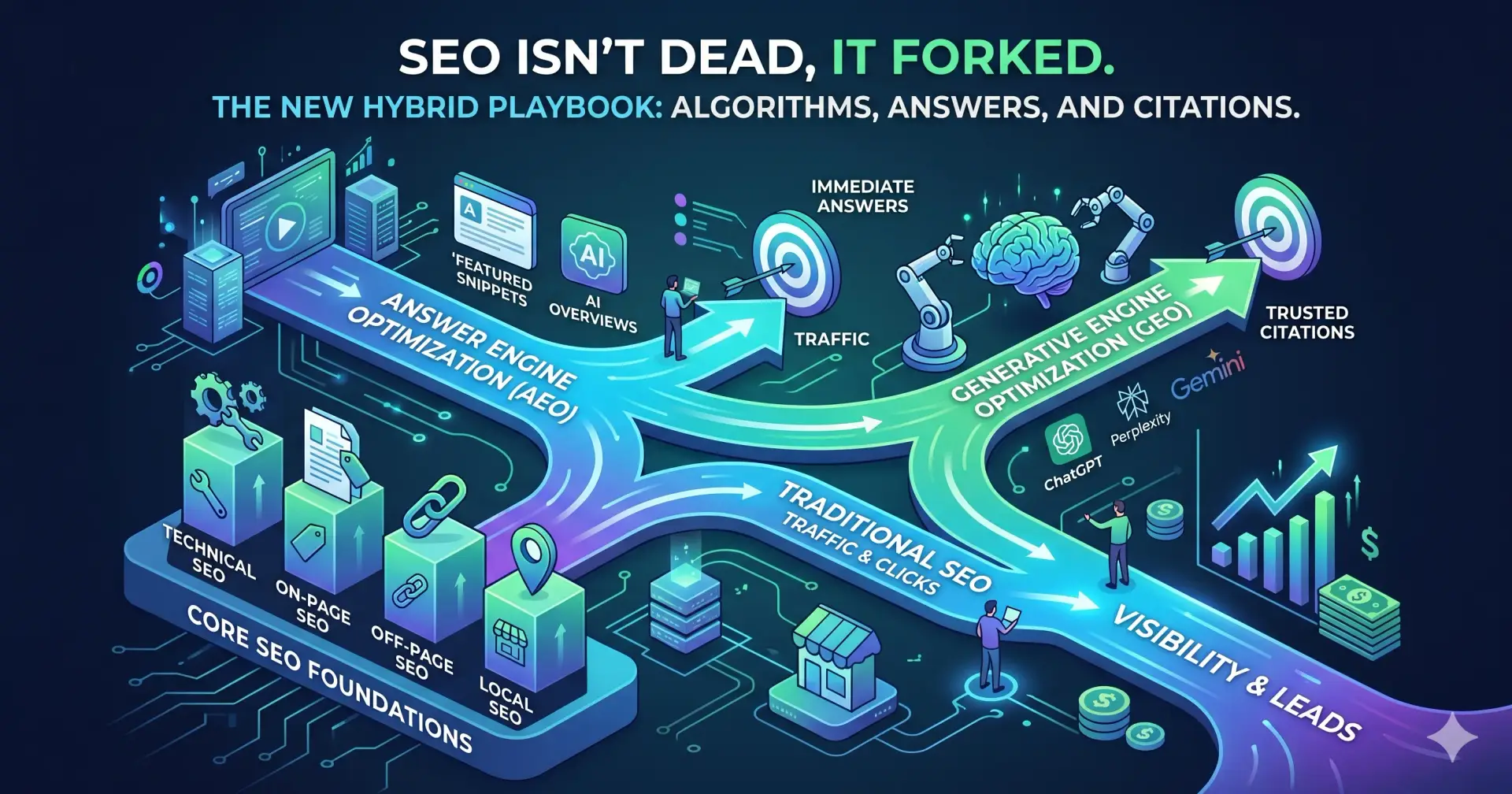
Everyone's arguing whether SEO is dead because of AI Overviews and ChatGPT. Wrong question. SEO didn't die — it forked.
You're now optimizing for three audiences at once: a ranking algorithm, an answer box, and a language model deciding whether to cite you. Ignore any one of them and you're invisible to a growing share of your buyers. Here's how to actually think about it.
SEO is still four disciplines, not one skill
If someone tells you "I do SEO," ask which kind, because there are four:
Technical SEO — crawlability, site speed, indexation, structured data. The plumbing. Nothing else works if this is broken.
On-Page SEO — title tags, headings, internal linking, content structure on the page itself.
Off-Page SEO — backlinks, brand mentions, digital PR. What the rest of the internet says about you.
Local SEO — Google Business Profile, NAP consistency, location-intent queries. Non-negotiable if you serve a geography.
Content sits across all four — it's not a fifth category, it's the fuel that makes the other three work. A perfectly technical site with no content has nothing to rank. Perfect backlinks pointing at thin pages don't convert.
SEO has always been a digital marketing discipline, not a coding trick. Every tactic below should trace back to a business outcome — traffic, leads, or citations — not vanity metrics.
The new layer: AEO and GEO
Here's what changed. Ahrefs' data shows AI Overviews have cut click-through rates on top-ranking Google content roughly in half over the past year. At the same time, a huge share of ChatGPT's daily prompts now function as search queries, and that channel converts attention very differently — people read the answer and never click through at all.
This is why two new disciplines matter now:
Answer Engine Optimization (AEO) — structuring content so search features (Featured Snippets, AI Overviews, People Also Ask) can lift a direct answer straight off your page.
Generative Engine Optimization (GEO) — earning the trust signals that make an LLM cite you by name when it synthesizes an answer in ChatGPT, Perplexity, Gemini, or Claude.
The honest framing: SEO gets you into the candidate pool. AEO makes you easy to extract from that pool. GEO makes the model pick you over the next ten sources saying roughly the same thing. You don't choose one. You stack all three, in that order.
The hybrid playbook: click-throughs + citations
This is the part most "AI SEO" content skips — the actual mechanics.
Make sure your website is technically sound. Crawlable, fast, mobile-first, clean sitemap, no orphaned pages. AI crawlers (GPTBot, PerplexityBot, ClaudeBot) hit the same technical walls human-facing crawlers do. If Googlebot can't parse it cleanly, neither can the model deciding whether to cite it.
Fix duplicate content. LLMs build confidence through consensus across the web — but duplicate or near-duplicate pages on your own domain dilute that signal instead of reinforcing it. Canonicalize, consolidate, or kill the duplicates.
Use internal linking deliberately. Internal links aren't just for PageRank flow anymore — they're how crawlers (and models) understand entity relationships on your site. Link the product page to the standard or spec it's certified against, and the FAQ to the relevant comparison page.
Structure your content for AI retrieval. Put the direct answer in the first 40–60 words under a question-style heading. Then expand. Models and snippet features both grab the nearest, cleanest answer to the query — bury it under three paragraphs of preamble and you lose both.
Optimize around different angles of the main query. Don't just target one keyword. Cover what it is, how it compares to the next best alternative, when to use it, and what standard or certification applies. AI tools test dozens of query variations against your content — single-angle pages lose to multi-angle ones.
Refresh outdated content on a schedule. Both Google's AI Overviews and Perplexity weight freshness for anything time-sensitive. A visible "last updated" date and current stats beat an untouched evergreen post every time.
Go after Featured Snippets deliberately. Snippet-winning pages are disproportionately the same pages AI Overviews pull from — nearly 40% of AI Overview citations come from page-one organic results. Snippet optimization and AEO are the same exercise wearing different clothes.
Don't skip the fundamentals while you chase AI
None of the above works without the basics still firing:
Create genuinely high-quality, well-researched content — not content engineered to game an algorithm.
Optimize for mobile — still the majority of search traffic, still a ranking factor.
Build real backlinks — from sites with actual authority in your niche, not link farms.
Improve site speed and performance — Core Web Vitals affect both rankings and bounce rate.
Enhance UX — clear navigation, readable layout, fast time-to-value on the page.
Leverage social and community channels — Copilot leans heavily on LinkedIn for B2B queries; your distribution channel is now part of your AI visibility strategy, not separate from it.
Optimize for voice and conversational search — natural-language headings, question-based structure.
Monitor, analyze, and iterate — track rankings and citation rate. If you're only watching Search Console, you're measuring half the funnel.
The strategic point
SEO was never really a checklist. It's a resource-allocation decision: where do you put your time and your client's budget when both Google and ChatGPT are moving targets? Treat the four core SEO disciplines as your foundation, treat AEO as your extraction layer, and treat GEO as your trust layer. Build in that order and you're not choosing between traffic and citations — you're stacking both.
If your content strategy still only has one column on the spreadsheet labeled "rankings," you're already behind.

Join Gowtham on Peerlist!
Join amazing folks like Gowtham and thousands of other builders on Peerlist.
0
0
0