

I Built a Goblin to Yell at Me When I Open TikTok During Focus Sessions
A behind-the-scenes look at building CogniFocus — a reactive focus app that actually notices when your attention slips
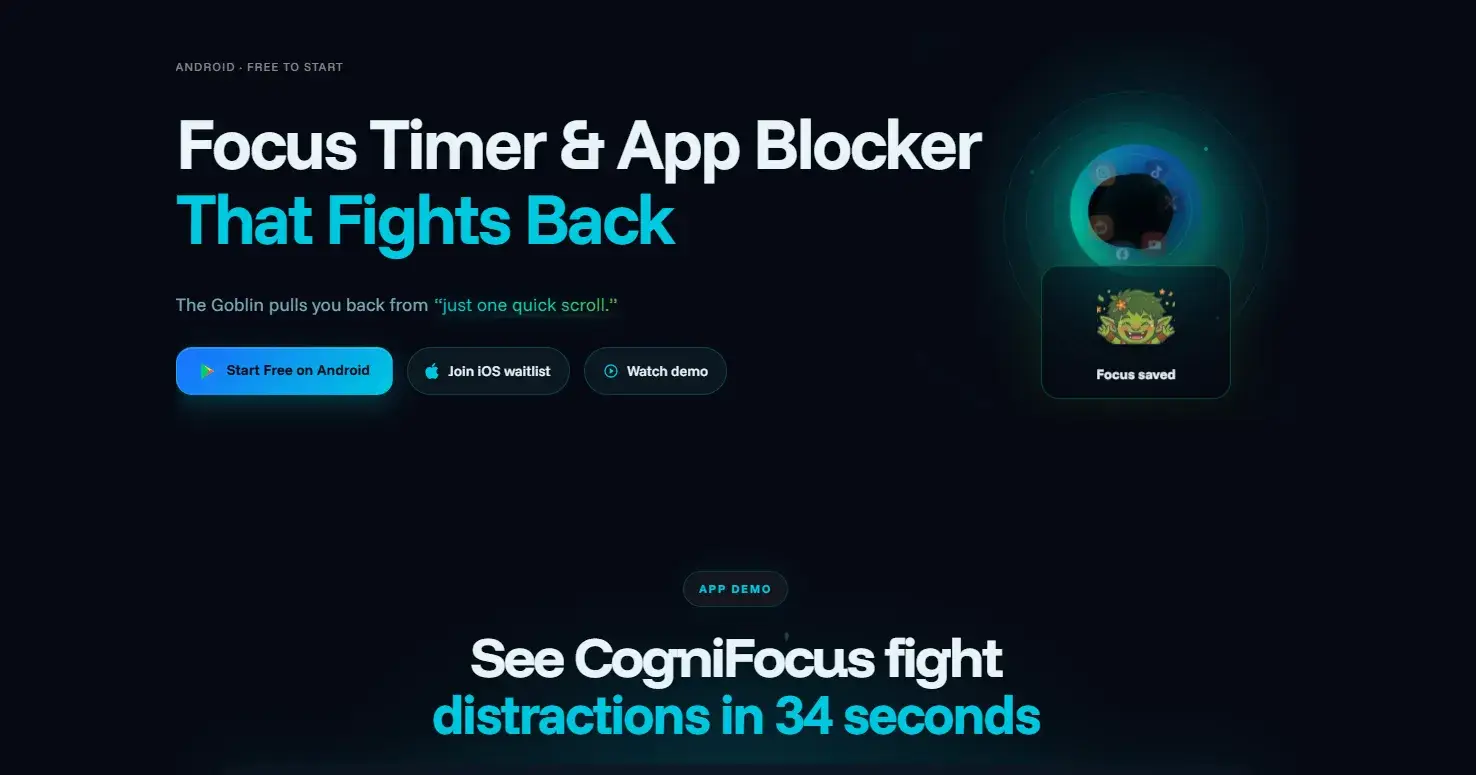
I started building CogniFocus because I kept lying to myself. Every work session began with the same promise: just one quick check on Instagram, then right back to it. I would open the app for ten seconds, look up half an hour later, and wonder where the time went. My focus timer was still running in the background, dutifully counting the minutes, completely unaware that my brain had already left the building.
That is the problem with most focus apps. They measure time, not attention. A timer running while you doom-scroll is not tracking focus. It is tracking presence. Your body is at the desk, but your brain is on TikTok, and the app never notices the difference.
I wanted something that would actually react when I slipped. Not a gentle reminder I could swipe away, not a stat I could review later and feel bad about. I needed something that would notice, in the moment, that I had drifted, and say something about it.
The Goblin Started as a Personal Chaos Agent
The first version of CogniFocus was built for an audience of one: me. I needed an accountability companion that would actually roast me when I drifted off during a session. A soft nudge was not going to cut it. Motivational quotes stopped working on me years ago. I needed something with enough personality to snap me out of autopilot.
I called it the Goblin. It started as a simple idea: if I open TikTok during a focus session, something should react. The Goblin would show up with a look, a message, a tone that matched what I had just done. The more I drifted, the more annoyed it got. The cleaner the session, the more it celebrated. Over time, it developed moods: neutral during calm sessions, annoyed when I peeked at Instagram, genuinely frustrated when I kept going, and cheerful when I finished clean.
What surprised me was how well it worked. The annoyed reaction was more effective than any notification I had ever used. There is something about a character reacting to your behavior that hits differently than a generic alert. It turns the moment of distraction into a tiny moment of accountability. One beta tester put it perfectly: "The angry reaction is ridiculous in the best way. It turns one more scroll into a tiny moment of accountability."
Why Reactive Beats Passive
Most focus tools fall into the same trap. They set a timer and hope you stick to it. When you do not, they might log the failure, send a gentle reminder, or block the app after the fact. But they never catch you mid-scroll. By the time you realize what happened, you are already twenty minutes deep in a content hole.
CogniFocus takes the opposite approach. It is reactive, not passive. When you start a focus session, the Distraction Shield monitors for blocked apps. If you open one, the Shield interrupts it. The Goblin reacts immediately. The tone and urgency change based on your behavior, not a preset schedule. A quick peek gets a raised eyebrow and a message like "opened TikTok again?" Repeated attempts get a much stronger reaction — the system escalates based on what you actually do. And if you do slip, the Recovery Nudges pull you back fast so you can keep the session alive instead of treating one distraction like total failure.
This matters because distraction does not announce itself. You do not plan to spend thirty minutes on Instagram. You plan to check one message, and then your thumb takes over. The window to recover is tiny — maybe a few seconds between opening the app and actually starting to scroll. A passive timer will never catch that. A reactive system can.
Built for the "Just One Minute" People
The app is designed for a specific kind of person: someone who genuinely wants to focus but keeps getting pulled into quick checks that turn into lost time. I have identified four patterns that kept coming up in early feedback:
The quick checker: opens Instagram for ten seconds, somehow comes back twenty-seven minutes later.
The app switcher: switches from work to TikTok before the timer even settles.
The timer ignorer: starts focus sessions, then leaves them running in the background while doing other things.
The muscle-memory scroller: thumb opens social apps before the brain approves it.
If any of those sound familiar, this app was built for you. It is also built for students who lose focus during study sessions, creators who need protected work blocks, developers who want deep work without the constant pull of notifications, and anyone with ADHD-style distraction patterns who finds that passive reminders do not cut it.
What Early Users Actually Say
I have been running an early access program for a few weeks, and the feedback has been both validating and occasionally surprising. The thing people mention most is not the app blocking or the timer. It is the Goblin's reactions. One user described them as "weirdly effective," which is probably the best compliment I could ask for.
One early access user went from eight Instagram breaks per study session to maybe one. The streak system — where the Goblin celebrates clean sessions — became the main motivation to keep going. Another user said the neutral look was "almost worse than a notification. It feels like the app noticed I was about to drift before I did." That is exactly the effect I was chasing. Not punishment. Just awareness. A tiny mirror held up at the exact moment you are about to disappear into a scroll hole.
The streak and XP system adds a layer of progress tracking that keeps people coming back. It turns focus into a daily practice rather than a one-off willpower test. Clean sessions build streaks. Streaks unlock affinity with the Goblin. Over time, the character adapts to your patterns and responds differently. It is lightweight, but it is enough to make the habit stick.
Where It Goes From Here
CogniFocus is currently available on Android, free to start. The Pro plan is $3.99 per month, or $2.67 per month if you pay yearly. Pro unlocks longer sessions, more blocked apps, planned sessions with reminders, recovery nudges, and cloud sync across devices. iOS is in development and will launch next. Desktop support is being explored for a later phase.
Right now, Product Hunt supporters can get the first month of Pro completely free. If you are reading this and the launch is still active, that is the best time to try it.
This is my first indie project, and I am building it in public. The landing page has been through three revisions already. The first one was terrible. The current one explains the product in five seconds, which is honestly the best metric I have found for whether a launch page is working.
The long-term vision goes beyond the Goblin. I want to build multiple companion personalities with completely different accountability styles. Some people respond to a cheeky roaster. Others might need a calm coach, a competitive rival, or a quiet observer. The goal is to give users a choice of how their attention is managed — and who calls them out when it is not.
The underlying philosophy is simple: behavioral systems should respond to what is actually happening, not just log it. If your focus app is still counting time while your brain is on TikTok, it is not helping you focus. It is just keeping the lights on.
CogniFocus is available now at cognifocus.app If you are the kind of person who keeps saying "just one minute" and losing an hour, the Goblin is waiting.
Qasim Khan is the founder of CogniElevate and the maker of CogniFocus. He is a software engineer based in Lahore, Pakistan, currently learning how to launch indie products in public. You can find him on Peerlist or reach out at [email protected].

Join Qasim on Peerlist!
Join amazing folks like Qasim and thousands of other builders on Peerlist.
2
1
0