

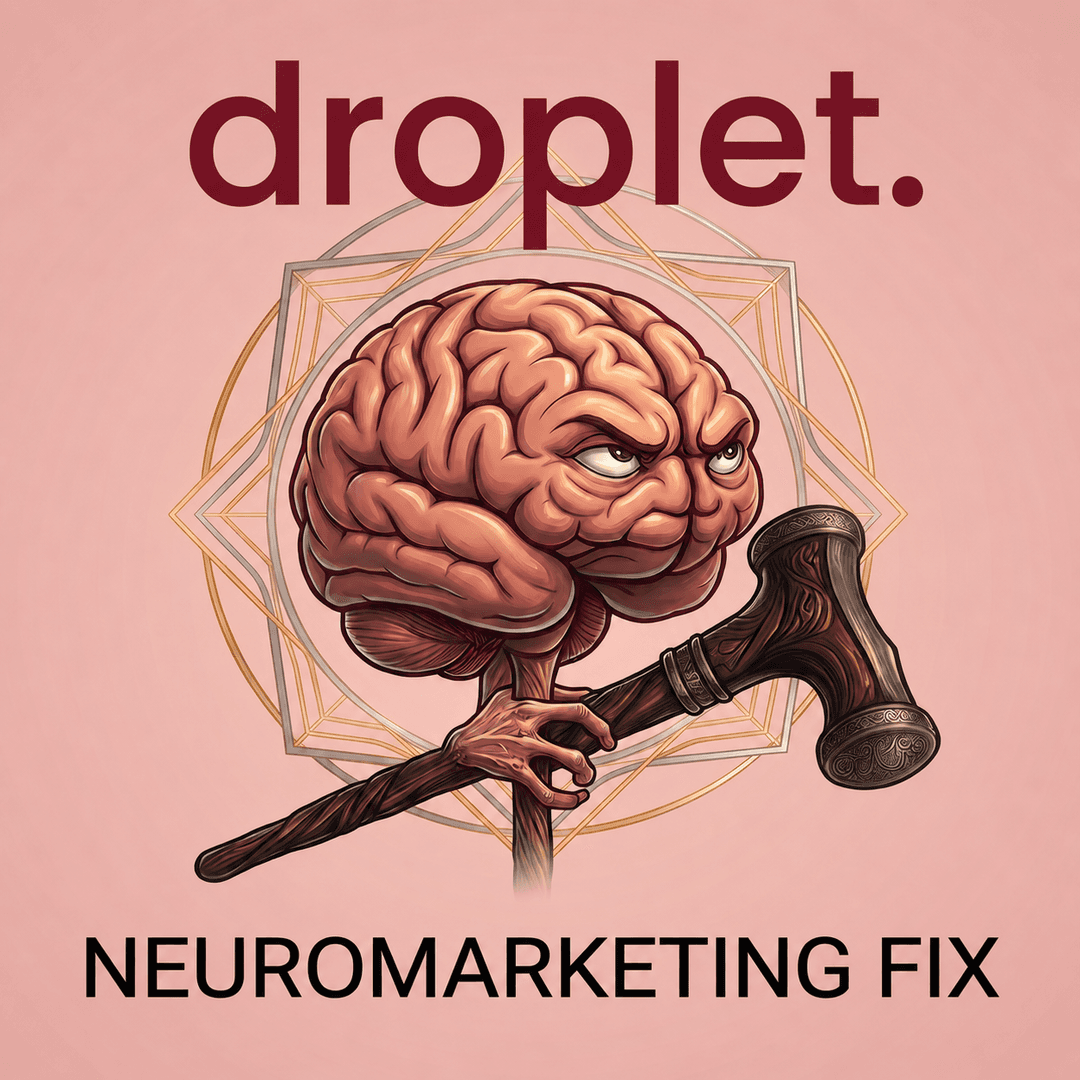
The Old Brain Buys: Neuro-Optimized Teardown
Stop designing pages. Start engineering brains.
Most landing page reviews focus on copy, UI, or aesthetics. I wanted to look at something different.
Instead of asking "Does this page look good?", I asked: "How does the visitor's brain process each section during the first few seconds?"
The Project
I dissected a neuro-optimized D2C landing page (Droplet) section by section through a neuromarketing lens — mapping the psychological job each component performs, from attention capture and cognitive fluency to trust formation, risk reduction, and decision acceleration.
What's Inside
Gaze Cueing & Attention Capture — How faces and eye direction in the hero visual subconsciously guide attention to the headline.
Pain Diagnosis — Why visceral verbs like "melt away" trigger instant relief visualization in the Old Brain.
CTA Psychology — Reward-framed CTAs and gamified 30-sec quizzes that cut cognitive friction.
Cognitive Fluency — Icon-based badges that let the brain scan value props with zero effort.
Risk Reversal — Micro-copy that silences the amygdala's "Pain of Paying" at the decision moment.
Social Proof Framing — Role-based testimonials and outcome metrics ("14,200+ Calm Days Delivered") balancing emotional trust with rational proof.
Authority Building — Certifications, clinically studied ingredients (KSM-66 Ashwagandha) and expert endorsements that turn claims into credible proof.
Why It Matters
Every block on a high-converting page has a purpose beyond looking polished. If you're building landing pages for SaaS, AI, or D2C products, this breakdown gives you a reusable neuro-framework to audit and optimize your own pages.
Disciplines applied: Neuromarketing • Behavioral Psychology • CRO • UX Writing • Cognitive Science
Built with


