

The chronology of AI landscape
Foundational era to Accelerated era
1942: Science fiction author Isaac Asimov’s Three Laws of Robotics appear in the short story “Runaround.”
1943: Mathematician Emil Post writes about “production systems,” a concept borrowed for the General Problem Solver of 1957.
1943: Publication of Warren McCulloch and Walter Pitts’ paper on a computational theory of neural networks, entitled “A Logical Calculus of the Ideas of Immanent in Nervous Activity.”
1944: John von Neumann, Norbert Wiener, Warren McCulloch, Walter Pitts, and Howard Aiken form the Teleological Society to study, among other things, communication and control in the nervous system.
1945: George Polya highlights the value of heuristic reasoning as a means of solving problems in his book How to Solve It.
1946: The first of ten Macy Conferences on Cybernetics begins in New York City. The theme of the first meeting is “Feedback Mechanisms and Circular Causal Systems in Biological and Social Systems.”
1948: Publication of Cybernetics, or Control and Communication in the Animal and the Machine by mathematician Norbert Wiener.
1949: Psychologist Donald Hebb proposes an explanation for neural adaptation in human education in The Organization of Behavior: “neurons that fire together wire together.”
1949: Publication of Giant Brains, or Machines That Think by mathematician Edmund Berkeley.
1950: The Turing Test, attributing intelligence to any machine capable of exhibiting intelligent behavior equivalent to that of a human, is described in Alan Turing’s “Computing Machinery and Intelligence.”
1950: Claude Shannon publishes a pioneering technical paper on “Programming a Computer for Playing Chess,” sharing search algorithms and techniques.
1951: Mathematics student Marvin Minsky and physics student Dean Edmonds design an electric rat capable of learning how to negotiate a maze utilizing Hebbian theory.
1951: Mathematician John von Neumann publishes “General and Logical Theory of Automata,” reducing the human brain and central nervous system to a computing machine.
1951: Christopher Strachey writes a checkers program and Dietrich Prinz creates a chess routine for the University of Manchester’s Ferranti Mark 1 computer.
1952: Design for a Brain: The Origin of Adaptive Behavior, on the logical mechanisms of human cerebral function, is published by cyberneticist W. Ross Ashby.
1952: Physiologist James Hardy and physician Martin Lipkin begin devising a McBee punched card system for mechanical diagnosis of patients at Cornell University Medical College.
1954: Groff Conklin publishes the theme-based anthology Science-Fiction Thinking Machines: Robots, Androids, Computers.
1954: The Georgetown-IBM experiment demonstrates the potential of machine translation of text.
1955: Artificial intelligence research begins at Carnegie Tech (now Carnegie Mellon University) under economist Herbert Simon and graduate student Allen Newell.
1955: Mathematician John Kemeny writes “Man Viewed as a Machine” for Scientific American.
1955: Mathematician John McCarthy coins the term “artificial intelligence” in a Rockefeller Foundation proposal for a Dartmouth University conference.
1956: Logic Theorist, an artificial intelligence computer program for proving theorems in Alfred North Whitehead and Bertrand Russell’s Principia Mathematica, is created by Allen Newell, Herbert Simon, and Cliff Shaw.
1956: The Dartmouth Summer Research Project, the “Constitutional Convention of AI,” brings together experts in cybernetics, automata, information theory, operations research, and game theory.
1956: Electrical engineer Arthur Samuel demonstrates his checkers-playing AI program on television.
1957: The General Problem Solver AI program is written by Allen Newell and Herbert Simon.
1957: The Rockefeller Medical Electronics Center demonstrates an RCA Bizmac computer program to aid the physician in the differential diagnosis of blood diseases.
1958: Publication of John von Neumann’s unfinished The Computer and the Brain.
1958: Firmin Nash gives a first public demonstration of the Group Symbol Associator at the “Mechanisation of Thought Processes” conference at UK’s Teddington National Physical Laboratory.
1958: Frank Rosenblatt introduces the single layer perceptron, including a neural network and supervised learning algorithm for linear classification of data.
1958: John McCarthy at the Massachusetts Institute of Technology (MIT) specifies the high- level programming language LISP for AI research.
1959: Physicist Robert Ledley and radiologist Lee Lusted publish “The Reasoning Foundations of Medical Diagnosis,” which introduces Bayesian inference and symbolic logic to problems of medicine.
1959: John McCarthy and Marvin Minsky start what becomes the Artificial Intelligence Laboratory at MIT.
1960: The Stanford Cart, a remote-control vehicle equipped with a television camera, is constructed by engineering student James L. Adams.
1962: Science fiction and fantasy author Fred Saberhagen introduces intelligent killer machines called Berserkers in the short story “Without a Thought.”
1963: The Stanford Artificial Intelligence Laboratory (SAIL) is founded by John McCarthy.
1963: The U.S. Department of Defense’s Advanced Research Projects Agency begins funding artificial intelligence projects at MIT under Project MAC.
1964: ELIZA, the first program for natural language communication with a machine (“chatbot”), is programmed by Joseph Weizenbaum at MIT.
1965: British statistician I. J. Good publishes his “Speculations Concerning the First Ultraintelligent Machine” about a coming intelligence explosion.
1965: Philosopher Hubert L. Dreyfus and mathematician Stuart E. Dreyfus release a paper critical of artificial intelligence entitled “Alchemy and AI.”
1965: The Stanford Heuristic Programming Project, with the twin goals of modeling scientific reasoning and creating expert systems, is initiated by Joshua Lederberg and Edward Feigenbaum.
1965: Donald Michie organizes the Department of Machine Intelligence and Perception at Edinburgh University.
1965: Georg Nees establishes in Stuttgart, West Germany, the first generative art exhibit, called Computer Graphic.
1965: Computer scientist Edward Feigenbaum begins a ten-year effort to automate the molecular analysis of organic compounds with the expert system DENDRAL.
1966: The Automatic Language Processing Advisory Committee (ALPAC) releases its skeptical report on the current state of machine translation.
1967: Richard Greenblatt completes work on Mac Hack, a program that plays competitive tournament chess, on a DEC PDP-6 at MIT.
1967: Ichiro Kato at Waseda University initiates work on the WABOT project, which unveils a full-scale anthropomorphic intelligent robot five years later.
1968: Director Stanley Kubrick turns Arthur C. Clarke’s science fiction book 2001: A Space Odyssey, about the HAL 9000 artificially intelligent computer, into one of the most influential and critically acclaimed movies of all time.
1968: Terry Winograd at MIT begins work on the natural language understanding program SHRDLU.
1969: The First International Joint Conference on Artificial Intelligence (IJCAI) is held in Washington, DC.
1972: Artist Harold Cohen creates AARON, an AI program to create paintings.
1972: Ken Colby reports on his experiments simulating paranoia with the software program PARRY.
1972: Hubert Dreyfus publishes his critique of the philosophical foundations of artificial intelligence in What Computers Can’t Do.
1972: The MYCIN expert system, designed to diagnose bacterial infections and recommend treatment options, is begun by doctoral student Ted Shortliffe at Stanford University.
1972: The Lighthill Report on Artificial Intelligence is released by the UK Science Research Council, highlighting failures of AI technology and difficulties of combinatorial explosion.
1972: Arthur Miller publishes The Assault on Privacy: Computers, Data Banks, and Dossiers, an early work on the social impact of computers.
1972: University of Pittsburgh physician Jack Myers, medical student Randolph Miller, and computer scientist Harry Pople begin collaborating on INTERNIST-I, an internal medicine expert system.
1974: Social scientist Paul Werbos finishes his dissertation on a now widely used algorithm for backpropagation used in training artificial neural networks for supervised learning tasks.
1974: Marvin Minsky releases MIT AI Lab memo 306 on “A Framework for Representing Knowledge.” The memo details the concept of a frame, a “remembered framework” that fits reality by “changing detail as necessary.”
1975: John Holland uses the term “genetic algorithm” to describe evolutionary strategies in natural and artificial systems.
1976: Computer scientist Joseph Weizenbaum publishes his ambivalent views of work on artificial intelligence in Computer Power and Human Reason.
1978: EXPERT, a generalized knowledge representation scheme for creating expert systems, becomes operational at Rutgers University.
1978: The MOLGEN project at Stanford is begun by Joshua Lederberg, Douglas Brutlag, Edward Feigenbaum, and Bruce Buchanan to solve DNA structures derived from segmentation data in molecular genetics experiments.
1979: The Robotics Institute is established by computer scientist Raj Reddy at Carnegie Mellon University.
1979: The first human is killed while working with a robot.
1979: The Stanford Cart, evolving over almost two decades into an autonomous rover, is rebuilt and equipped with a stereoscopic vision system by Hans Moravec.
1980: The First National Conference of the American Association of Artificial Intelligence (AAAI) is held at Stanford University.
1980: Philosopher John Searle makes his Chinese Room argument that a computer’s simulation of behavior does not in itself demonstrate understanding, intentionality, or consciousness.
1982: Release of the science fiction film Blade Runner, which is broadly based on Philip K. Dick’s story Do Androids Dream of Electric Sheep? (1968).
1982: Physicist John Hopfield popularizes the associative neural network, first described by William Little in 1974.
1984: Tom Alexander publishes “Why Computers Can’t Outthink the Experts” in Fortune Magazine.
1984: Computer scientist Doug Lenat starts the Cyc project to build a massive commonsense knowledge base and artificial intelligence architecture at the Microelectronics and Computer Consortium (MCC) in Austin, TX.
1984: The first Terminator film, with android assassins from the future and an AI called Skynet, is released by Orion Pictures.
1986: Honda opens a research center for the development of humanoid robots to coexist and collaborate with human beings.
1986: MIT roboticist Rodney Brooks introduces the subsumption architecture for behavior- based robotics.
1986: Marvin Minsky publishes The Society of Mind, which describes the brain as a set of cooperating agents.
1989: Rodney Brooks and Anita Flynn of the MIT Artificial Intelligence Lab publish “Fast, Cheap, and Out of Control: A Robot Invasion of the Solar System,” about the potential for launching tiny robots on missions of interplanetary discovery.
1993: Rodney Brooks, Lynn Andrea Stein, Cynthia Breazeal, and others launch the Cog interactive robot project at MIT.
1995: Musician Brian Eno coins the term generative music to describe systems that create ever-changing music by altering parameters over time.
1995: The General Atomics MQ-1 Predator unmanned aerial vehicle enters U.S. military and reconnaissance service.
1997: IBM’s Deep Blue supercomputer defeats reigning chess champion Garry Kasparov under regular tournament conditions.
1997: The first RoboCup, an international competition with over forty teams fielding robot soccer players, is held in Nagoya, Japan.
1997: Dragon Systems releases NaturallySpeaking, their first commercial speech recognition software product.
1999: Sony releases AIBO, a robotic dog, to the consumer market.
2000: Honda introduces its prototype ASIMO, the Advanced Step in Innovative Mobility humanoid robot.
2001: Visage Corporation debuts the FaceFINDER automated face-recognition system at Super Bowl XXXV.
2002: The iRobot Corporation, founded by Rodney Brooks, Colin Angle, and Helen Greiner, begins marketing the Roomba autonomous home vacuum cleaner.
2004: DARPA sponsors its first autonomous car Grand Challenge in the Mojave Desert around Primm, NV. None of the cars finish the 150-mile course.
2005: The Swiss Blue Brain Project to simulate the mammalian brain is established under neuroscientist Henry Markram.
2006: Netflix announces a $1 million dollar prize to the first programming team that develops the best recommender system based on a dataset of previous user ratings.
2007: DARPA launches its Urban Challenge, an autonomous vehicle competition meant to test merging, passing, parking, and negotiating traffic and intersections.
2009: Google begins its Self-Driving Car Project (now called Waymo) in the San Francisco Bay Area under Sebastian Thrun.
2009: Stanford University computer scientist Fei-Fei Li presents her work on ImageNet, a collection of millions of hand-annotated images for training AIs to visually recognize the presence or absence of objects.
2010: A “flash crash” of the U.S. stock market is triggered by human manipulation of automated trading software.
2011: UK artificial intelligence start-up DeepMind is founded by Demis Hassabis, Shane Legg, and Mustafa Suleyman to teach AIs to play and excel at classic video games.
2011: IBM’s natural language computing system Watson defeats past Jeopardy! Champions Ken Jennings and Brad Rutter.
2011: Apple releases the mobile recommendation assistant Siri on the iPhone 4S.
2011: An informal Google Brain deep learning research collaboration is started by computer scientist Andrew Ng and Google researchers Jeff Dean and Greg Corrado.
2013: The Human Brain Project of the European Union is launched to understand how the human brain works and also emulate its computational capabilities.
2013: Human Rights Watch begins a campaign to Stop Killer Robots.
2013: Her, a science fiction drama directed by Spike Jonze, is released. The film features a romance between a man and his AI mobile recommendation assistant Samantha.
2014: Ian Goodfellow and collaborators at the University of Montreal introduce Generative Adversarial Networks (GANs) for use in deep neural networks, which prove useful in creating realistic images of fake people.
2014: The chatbot Eugene Goostman, portraying a thirteen-year-old boy, is controversially said to have passed a Turing-like test.
2014: Physicist Stephen Hawking predicts the development of AI could result in the extinction of humanity.
2015: Facebook releases DeepFace deep learning facial recognition technology on its social media platform.
2016: DeepMind’s AlphaGo program defeats 9th dan Go player Lee Sedol in a five-game match.
2016: Microsoft’s artificial intelligence chatbot Tay is released on Twitter, where users train it to make offensive and inappropriate tweets.
2017: The Future of Life Institute organizes the Asilomar Meeting on Beneficial AI.
2017: The Way of the Future church is founded by AI self-driving start-up engineer Anthony Levandowski, who is motivated to create a superintelligent robot deity.
2018: Google announces Duplex, an AI application for scheduling appointments over the phone using natural language.
2018: The European Union publishes its General Data Protection Regulation (GDPR) and “Ethics Guidelines for Trustworthy AI.”
2019: Google AI and Northwestern Medicine in Chicago, IL, collaborate on a lung cancer screening AI that outperforms specialist radiologists.
2019: OpenAI, cofounded by Elon Musk, develops an artificial intelligence text generation system that creates realistic stories and journalism. It is initially deemed “too dangerous” to use because of its potential to generate fake news.
2020: Google AI in collaboration with the University of Waterloo, the “moonshot factory” X, and Volkswagen announce TensorFlow Quantum, an open-source library for quantum machine learning.
2021: OpenAI releases DALL-E, a deep learning model that generates images from text descriptions, popularizing the concept of text-to-image AI.
2021: Anthropic raises $124 million in its Series A funding round to develop reliable and steerable AI systems.
2021: DeepMind publishes its paper on AlphaFold 2 in Nature, detailing a neural network model that predicts protein structures with atomic accuracy, widely recognized as a major breakthrough in biological research, and makes the AlphaFold Protein Structure Database freely available.
2021: Google introduces the first generation of LaMDA (Language Model for Dialogue Applications), specifically trained on dialogue for advanced and more natural conversational AI capabilities.
2021: GitHub and OpenAI launch GitHub Copilot technical preview, an AI-powered code completion tool.
2021: Stanford Institute for Human-Centered AI publishes "On the Opportunities and Risks of Foundation Models," establishing the term "foundation model" in AI discourse.
2021: EleutherAI releases GPT-J-6B and "The Pile" training corpus, advancing open-source large language model research.
2021: UNESCO's General Conference adopts the Recommendation on the Ethics of Artificial Intelligence, creating the first global standard-setting instrument on AI ethics.
2022: OpenAI announces DALL-E 2, a successor model designed to generate more realistic images at higher resolutions with greater accuracy, later making it available in beta and removing the waitlist for public access.
2022: Anthropic announces a $580 million Series B funding round to advance its work on interpretable and robust AI systems.
2022: Stability AI publicly releases Stable Diffusion, a powerful open-source text-to-image model that significantly democratizes access to high-quality generative AI art.
2022: OpenAI launches ChatGPT, a conversational AI chatbot built on the GPT-3.5 architecture, which triggers unprecedented public attention and becomes the fastest-growing consumer application in history.
2022: Anthropic is formally founded by former OpenAI researchers with a mission to build safe and beneficial AI systems, beginning development of its Claude family of large language models and introducing "Constitutional AI."
2022: OpenAI demonstrates InstructGPT, showing reinforcement learning from human feedback (RLHF) as an effective method for aligning language models with human preferences.
2022: Google introduces PaLM (Pathways Language Model) with 540 billion parameters, demonstrating strong few-shot reasoning capabilities across multiple languages.
2022: DeepMind presents Gato, a single transformer model trained across diverse modalities including robotics, games, and natural language tasks.
2022: OpenAI releases Whisper, an open-source automatic speech recognition system capable of multilingual transcription and translation.
2022: The White House publishes a Blueprint for an AI Bill of Rights, outlining principles for automated systems and public protections.
2023: Google announces and begins rolling out early access to Bard, a conversational AI chatbot powered by its LaMDA model, as a direct competitive response to the immense popularity of OpenAI's ChatGPT.
2023: OpenAI releases GPT-4, a large multimodal model that demonstrates significantly improved reasoning, creativity, and the ability to accept both text and image inputs.
2023: Google formally announces the Gemini family of models, positioning it as its next-generation, natively multimodal AI architecture designed to compete directly with GPT-4.
2023: Anthropic publicly releases Claude 2, making its AI assistant more widely available and showcasing its capabilities in areas like long-context processing and thoughtful responses.
2023: Amazon announces a strategic collaboration with Anthropic, committing to an initial investment of $1.25 billion.
2023: The U.S. government issues the Executive Order on the Safe, Secure, and Trustworthy Development and Use of Artificial Intelligence, establishing a comprehensive, government-wide approach to AI governance.
2023: Google officially announces the Gemini 1.0 family of models, comprising the high-end Ultra, the versatile Pro, and the on-device Nano, with benchmarks showing Gemini outperforming GPT-4 in several areas.
2023: The European Union's Council and Parliament reach a provisional political agreement on the EU AI Act, a landmark bill aiming to establish the world's first comprehensive, risk-based legal framework for artificial intelligence.
2023: Meta releases LLaMA (Large Language Model Meta AI) to researchers, later followed by Llama 2 under a permissive commercial license.
2023: Anthropic introduces its Claude large language model, designed with constitutional AI principles emphasizing helpfulness, harmlessness, and honesty.
2023: Microsoft integrates GPT-4 into Bing search engine and launches Microsoft 365 Copilot, bringing generative AI to mainstream productivity software.
2023: The United Kingdom hosts the first AI Safety Summit at Bletchley Park, convening international leaders to address frontier AI risks and safety evaluations.
2023: OpenAI experiences significant governance turmoil with the temporary removal and reinstatement of CEO Sam Altman.
2024: OpenAI unveils Sora, a text-to-video model capable of generating high-fidelity, minute-long videos from textual prompts, demonstrating a sophisticated understanding of physical world dynamics.
2024: Google releases Gemini 1.5 Pro in a limited preview for developers, introducing a breakthrough 1 million token context window, the largest of any large-scale foundation model at the time.
2024: Anthropic releases the Claude 3 family of models: Opus, Sonnet, and Haiku, with the flagship model Opus demonstrating state-of-the-art performance and advanced vision capabilities.
2024: Meta releases Llama 3, the next generation of its open-source large language models, further advancing capabilities and accessibility, and subsequently releases Llama 3.1.
2024: OpenAI introduces GPT-4o ("o" for "omni"), a natively multimodal model that processes and generates text, audio, and images in real-time with human-like response times, making GPT-4 level intelligence available to free ChatGPT users.
2024: Google makes Gemini 1.5 Pro and its 1 million token context window broadly available to Gemini Advanced subscribers, and announces a new, more efficient model, Gemini 1.5 Flash.
2024: Apple announces "Apple Intelligence," its strategy for integrating generative AI capabilities across its ecosystem of devices and applications.
2024: The European Union formally adopts the AI Act, creating the world's first comprehensive legal framework for artificial intelligence regulation.
2024: Anthropic launches Claude 3.5 Sonnet, featuring enhanced reasoning and coding capabilities.
2024: DeepMind and Isomorphic Labs present AlphaFold 3, extending protein structure prediction to include interactions with DNA, RNA, and small molecules for drug discovery applications.
2024: NVIDIA announces the Blackwell architecture (B200/GB200) designed for trillion-parameter model training and improved inference efficiency in AI workloads.
2025: OpenAI releases "Operator" for Pro subscribers, an experimental AI agent capable of browsing websites and performing actions on behalf of a user.
2025: Google introduces Gemini Flash Thinking 0121, an enhanced reasoning model.
2025: Chinese AI company DeepSeek open-sources its powerful reasoning models R1 and R1-Zero, spurring development of similar "R1-style" reasoning approaches globally.
2025: The Trump administration announces "Stargate," a public-private partnership with a stated goal of investing $500 billion in U.S. AI infrastructure.
2025: xAI launches the Grok 3 family of models.
2025: Anthropic introduces Claude 3.7 and Claude 3.7 Thinking, featuring enhanced coding performance.
2025: OpenAI unveils "Deep Research," a tool for autonomous research, and releases a research preview of GPT-4.5, its next major model.
2025: Google releases Gemini 2.5 Pro.
2025: Anthropic introduces its next generation of models, Claude Opus 4 and Claude Sonnet 4, pushing the frontier in coding capabilities and featuring "extended thinking" modes for complex, long-running tasks.
2025: OpenAI makes its reasoning model o3-pro available for Pro users in ChatGPT and via the API.
2025: Meta CEO Mark Zuckerberg publishes a policy paper detailing that Meta's AI systems have begun showing early signs of self-improvement without direct human programming.
2025: Anthropic releases Claude Opus 4.1, a model specifically optimized for complex agentic and coding tasks, delivering state-of-the-art performance on benchmarks like SWE-bench.
2025: OpenAI officially launches GPT-5, describing it as a "significant leap" in intelligence and reasoning, replacing previous versions as the default in ChatGPT.
2025: Anthropic announces it will offer its Claude AI chatbot to the U.S. federal government for a symbolic price of $1 per year, per agency.
2025: Researchers at Stanford University, in collaboration with the Chan Zuckerberg Biohub, demonstrate a landmark achievement in scientific automation through an autonomous multi-agent AI lab that successfully conceives, designs, and validates new therapeutic candidates.
2025: The EU AI Act's obligations for general-purpose AI systems begin enforcement twelve months after entry into force, establishing compliance requirements for AI providers across the European Union.
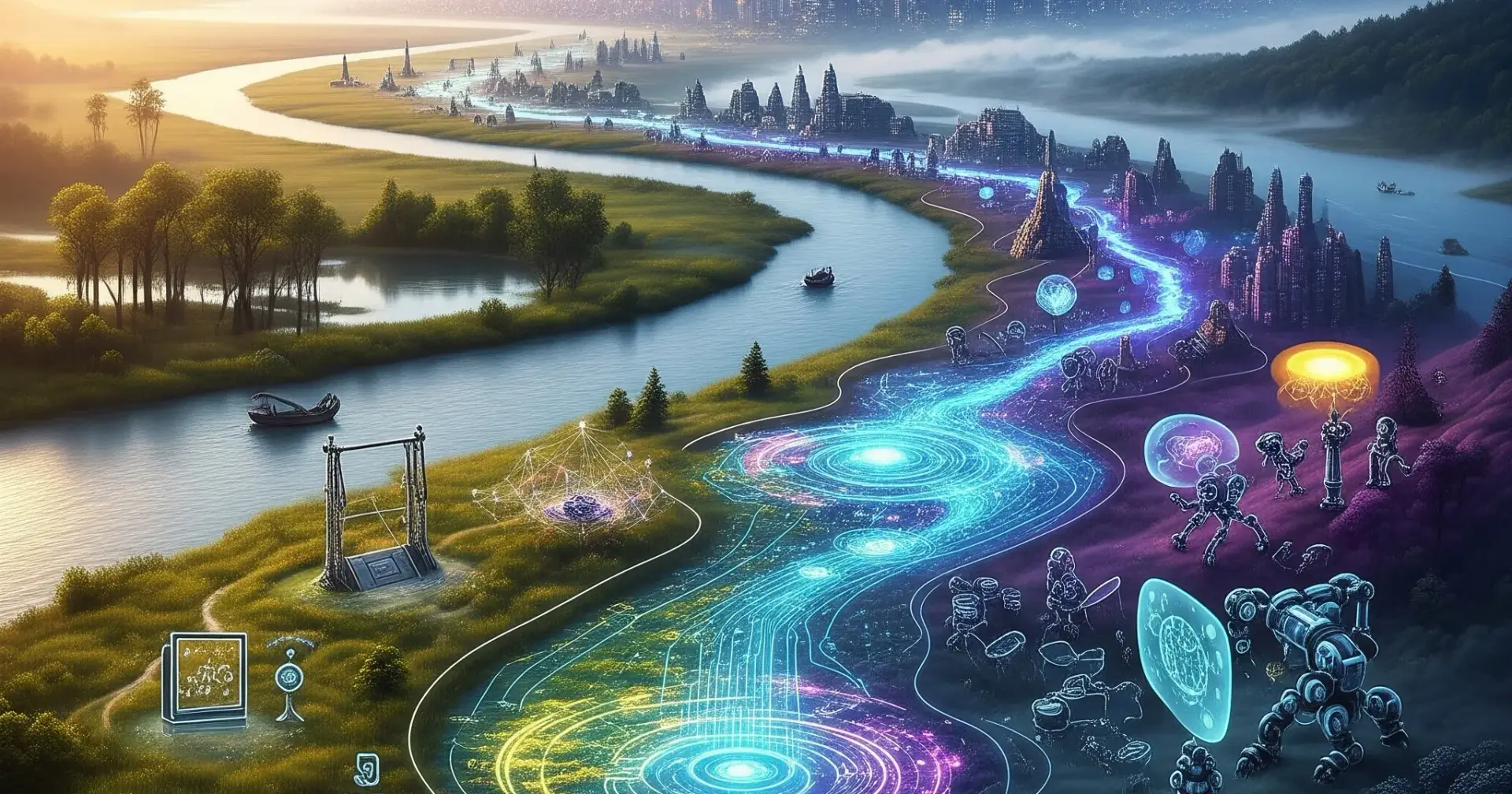
The image was generated using Gemini.

Join Jaideep on Peerlist!
Join amazing folks like Jaideep and thousands of other builders on Peerlist.
2
0
0