

The ten critical dimensions of LLMs evaluation: Moving beyond benchmarks
Elevating LLM selection from guesswork to disciplined strategic choice!
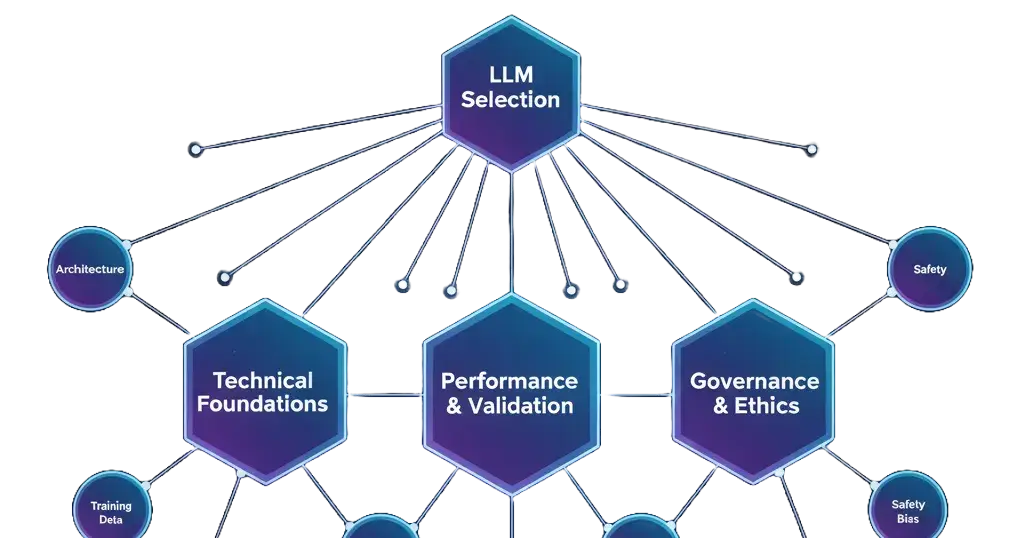
The LLM market is saturated with models all claiming high performance. The problem for decision-makers is that these benchmark scores often fail when the model faces real-world, industry-specific tasks. Choosing an LLM is a strategic decision that affects your budget, legal compliance, and long-term capabilities. To move past simple metrics and vendor talk, we must use a clear system. This taxonomy focuses on transformer-based LLMs, helping experts by looking closely at the technical and operational facts from the model's design to its ethical rules that truly decide if a model fits your goal.
The 10-point strategic LLM blueprint
1. The model's digital DNA: Architecture and identity
Any serious review must start with the foundation: the Static model parameters. Ignore the total parameter count that is a vanity metric. The actual limits and abilities are in the technical details:
Layer count, Head size, and Activation function: These build the model's complexity and thinking power.
Context window: This metric is vital. It sets the maximum memory for reasoning, which heavily influences how well the model handles long, complex documents.
Export formats: The practical side. PyTorch, ONNX, or ggml compatibility decides where you can run the model (e.g., on different hardware environments).
2. The Language interface: Tokenization and vocabulary
This shows how the machine reads and interprets human language. The Tokenizer type (BPE, SentencePiece, etc.) and Vocabulary size are not minor details; they determine the model’s speed, efficiency, and ability to handle specialized words. To ensure trust, releasing checksums for weights and tokenizer files is required.
3. The fuel of Intelligence: Training data and preparation
A model is only as strong as the material it learned from. Transparent training data & preparation is essential for controlling bias and compliance risk. Look closely at these points:
Dataset composition and sources: You must understand the data’s licensing and origin for basic compliance.
Total training tokens and Language distribution: These factors show how much and how broadly the model knows things.
Data curation filters: The filtering, removing duplicates, and quality control steps directly affect the model's final reliable performance.
4. The craftsmanship: Core training settings
A capable model becomes a market leader due to the precise Core training hyperparameters. These settings show the optimization plan, and they influence cost, time, and stability:
Optimizer type and Learning rate schedule: These control the speed and path of learning.
Batch size and Gradient accumulation: Metrics that reflect how effectively hardware is used.
Mixed precision settings (FP16, BF16): These technical points are key to understanding the memory needed and the numerical stability required for successful fine-tuning or copying the results.
5. Operational cost and footprint: Infrastructure and resources
Deploying an LLM strategically means you must know the true computing cost. Infrastructure & Resource metadata turns training claims into useful financial and environmental estimates:
Hardware used and Training throughput: These directly measure the system's speed and ability to scale.
Peak memory footprint: Needed for deployment planning.
Energy consumption or CO₂ footprint estimates: Companies increasingly need to share these for modern sustainability goals.
6. Validation and Trust: Evaluation and reproducibility
You build trust by verifying claims. This section on Evaluation, checkpoints & reproducibility moves past simple scores to focus on the science behind the model's release:
Evaluation metrics and Sliced evaluations: Evaluations broken down by language or safety criteria give a much richer picture than a single, simple score.
Exact codebase and Reproducibility scripts: Providing these is the minimum standard for academic and commercial trust.
Latency and Throughput benchmarks: This is the practical data you need to size your infrastructure spending.
7. Real-world viability: Inference and deployment
An amazing model is useless if it can't run efficiently. Inference & Deployment focuses on preparing the model for cloud or edge devices:
Quantization support and trade-offs: Does it use 4-bit or 8-bit techniques? This determines whether a strong model runs on standard hardware or needs huge server clusters.
KV cache and Streaming support: These show how the model handles long, interactive sessions.
Recommended deployment scenarios: Essential guidance for infrastructure planning (e.g., single-GPU vs. multi-GPU).
8. Customization and Extensibility: Fine-tuning and adaptation
For companies, the ability to change a base model using proprietary data is vital. This dimension covers how you can customize it:
Adapter/LoRA Support: These technologies reduce the cost and effort of fine-tuning.
Fine-tuning recipes and Example commands: Providing these resources makes it much easier for internal development teams to start working.
9. Governance and Liability: Safety, License, and Ethics
This is a critical business strategy element. Safety, License & Governance handles legal, ethical, and liability risks:
Licenses for weights and Training data: Clarifying commercial usage rights is mandatory.
Safety evaluations and Mitigation layers (RLHF): Showing steps taken to manage toxicity and harmful outputs is essential for brand protection.
Security and Privacy policies: Clear rules for handling PII and disclosing vulnerabilities are foundational for compliance.
10. Archival integrity: Release artifacts and Operational metadata
The final check confirms the model can actually be used long-term. Release artifacts & Operational metadata ensures all necessary components are available and verifiable, including artifact lists, version mapping, and environmental disclosures.
Conclusion: This taxonomy system helps Organizations ignore marketing hype and complete a systematic check. You can now evaluate open-source models (high clarity and customization) versus proprietary models (often better performance but requiring vendor management) using a clear, technical, and strategic basis. LLM evaluation is changing quickly.
Practitioners must use this taxonomy regularly, remembering that technical parts will evolve. By demanding clarity across these ten points, stakeholders can ensure they deploy models responsibly and effectively, balancing the need for innovation with the core requirements for transparency and safety.
The image was generated using Copilot.

Join Jaideep on Peerlist!
Join amazing folks like Jaideep and thousands of other builders on Peerlist.
0
14
1