

You're Not Burned Out. You're Exhausted From Adapting to Permanent Instability.
The exhaustion isn't from working too hard. It's from adapting to conditions that never resolve into a new normal. And no amount of optimization will fix that.
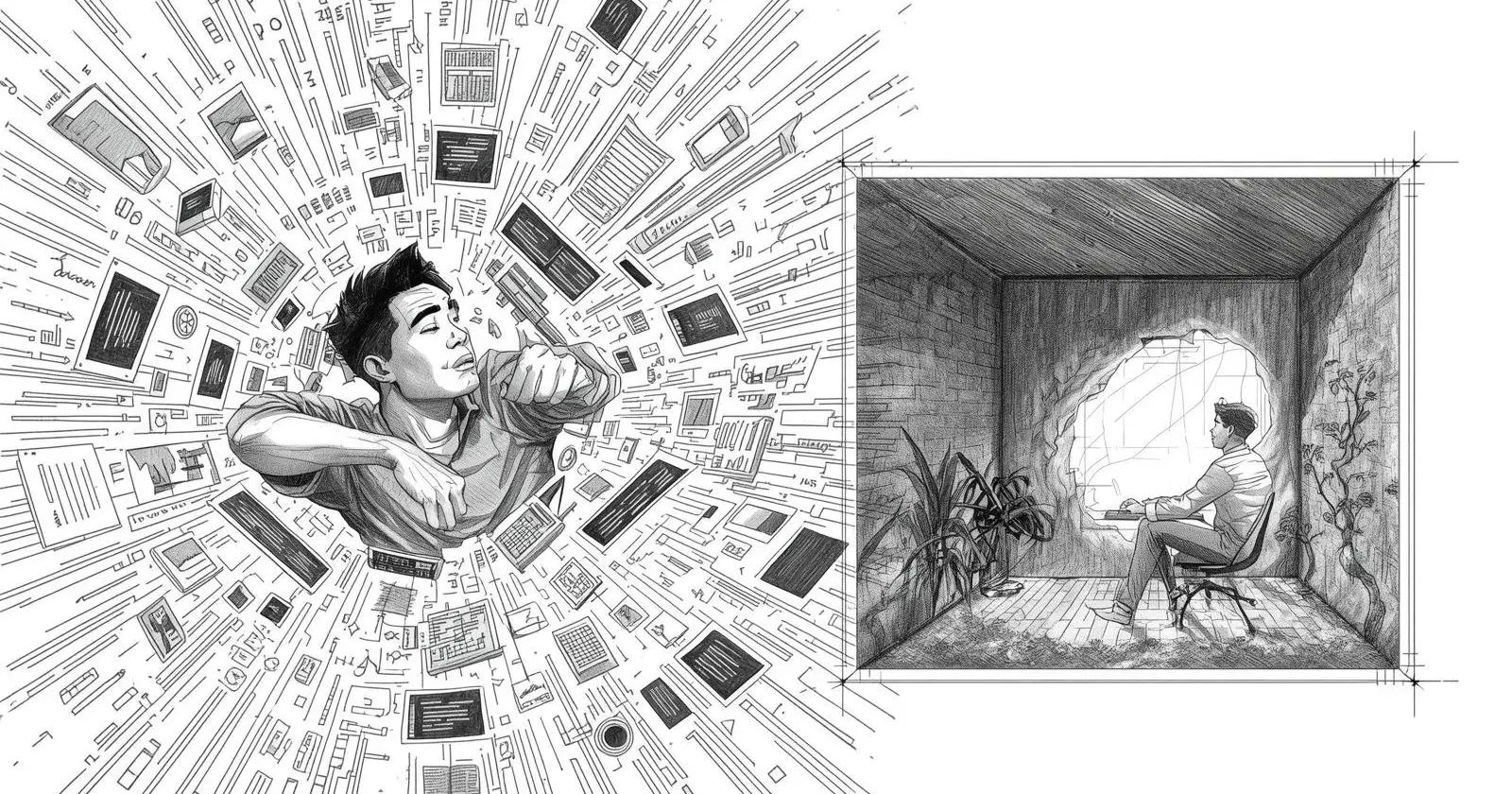
You've established boundaries. You've dedicated Sundays to self-care. You've given the Pomodoro Technique a shot, tried digital detoxes, installed meditation apps, started declining more requests, and probably cycled through several productivity systems that all promised to fix everything.
They didn't work.
Not for long, anyway. Perhaps you felt better for a week. Maybe you cleared your inbox or finally took that vacation. But the exhaustion returned. The sensation of being perpetually behind came back. The feeling that you're running on a treadmill that keeps accelerating never truly disappeared.
Here's what nobody's telling you: it's not because you lack willpower. It's not because you're approaching self-care incorrectly. It's because you've been addressing symptoms while the underlying disease keeps advancing.
I. The Misdiagnosis
The most popular approaches to burnout in 2026 all share the same core flaw: they assume the issue is you.
Approach #1: Optimize your productivity. The logic appears sound. If you could just be more efficient, process information quicker, make decisions faster, you'd get ahead of the chaos. So you experiment with time-blocking, task batching, automation tools, AI assistants to manage the overflow. You're perpetually upgrading your systems.
But here's what occurs: every efficiency gain simply creates room for more demands. Your inbox clears faster, so people send additional emails. You automate one process, your boss assigns three more responsibilities. The treadmill doesn't slow down. It just recalibrates to your new speed.
Approach #2: Set better boundaries. Disable notifications. Don't check work email after 6pm. Guard your weekends. Decline commitments. This guidance isn't wrong, exactly. But it's treating a symptom while overlooking the underlying condition.
Because the problem isn't that you personally haven't established boundaries. The problem is that the entire culture has dissolved the concept of bounded time. When your coworkers span three time zones, when breaking news arrives at 2am, when your job security relies on being responsive, when everyone else appears to be always-on, your individual boundaries feel like bringing a pocket knife to a structural collapse.
Approach #3: Practice more self-care. Take baths. Journal. Exercise. Eat well. Sleep eight hours. These activities matter. They're beneficial for you. But they're maintenance, not medicine.
You can't self-care your way out of a society-wide crisis. You can't meditate away the reality that you're attempting to build a stable life on fundamentally unstable ground. That's like practicing yoga while your house is on fire and congratulating yourself for remaining calm.
Approach #4: Lower your expectations. Stop attempting to keep up. Accept that you can't know everything, read everything, optimize everything. Release FOMO. This is closer to wisdom, but it still misses the point.
Because the anxiety isn't simply about missing out. It's about falling behind in ways that carry real consequences. When industries transform overnight, when skills become obsolete mid-career, when the rules shift faster than you can adapt, "letting go" starts to feel like negligence.
The real issue is deeper. And it's not about you at all.

II. The Actual Condition
What you're experiencing isn't burnout in the conventional sense. It's not exhaustion from working too hard at a stable job. It's not compassion fatigue from caring too much about a specific cause.
It's something closer to systemic exhaustion. Your nervous system is responding appropriately to a genuinely threatening environment. The threat just isn't what we're accustomed to defending against.
Consider what your brain is processing every single day in 2026:
The ground keeps shifting. Every month introduces new technologies that change how work happens. New AI capabilities that make your skills feel precarious. New crises that rewrite social contracts. New information that contradicts what you learned last year.
Human beings are wired to learn patterns, build expertise, and use that knowledge to navigate the world. But patterns keep breaking. Expertise expires. The map you're holding doesn't match the territory anymore, and by the time you acquire a new map, the territory has changed again.
This isn't background stress. This is your threat-detection system running continuously, attempting to track a thousand moving variables, never getting to rest because the danger never fully passes.
Your brain treats unpredictability like a physical threat. When you can't predict your economic future, when you don't know if your job will exist in its current form next year, when even social norms feel temporary, your nervous system interprets this as danger.
The autonomic response is identical whether you're facing a predator or facing radical uncertainty about your livelihood. Your body doesn't distinguish. It just knows: the future is not safe to plan for. Stay alert. Don't relax.
You're carrying infinite context with no ability to act on most of it. You know about the climate crisis. The geopolitical tensions (wars, global threats). The latest pandemic variant. The economic indicators. The social conflicts. The technological disruptions.
Your ancestors worried about their village. Perhaps the next village over. You're worried about the entire planet, in real-time, with push notifications.
This creates a particular kind of torture: global awareness with local agency. You feel responsible for knowing about everything while being functionally powerless to influence most of it. The gap between what you're aware of and what you can actually do generates constant low-level distress.
And here's the mechanism that makes it stick: Every time you successfully adapt to a new change, the pace accelerates. Every time you develop a coping strategy, the demands evolve past it. Your resilience isn't rewarded with stability. It's rewarded with harder tests.
You're not burned out from working too hard. You're exhausted from adapting to instability that never resolves into a new normal. You're tired of running a race with no finish line, where the track itself keeps transforming mid-stride.
This is what you're actually dealing with. Not a personal failing. Not a lack of optimization. A rational response to genuinely irrational conditions.
III. How You Developed This
This didn't happen overnight. And it's not your fault.
You probably entered adulthood with certain assumptions. Work hard, build skills, and you'll have security. Develop expertise, and you'll have value. Make plans, save money, and you can build toward a future you control.
These weren't naive beliefs. They were reasonable expectations based on how the world functioned for generations.
But somewhere in the last decade, the ground rules changed. Not all at once. Gradually, then suddenly.
The accelerating pace started feeling normal. Remember when a new phone model every two years felt fast? Now AI capabilities double every few months (weeks). Remember when you could learn an industry and work in it for decades? Now entire professions are questioning their relevance to AI every quarterly earnings call.
You adapted. Everyone adapted. That's what humans do. But adaptation carries a cost.
The always-on culture became inescapable. Remote work was supposed to give you flexibility. Instead it erased the boundary between work and home. You gained the freedom to work from anywhere. You lost the freedom to be fully away from work.
Slack messages at 9pm aren't emergencies. But they create a psychological weight. Someone is waiting. Something is unfinished. The mental tab stays open.
Social media turned existence into performance. It started as a way to stay connected. It became a comparison engine running 24/7 in your pocket. Everyone else's highlight reel versus your behind-the-scenes struggle. Even your successes feel hollow when someone's doing it better, faster, with more followers.
The pressure isn't to live well. It's to prove you're living well. To document, curate, optimize every experience for an audience that's simultaneously your community and your judge.
And institutions stopped feeling trustworthy. Governments can't seem to solve basic problems. Employers offer no real job security. Communities fracture along ideological lines. The traditional sources of stability, the things that were supposed to catch you if you fell, feel unreliable at best.
So you started carrying everything yourself. Planning for every contingency. Building personal resilience because systemic resilience doesn't exist. Becoming your own safety net, your own career planner, your own mental health support, your own financial advisor, your own news analyst.
That's exhausting. It's supposed to be exhausting. You're doing the work that used to be distributed across multiple institutions and social structures.
This isn't a character flaw. It's an adaptation that made sense in the moment. Every small adjustment, checking email before bed, scrolling news during breakfast, saying yes to stay valuable, monitoring your brand, felt like necessary survival behavior.
The pattern reinforces itself because every time you let your guard down, something confirms you can't afford to. Miss a few days of industry news, and you're behind. Stop optimizing, and someone else gets the opportunity. Rest too long, and you lose momentum.
You learned this. And now your nervous system believes it's true.

IV. The Criteria for Real Change
So what actually works?
Not willpower. Not individual optimization. Not one more productivity system or self-care routine.
Real change requires acknowledging something uncomfortable: you can't fix a systemic problem with personal solutions. You can't think your way out of conditions that are designed to overwhelm individual capacity.
The failed approach looks like this: More discipline. Better systems. Stronger boundaries. Basically, becoming so resilient that you can handle infinite instability without breaking.
This is the trap. You're attempting to become invulnerable to conditions that are genuinely harmful. You're pathologizing your exhaustion as personal weakness when it's actually a rational response to an irrational situation.
The successful approach looks different: Accept that you can't control the chaos. Stop attempting to keep up with everything. Build a small, defendable life within the larger instability.
This isn't resignation. It's a strategic withdrawal. It's recognizing that finite humans need finite worlds, even when the actual world is infinite and chaotic.
Someone who changed successfully didn't become more capable of handling everything. They became more selective about what they handled at all. They didn't expand their capacity. They protected it ruthlessly.
They stopped treating every piece of information as equally important. They stopped believing every opportunity was essential. They stopped measuring themselves against the entire internet's highlight reel.
They built a deliberate life in a time that demands constant reactivity. And it required making peace with the discomfort of missing out, falling behind, and not knowing everything.
That discomfort is the price of sanity in 2026. You can pay it consciously or pay it in breakdown. But you'll pay it either way.
V. The Treatment Protocol
Real change happens through deliberate redesign, not revelation. Here's the process.
Phase 1: Excavation (one sitting, 30-45 minutes)
Find a quiet hour. No phone. No interruptions. Answer these questions in writing. Don't edit yourself. Don't perform for an imaginary audience. Just excavate what's actually true.
Current Reality Questions:
What am I attempting to keep up with that genuinely doesn't matter to my actual life? (Be specific. List platforms, news sources, professional groups, social obligations.)
What would I lose if I stopped tracking [add that thing from question 1] completely? What would I actually lose, not what I'm afraid I might lose.
When was the last time I felt genuinely rested, not just physically relaxed, but mentally at peace? What was different about that time?
What am I doing out of fear of becoming obsolete versus what I'm doing because it genuinely serves my goals?
How much of my daily anxiety is about real, immediate threats versus hypothetical future scenarios I'm attempting to prevent?
Protection and Avoidance Questions:
What am I protecting by staying this busy? (Status? Identity as a high-performer? Distraction from other issues?)
If I stopped optimizing everything, who would I be? What would that say about me?
What conversation or decision am I avoiding by staying in constant motion?
Identity Questions:
Who would I be if I wasn't attempting to keep up with everyone else's pace?
What would I do if I trusted that missing things was okay?
Phase 2: Architecture (one sitting, 20-30 minutes)
Now design what replaces the pattern. You're not just removing behaviors. You're building a new structure.
Desired State Questions:
What does a sustainable pace actually look like for me? Not aspirationally. Realistically, given my actual energy and capacity.
What are the 3-5 sources of information I actually need to stay informed about my work and life? Everything else is optional.
What relationships and commitments genuinely matter to me versus what I'm maintaining out of obligation or fear?
What would "enough" look like in terms of productivity, achievement, and knowledge? Can I define it?
Identity Shift Questions:
What kind of person can live well in unstable times? (Not who survives everything, but who thrives within limits.)
What do I need to give myself permission to stop doing?
First Steps Questions:
What's one source of information I can eliminate this week without genuine consequence?
What's one commitment I can release or reduce?
Phase 3: Installation (ongoing)
Change happens through repetition, not revelation. Use these daily practices. Each takes under five minutes. Do them until they become automatic.
Practice 1: The Containment Ritual
Purpose: Limit exposure to chaos to specific, boundaried times.
How: Choose two 20-minute windows per day for "chaos time" when you check news, social media, industry updates, whatever feeds your sense of needing to keep up. Outside those windows, the world can burn without your awareness.
This isn't ignorance. It's recognizing that knowing about everything constantly doesn't help anyone and destroys your capacity to help at all.
Practice 2: The Enough Line
Purpose: Define completion in a world that never stops demanding more.
How: At the start of each day, write down what "enough" is. Three meaningful work tasks. One genuine rest activity. That's it. When you hit those marks, you're done. Everything else is bonus, not requirement.
Your worth isn't measured by how much you produce. Retraining yourself to believe that takes daily repetition.
Practice 3: The Comparison Fast
Purpose: Break the cycle of measuring yourself against infinite others.
How: Pick one platform that most feeds your comparison anxiety. Delete the app. Not just logging out. Delete it. For one month minimum.
Watch what happens to your baseline stress level when you're not constantly measuring your life against curated highlight reels.
Practice 4: The Capacity Check
Purpose: Make decisions based on your actual energy, not idealized capacity.
How: Before saying yes to anything new, ask: "Do I have capacity for this, or am I borrowing from reserves I don't have?" If you're borrowing, the answer is no.
You can't do everything. Choosing what not to do is as important as choosing what to do.
Weekly Review Question:
Every Sunday evening, ask: "What did I protect this week that mattered? What did I let go of that I feared losing but actually didn't need?"
This is how you build evidence that you can live well within limits. That missing out is survivable. That you don't need to consume everything to be valuable.

VI. The Long Game
Change like this doesn't happen in a week. It takes months. Perhaps longer.
Progress won't be linear. You'll have days where you fall back into the pattern, checking everything, attempting to keep up, feeling the familiar anxiety rising. That's normal. It doesn't mean you're failing. It means you're human.
Here's what actual progress looks like:
You'll notice moments where you don't feel the urge to check. Brief windows where your nervous system actually settles. Small instances where you chose rest over productivity and the world didn't end.
You'll start to see other people's constant motion as what it is: often another expression of the same exhaustion you're attempting to escape, not evidence that you should be doing more.
You'll realize that the people who seem most "on top of everything" are often the most fragile. That real stability comes from building a small, defendable life, not from becoming invulnerable to chaos.
The goal isn't to eliminate all burnout. It's to stop generating it through your own choices. To recognize that you can't change the pace of the world, but you can change your relationship to it.
You can stop treating every change as a crisis requiring immediate adaptation. You can stop believing that the answer to overwhelm is to become more capable of handling overwhelm. You can stop measuring yourself against the entire internet.
You can build a life that fits your actual capacity. Not your ideal capacity. Not what you think you should be capable of. Your real, human, limited capacity.
That's not settling. That's sanity.
The world will keep changing faster than you can track. Technologies will keep disrupting. Crises will keep emerging. Information will keep flooding in.
But you don't have to drink from the firehose. You can build a well instead. Smaller. Deeper. Sufficient.
Start with one practice. Protect one boundary. Define one version of enough.
The rest will follow.
Jan
Books You Should Read:
How To Talk To AI: AI isn’t replacing jobs, it’s reshaping them and the winners will be those who know how to work with it. How to Talk to AI teaches you the most valuable skill for today’s job market and tomorrow’s. Available on any Amazon store!

Job Search Guide: The job market has changed, and traditional advice no longer works. Job Search Guide gives you modern, practical strategies to stand out, land interviews, and get hired faster. Available on any Amazon store.
Full Stack Recruiter - The Ultimate Edition: Recruiting is evolving, and the best recruiters are those who master the entire process. Full Stack Recruiter is the ultimate playbook to sharpen your skills, source smarter, and hire the right talent in any market. Available on any Amazon store.

Join Jan on Peerlist!
Join amazing folks like Jan and thousands of other builders on Peerlist.
0
8
0