

AI Face Swap in 2025: Complete Guide to Tools, Trends & Best Practices
AI Face Swap
AI face swap technology has evolved from a novelty feature to a powerful creative tool that's reshaping content creation, entertainment, and digital marketing. In 2025, this technology has become more accessible, sophisticated, and integrated into our daily digital interactions than ever before. Whether you're a social media content creator looking to produce viral videos, a marketer seeking innovative campaign strategies, or simply curious about swapping faces with celebrities for fun, understanding AI face swap technology is essential.
This comprehensive guide explores everything you need to know about AI face swap in 2025, from how the technology works to the best tools available, ethical considerations, and emerging trends that will shape the future of this rapidly growing industry. By the end of this article, you'll have a clear understanding of which face swap solution fits your needs and how to use it effectively and responsibly.
What is AI Face Swap?
AI face swap is a technology that uses artificial intelligence and deep learning algorithms to digitally replace one person's face with another's in photos or videos. Unlike traditional photo editing that requires manual manipulation in tools like Photoshop, AI face swap automates the entire process by analyzing facial features, expressions, and lighting conditions to create seamless, realistic results in seconds.
The technology relies on sophisticated neural networks, particularly Generative Adversarial Networks (GANs) and deep learning models, that have been trained on millions of facial images. These systems can identify key facial landmarks such as eyes, nose, mouth, and jawline, then map one face onto another while preserving natural expressions, head movements, and even lighting conditions.
What sets modern AI face swap apart from earlier attempts is the level of realism achieved. Today's algorithms can maintain facial expressions, match skin tones, adjust for different angles, and even synchronize lip movements in videos. The process that once required hours of manual work by professional editors can now be completed in minutes by anyone with a smartphone.
The main applications span entertainment, social media content creation, professional video production, marketing campaigns, and even emerging use cases in virtual reality and the metaverse. As the technology becomes more accessible, it's transforming how we create and consume digital content across multiple platforms.
Top Use Cases for AI Face Swap
Social Media Content Creation
Social media has become the primary driver of AI face swap adoption. Content creators use face swap technology to produce engaging, shareable content that stands out in crowded feeds. Meme creation represents one of the most popular applications, where users swap their faces with celebrities, movie characters, or historical figures to create humorous content that often goes viral.
Gender swap filters have also gained massive popularity, allowing users to see themselves with opposite gender features. These transformations generate curiosity and entertainment value, making them highly shareable across platforms like Instagram, TikTok, and Snapchat. The technology enables creators to experiment with different personas and creative concepts without expensive production setups.
Viral challenges frequently incorporate face swap elements, with users participating in trends that involve swapping faces with friends, family members, or even pets. This social aspect drives engagement and helps content spread organically across networks. For influencers and content creators, face swap technology has become an essential tool for maintaining audience interest and producing fresh, innovative content regularly.
Professional Applications
Beyond entertainment, AI face swap has found serious applications in professional industries. The film and television industry uses advanced face swap technology for de-aging actors, digital resurrection of deceased performers, and creating stunt doubles for dangerous scenes. This reduces production costs and expands creative possibilities for filmmakers.
Marketing and advertising agencies leverage face swap for personalized campaigns where potential customers can see themselves using products or experiencing services. Automotive companies let buyers visualize themselves driving new car models, while fashion brands enable virtual try-on experiences. This personalization increases engagement and conversion rates significantly.
The emergence of AI influencers represents another groundbreaking application. Brands create entirely virtual personalities with consistent faces and personas that can be controlled and scaled without the limitations of human influencers. These digital entities can appear in unlimited content, never age, and maintain perfect brand alignment. Virtual influencers have already secured major brand partnerships and amassed millions of followers across social platforms.
Personal Entertainment
For everyday users, AI face swap provides endless entertainment possibilities. Swapping faces with celebrities allows people to imagine themselves as their favorite actors, musicians, or public figures. This fantasy fulfillment drives significant usage, particularly among younger demographics who enjoy sharing these transformations with friends.
Historical face swaps have educational and entertainment value, letting users see themselves as historical figures or place modern faces into vintage photographs. This application bridges past and present in creative ways, making history more relatable and engaging.
Virtual styling applications use face swap adjacent technology to let users try different hairstyles, makeup looks, and accessories before making actual purchases or salon appointments. This reduces the risk associated with dramatic style changes and helps people make more confident decisions about their appearance. The technology has become particularly valuable for online shopping, where trying before buying isn't physically possible.
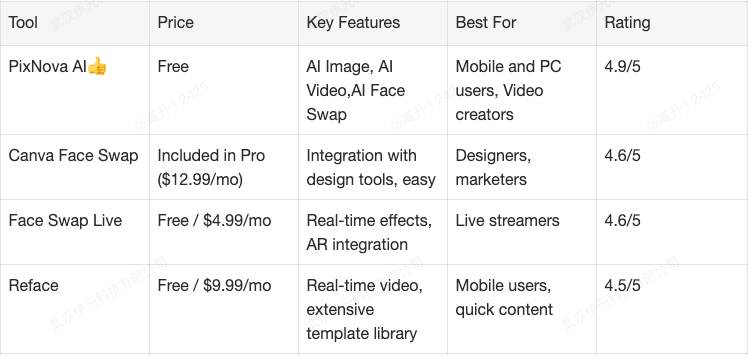
Best AI Face Swap Tools in 2025
Comprehensive Tool Comparison
How to Use AI Face Swap: Step-by-Step Tutorial
Choosing the Right Tool
Start by identifying your primary use case. For quick social media posts and casual entertainment, mobile apps like Reface provide the fastest path to results. If you're creating professional video content, web-based platforms like DeepSwap offer more control and higher quality output. Designers already using Canva should leverage the integrated face swap feature for workflow efficiency.
Consider your budget and frequency of use. Occasional users may find free tools sufficient, while regular content creators benefit from paid subscriptions that remove limitations and watermarks. Evaluate whether you need photo swaps, video swaps, or both, as some tools specialize in one format over the other.
Preparing High-Quality Source Images
Image quality dramatically impacts face swap results. Use photos with clear, well-lit faces where facial features are fully visible and unobstructed. Front-facing or slight three-quarter angle photos work best. Avoid images with hands covering parts of the face, heavy shadows, or extreme expressions that may confuse the AI.
Resolution matters significantly. Images should be at least 512x512 pixels, with higher resolutions producing better results. Ensure both the source face (the face you want to use) and target image (where the face will be placed) have similar lighting conditions and angles for the most seamless blending.
Remove glasses, hats, or other accessories that obscure facial features unless they're also present in the target image. The AI algorithms need to see complete facial structures to map features accurately. For video swaps, choose footage with consistent lighting and minimal rapid movements for optimal results.
Step-by-Step Process
Step 1: Upload your source image containing the face you want to use. Most tools let you take a photo directly through the app or select from your device's photo library. Ensure the face is clearly visible and properly framed.
Step 2: Select or upload the target image or video where you want the face to appear. Many tools provide template libraries you can browse, or you can use custom content. The AI will automatically detect faces in the target material.
Step 3: The AI processes the swap, which typically takes 5-30 seconds for photos and 1-5 minutes for videos depending on length and quality settings. During this time, the algorithm analyzes facial landmarks, matches skin tones, and adjusts for lighting and angle differences.
Step 4: Review the result and use any available editing tools to refine the swap. Many platforms offer adjustments for blend strength, color matching, and edge smoothness. Make small tweaks to enhance realism, particularly around the hairline and jawline where blending challenges often occur.
Step 5: Export your creation in your desired format. Choose appropriate resolution settings based on where you'll share the content. Social media platforms often compress files, so selecting moderate quality settings prevents unnecessary file sizes while maintaining acceptable visual quality.
Common Mistakes to Avoid
Using low-quality or poorly lit source images is the most frequent error. The AI can only work with the information provided, so starting with clear, high-resolution photos is essential. Avoid using images where the face is too small or taken from extreme angles, as these make accurate feature mapping impossible.
Mismatched lighting between source and target creates unnatural results. If your source photo has bright daylight lighting and the target has dim indoor lighting, the swapped face will appear out of place. When possible, choose images with similar lighting conditions or use tools that offer lighting adjustment features.
Ignoring aspect ratios and face angles leads to distorted results. Swapping a face from a straight-on photo into a profile view rarely works well. Try to match the angle of the source face to the target position for the most convincing results.
Over-processing can make face swaps look artificial. If a tool offers blend strength controls, resist the temptation to set everything to maximum. Natural-looking results often require subtle adjustments rather than aggressive processing. Sometimes a slight imperfection looks more realistic than an over-smoothed, overly perfect swap.
Pro Tips for Optimal Results
Match facial expressions between source and target when possible. A smiling source face swaps more naturally onto a smiling target than onto a neutral or frowning expression. The AI handles similar expressions better than dramatic differences.
Use multiple source photos of yourself from different angles. Having a collection of high-quality photos in various lighting conditions gives you better options when matching to different target scenarios. Build a personal library of swappable images optimized for face swap use.
Experiment with enhancement features after the initial swap. Many tools offer skin smoothing, color correction, and sharpness adjustments that can polish results. Apply these enhancements subtly to maintain realism while improving overall quality.
For video swaps, test with short clips first. Processing time and cost increase with video length, so validate that the swap works well with a brief segment before committing to longer footage. This saves time and money while allowing you to adjust settings for optimal results.
AI Face Swap Trends for 2025
Real-Time Face Swapping for Live Streaming
Real-time face swap technology has matured to the point where streamers and video callers can swap faces with zero noticeable lag. This advancement opens new possibilities for live content creation, allowing streamers to appear as different personas or characters while maintaining natural expressions and reactions. Gaming streamers use this to embody game characters while playing, creating more immersive entertainment experiences.
Video conferencing applications are beginning to integrate face swap features, though primarily for entertainment rather than professional meetings. The technology enables virtual costume parties, themed calls, and creative icebreakers for remote teams. Processing requirements have decreased significantly, making real-time swaps possible on standard consumer hardware rather than requiring powerful workstations.
The social interaction dimension is evolving as platforms enable multiple participants to swap faces simultaneously in group calls or live streams. This creates collaborative entertainment experiences where entire groups can transform together, enhancing the social bonding aspect of digital interactions.
Multi-Person Face Swap Technology
Advanced algorithms now handle complex scenes with multiple faces, swapping several people simultaneously while maintaining individual realism. This capability is particularly valuable for group photos, crowd scenes in videos, and collaborative content creation. The technology intelligently manages overlapping faces, different angles, and varying lighting conditions across multiple subjects.
Family photo recreation has become a popular application, where modern family members can place their faces into vintage family photographs, creating humorous cross-generational images. Event planners use multi-person swaps to create marketing materials showing potential attendees enjoying events before they occur.
The computational requirements for multi-person swaps remain higher than single-face swaps, but cloud processing solutions are making these features accessible to average users without requiring powerful local hardware. Batch processing capabilities allow users to process multiple people across entire video sequences efficiently.
AI-Generated Virtual Influencers
The virtual influencer market has exploded, with AI-generated personalities securing major brand deals and building massive followings. These digital entities combine face swap technology with computer-generated imagery to create consistent, controllable brand ambassadors. Unlike human influencers, virtual personalities never age, can appear in unlimited content simultaneously, and maintain perfect brand alignment.
Luxury brands have led adoption, creating sophisticated virtual models for fashion campaigns and product launches. These AI influencers can be customized for different markets and demographics without the scheduling and logistics challenges of human talent. The technology allows brands to test different personas and messaging approaches rapidly.
Ethical debates continue around disclosure requirements and authenticity in marketing. Most platforms now require clear labeling when content features AI-generated personalities, though enforcement remains inconsistent. The boundary between enhanced human influencers and fully synthetic personalities continues to blur as technology advances.
Gaming and Metaverse Integration
Face swap technology is becoming integral to gaming and metaverse experiences, allowing players to map their real faces onto game avatars for unprecedented personalization. This creates stronger emotional connections between players and their digital representations, enhancing immersion and engagement.
Virtual reality applications use face tracking combined with face swap to enable realistic social interactions in virtual spaces. Attendees at virtual conferences and events can appear as themselves or chosen personas while maintaining natural facial expressions and reactions. This technology bridges the gap between anonymous avatars and video call realism.
Game developers are integrating face swap features into character creation systems, letting players easily generate avatars that resemble themselves or desired appearances. Cross-platform identity systems are emerging that allow users to maintain consistent facial appearances across different games and virtual environments.
Augmented Reality Integration
AR face swap applications overlay swapped faces onto real-world views through smartphone cameras, creating mixed reality experiences where users interact with their environment while displaying different faces. This technology powers interactive museum exhibits, retail experiences, and location-based entertainment.
Social AR filters that incorporate face swap elements have become marketing tools for brands, allowing customers to virtually try on products while simultaneously swapping faces with brand ambassadors or campaign imagery. These filters spread organically as users share their experiences across social networks.
Educational applications use AR face swap to help students visualize historical figures or scientific concepts in their immediate environment. Medical training incorporates the technology to help practitioners recognize various conditions and facial characteristics across different demographics by mapping diverse faces onto training scenarios.
Ethics, Privacy & Legal Considerations
The Deepfake Dilemma
AI face swap technology is fundamentally the same as deepfake creation, raising serious ethical concerns about potential misuse. Deepfakes can spread misinformation, damage reputations, and enable various forms of fraud. Non-consensual intimate imagery created through face swapping represents a particularly harmful application that victimizes individuals, predominantly women.
The technology's accessibility makes these concerns more pressing. Tools that once required technical expertise are now available to anyone with a smartphone. This democratization of powerful technology creates responsibility for developers, platforms, and users to prevent harmful applications while preserving legitimate creative uses.
Political deepfakes pose threats to democratic processes by enabling the creation of false statements or actions attributed to public figures. During election cycles, fabricated videos can spread rapidly before fact-checkers can respond, potentially influencing voter opinions based on false information. Several countries have experienced this firsthand, spurring legislative responses.
Privacy Protection Measures
Responsible face swap platforms implement consent verification systems that require proof of authorization before allowing face swaps involving other people's likenesses. Some tools use biometric verification to ensure that users own the faces they're uploading, preventing unauthorized use of someone else's photographs.
Data handling practices vary significantly across platforms. Reputable services delete uploaded images after processing, while others may retain photos for model training or unspecified purposes. Users should review privacy policies carefully and prefer services with clear data retention limits and strong encryption.
Some platforms now include automated detection systems that identify and flag potentially problematic content, such as face swaps involving minors or public figures in compromising situations. These safeguards remain imperfect but represent important steps toward responsible technology deployment.
Legal Regulations Worldwide
Legal frameworks around AI face swap technology vary dramatically by jurisdiction. The European Union's AI Act classifies deepfake systems as high-risk applications requiring strict compliance measures, transparency obligations, and clear disclosure when synthetic content is published. Violations can result in significant fines based on company revenue.
Several U.S. states have enacted specific deepfake legislation, particularly addressing non-consensual intimate imagery and election interference. California's laws make it illegal to distribute sexually explicit deepfakes without consent or to create misleading political deepfakes within 60 days of elections. Texas, Virginia, and New York have similar statutes with varying enforcement mechanisms.
China requires deepfake content to be clearly labeled and mandates that platforms deploying the technology register with government authorities. The regulations emphasize information authenticity and hold platforms accountable for content created using their services. Other Asian countries are developing similar frameworks as awareness grows.
Responsible Use Guidelines
Always obtain explicit consent before creating face swaps involving other people, particularly if you intend to share the results publicly. This applies even in seemingly harmless contexts like creating humorous content with friends' faces. What seems funny to you might be embarrassing or harmful to them.
Clearly label synthetic content when sharing publicly. Many platforms now support "synthetic media" tags or similar indicators that help viewers understand what they're seeing. Transparency builds trust and helps combat misinformation, even when content is created for entertainment rather than deception.
Avoid creating face swaps that could be mistaken for authentic footage, especially involving public figures, politicians, or celebrities in sensitive contexts. Even if you include disclaimers, content can be stripped of context as it spreads across platforms. Consider potential consequences before creating and sharing synthetic media.
Educate yourself and others about identifying manipulated content. Understanding the telltale signs of face swaps, such as unnatural skin textures, inconsistent lighting, or odd blinking patterns, helps people critically evaluate digital content. Share this knowledge to build collective media literacy.
How to Detect Manipulated Content
Several visual indicators suggest face swap manipulation. Watch for inconsistent lighting between the face and surrounding areas, particularly around the jawline and ears. Skin texture may appear unnaturally smooth or inconsistent, and facial boundaries often show subtle blurring or discontinuities.
Behavioral cues include unnatural blinking patterns, as AI-generated faces sometimes blink too frequently or too rarely compared to normal human behavior. Lip synchronization in videos may appear slightly off, with mouth movements not perfectly matching audio. These discrepancies become more noticeable when viewing content at reduced playback speed.
Technical analysis tools are emerging to help detect synthetic media. Several research organizations and companies offer deepfake detection services that analyze videos and images for algorithmic signatures left by face swap processes. These tools examine factors invisible to human observers, such as pixel-level inconsistencies and compression artifacts.
Context awareness remains critical. If content seems designed to provoke strong emotional reactions or presents information that contradicts established facts, approach it skeptically. Verify extraordinary claims through multiple credible sources before accepting or sharing potentially manipulated content.
Face Swap for Business: Marketing Applications
Brand Advertising Innovation
Forward-thinking brands use face swap technology to create personalized advertising experiences where potential customers see themselves using products or enjoying services. Automotive companies let website visitors place their faces in luxury vehicles, creating emotional connections that static imagery cannot achieve. This personalization significantly increases engagement metrics and conversion rates.
Fashion and beauty brands leverage face swap for virtual try-on experiences that reduce return rates and increase customer confidence. Shoppers can see themselves wearing different makeup looks, hairstyles, or clothing items before purchasing, bridging the gap between online convenience and in-store try-on experiences.
Entertainment industry marketing frequently incorporates face swap elements in promotional campaigns. Movie studios create filters that let fans place themselves into movie scenes or alongside characters, generating organic social media promotion as users share their creations. This user-generated content amplifies marketing reach at minimal cost.
Social Media Marketing Strategies
Branded face swap filters on Instagram and TikTok create viral marketing opportunities with minimal production costs. When designed creatively, these filters spread organically as users discover and share them. Successful campaigns generate millions of impressions while creating positive brand associations through entertaining experiences.
Influencer partnerships incorporating face swap technology produce unique content that stands out in crowded social feeds. Brands collaborate with creators to develop custom face swap applications featuring both the influencer and product, creating shareable content that feels less like traditional advertising and more like entertainment.
Contest campaigns that encourage users to create face swap content with brand elements drive engagement and build community. Users submit their creations for prizes, generating authentic user testimonials and product demonstrations that feel more credible than brand-created content.
Personalized Content at Scale
Marketing automation platforms increasingly integrate face swap capabilities, allowing brands to generate personalized content for different demographic segments automatically. A single campaign concept can be deployed with faces representing various ethnicities, ages, and genders, improving relevance and representation without multiplying production costs.
Email marketing campaigns use face swap to insert subscriber faces into product demonstrations or success stories, creating hyper-personalized messages that drive higher open and click-through rates. This level of personalization was previously impossible at scale but now requires only automated processing.
Event marketing benefits from face swap technology through interactive booth experiences that create shareable moments. Attendees can instantly receive images or videos with their faces swapped into branded scenarios, creating memorable experiences and social media content that extends event reach beyond physical attendees.
ROI and Performance Measurement
Campaign analytics show that face swap content typically achieves higher engagement rates than traditional media. Interactive content generates 2-3 times more shares and comments compared to static advertisements, translating to improved brand awareness metrics and reduced customer acquisition costs.
Conversion tracking reveals that personalized face swap experiences increase purchase intent significantly. A/B testing consistently shows that allowing customers to visualize themselves using products through face swap technology increases conversion rates by 15-40% depending on product category and implementation quality.
Brand recall metrics improve when marketing incorporates interactive face swap elements. The participatory nature of creating personalized content strengthens memory formation, making brand messages more memorable than passive viewing experiences. This effect persists longer than traditional advertising exposure.
In conclusion
PixNova AI Face Swap is one of the options worth trying. It doesn't require many steps, and compared to other face-swapping tools, it better meets users' needs.

Join Jason on Peerlist!
Join amazing folks like Jason and thousands of other builders on Peerlist.
0
1
0