

How Restaurants Can Use WhatsApp Broadcasts to Fill Seats During Off-Peak Hours
Learn more on setting up the WhatsApp Broadcats and WhatsApp Loyalty program for restaurants to increase customers during non peak hours.
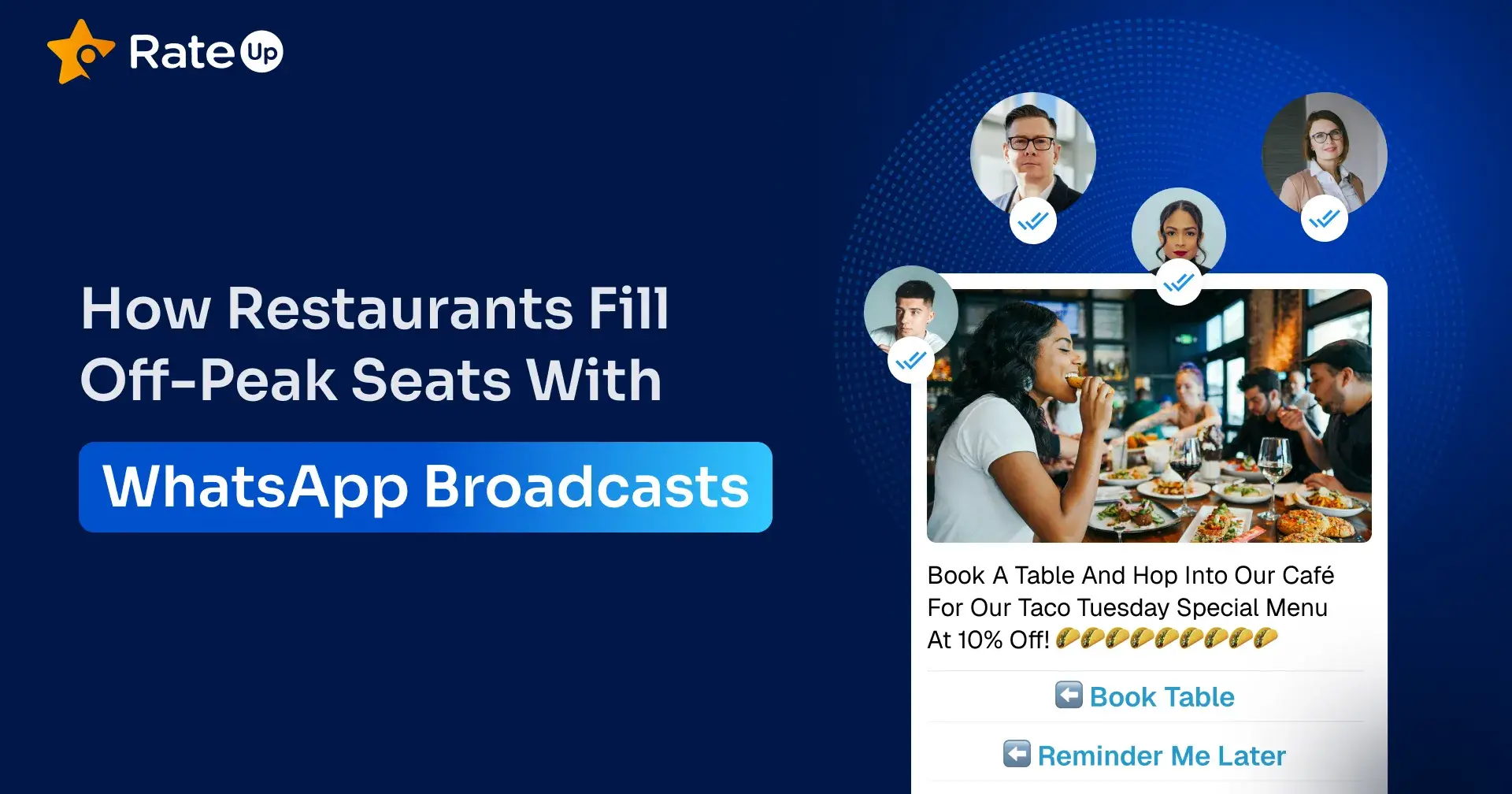
Every restaurant has them — the empty Monday lunch, the hollow Tuesday evening, the dead 3pm stretch where staff outnumber guests two to one. Off-peak hours are not just a revenue gap. They are a fixed-cost problem: rent, wages, utilities, and food prep costs do not pause because the tables are empty. The restaurants solving this in 2026 are not running expensive ads or dropping prices permanently. They are sending targeted WhatsApp broadcasts to fill seats during off-peak hours — using loyalty programme members as a ready-made audience of customers who already trust the brand, have already eaten there before, and are primed to respond to a personal, timely, exclusive offer. This guide shows exactly how it works, what to send, when to send it, and how RateUp powers the complete broadcast and loyalty stack in one platform.
Why Off-Peak Hours Are a Fixed-Cost Crisis, Not Just a Quiet Spell
The economic reality of an empty restaurant during off-peak hours is harsher than most operators acknowledge openly. A restaurant with 60 covers, a chef, three servers, and a manager on shift during a slow Tuesday lunch is burning ₹8,000–₹15,000 per hour in fixed costs regardless of how many people are eating.
The traditional responses — early bird discounts, happy hour offers, weekday set menus — are effective but passive. They require customers to already know about the offer, already be planning a meal, and already be choosing between options. They do not reach customers who have forgotten your restaurant exists.
WhatsApp broadcasts change the dynamic entirely. Instead of waiting for customers to discover your off-peak offer, you send the offer directly to them — personally, immediately, at the exact moment they are making a meal decision. The difference between passive promotion and active, personal outreach is the difference between hoping a table fills and making it fill.
Indian restaurants using WhatsApp marketing report 40% higher repeat visit rates, 85–95% message open rates, and 3–5x ROI compared to traditional SMS and email marketing. The combination of a WhatsApp broadcast and a WhatsApp loyalty program is the most powerful off-peak tool available to restaurants today.
What Is a WhatsApp Broadcast for Restaurants?
A WhatsApp broadcast for restaurants is a one-to-many message sent simultaneously to a list of opted-in customers — each recipient receiving it as a direct, private message from the restaurant, not as a group chat notification. Recipients can reply directly to start a one-on-one conversation, make a reservation, or claim an offer.
The critical distinction from group chats is privacy and personalisation. A WhatsApp broadcast delivers your off-peak flash deal to 500 loyalty members in a way that feels like a personal message from a restaurant that knows them — not a mass marketing blast. Add the customer's name, reference their last visit or favourite dish, and the message becomes genuinely personal at scale.
Broadcasts through the WhatsApp Business API — which RateUp provides access to — unlock additional power: unlimited recipient lists, segmentation by visit frequency and food preference, personalisation tokens (name, last order, loyalty points balance), rich media (food photos, menu images), and real-time delivery and read analytics.
[Image 1: Off-peak broadcast timing strategy]
The 5 Best Times to Send WhatsApp Broadcasts for Off-Peak Seat Filling
Timing a WhatsApp broadcast is the most critical execution decision. Send too early and customers are not thinking about food yet. Send too late and they have already made plans. Best practices include sending broadcasts between 11:00–11:30 AM (pre-lunch decision window) or 5:30–6:00 PM (pre-dinner), limited to 2–3 broadcasts per week maximum.
Here are the five optimal broadcast windows for off-peak seat filling:
1. 10:30–11:00 AM (Pre-Lunch Flash Deal) Target: quiet lunch periods (Monday–Wednesday). Message goes out before customers make lunch plans. Works best with a time-limited incentive expiring at 2pm — creating genuine urgency without dishonesty.
2. 2:00–3:00 PM (Afternoon Slump Activation) Target: the dead zone between lunch service and dinner prep. Customers who work nearby, work from home, or are on an afternoon break. Offer: extended happy hour, tea-time set menu, or "quiet table" booking for meetings.
3. 5:00–5:30 PM (Pre-Dinner Early Bird) Target: dinner bookings for 6:00–7:30pm, before the 8pm rush. Create a VIP early-arrival window for loyalty members with reserved seating and a welcome drink. Makes off-peak feel exclusive, not desperate.
4. Monday and Tuesday Specifically These are statistically the quietest dining days globally. A Monday broadcast sent at 10:30am positions your restaurant as the obvious lunch choice for a day when customers have no strong restaurant association. Loyalty members who have not visited in 7+ days are the primary target.
5. Weather-Triggered Broadcasts Rainy afternoons and overcast evenings create spontaneous dining demand that restaurants almost never capture. Send a targeted broadcast 2–3 hours before the slow period: "Rainy day special! Order any main course today and get a hot soup FREE. Valid 12 PM – 3 PM only. Reply SOUP to claim." These messages feel serendipitously relevant and drive remarkable response rates.
8 WhatsApp Broadcast Templates That Fill Tables During Off-Peak Hours
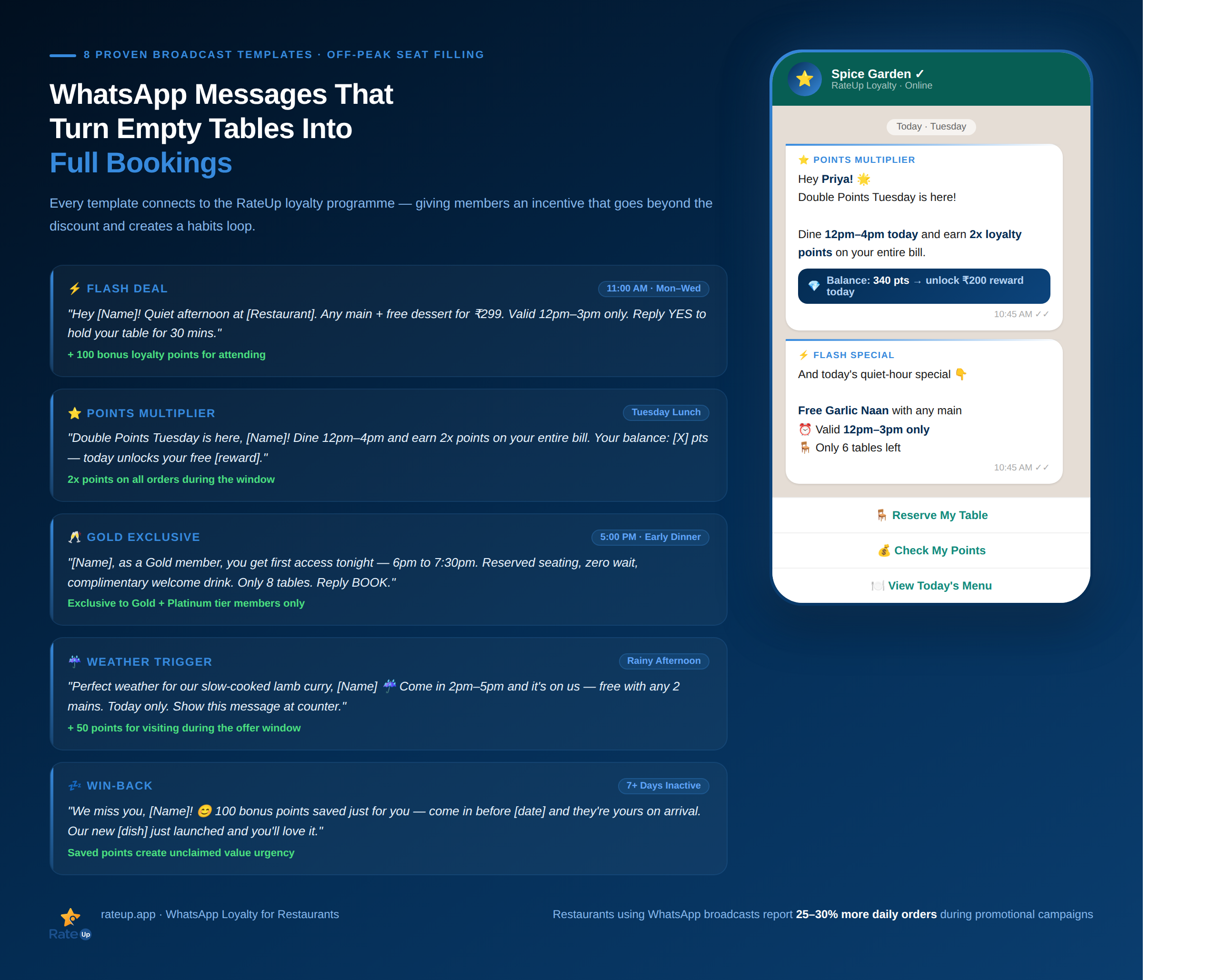
The following templates are proven to drive off-peak reservations and walk-ins. Each one is connected to the RateUp loyalty programme — rewarding customers for coming during quieter hours and creating a habits loop that keeps them returning.
Template 1: The Flash Deal (11:00 AM, Monday–Wednesday)
"Hey [Name]! 🍽️ It's a quiet afternoon at [Restaurant Name] and we saved your favourite corner table. Today only: any main + free dessert for ₹299. Valid 12pm–3pm. Reply YES and we'll hold it for you for 30 mins. + earn 100 bonus loyalty points 🎯"
Why it works: Personalised, time-limited, creates scarcity, and the loyalty bonus gives an additional incentive that goes beyond the discount.
Template 2: The Loyalty Points Multiplier (Tuesday Lunch)
"Double points Tuesday is here, [Name]! 🌟 Dine with us between 12pm–4pm today and earn 2x loyalty points on your entire bill. Your current balance: [X] points — today could unlock your free [reward]. Reserve your table: [link]"
Why it works: The points multiplier is a loyalty-programme-native incentive that only makes sense for enrolled members. It rewards loyalty while filling quiet slots.
Template 3: The Exclusive Member Offer (5:00 PM, Early Dinner)
"[Name], as one of our Gold members, we're giving you first access to our quiet dining window tonight — 6pm to 7:30pm. Reserved seating, zero wait, and a complimentary welcome drink. Only 8 tables available. Reply BOOK to reserve yours 🥂"
Why it works: Tier-based exclusivity makes off-peak dining feel prestigious, not discounted. Gold members are your highest-value customers — filling their seats during off-peak with added value is pure margin.
Template 4: The Weather Trigger (Rainy Afternoon)
"It's the perfect weather for our slow-cooked lamb curry, [Name] ☔ Come in between 2pm–5pm today and it's on us — free when you order any 2 mains. Valid today only. Show this message at the counter 🍲"
Why it works: Weather relevance makes the message feel like a coincidence rather than marketing. The specific dish mention signals a restaurant that genuinely knows its food.
Template 5: The Win-Back Campaign (7+ Days Inactive Member)
"We miss you, [Name]! 😊 It's been a while since your last visit. We've saved 100 bonus points just for you — come in any time before [date] and they're yours the moment you sit down. Plus, our new [dish] just launched and we think you'd love it. Reserve: [link]"
Why it works: The saved points create a sense of unclaimed value. The new menu item adds genuine novelty. The personalised absence acknowledgement feels human.
Template 6: The Staff Favourite (Wednesday Afternoon)
"Chef's pick of the week: the [dish] with [description] — and our team can't stop talking about it 👨🍳 Come try it this [day] between 2pm–6pm and it's 20% off. We're quiet enough that you'll actually get Chef to come say hello. Reserve: [link] | +50 bonus loyalty points"
Why it works: Behind-the-scenes intimacy makes off-peak feel like a feature, not a flaw. Customers who want a genuine dining experience prefer a quiet restaurant over a noisy one.
Template 7: The Group Booking Catalyst (Friday Afternoon)
"Planning where to eat this weekend, [Name]? 🎉 We have 3 tables left for this Saturday's dinner service — and Gold members get priority before we open them to the public at 6pm. Bring your people: [link] | Earn 50 pts per guest who joins you"
Why it works: The group referral mechanic turns individual loyalty members into table-filling agents. Every person they bring earns the primary member more points.
Template 8: The Subscription / Regular Slot Offer
"[Name], would you like your own standing table every [day] at [time]? 🍽️ Our quiet regulars get the same table, the same server, and a 10% standing discount — no reservation needed, ever. Interested? Reply YES and we'll set it up."
Why it works: Converting occasional visitors into standing regulars is the highest-value loyalty outcome. This offer is only viable during off-peak slots and creates a permanent, recurring revenue stream.
How Loyalty Segmentation Makes Off-Peak Broadcasts 3x More Effective
Sending the same off-peak broadcast to your entire customer list is significantly less effective than sending segmented messages to specific customer groups. Segment broadcast lists (lunch crowd vs. dinner crowd, families vs. date night), personalise with names and preferences, include clear calls-to-action, and track what works.
RateUp's loyalty programme creates the segmentation data that makes this possible:
By visit frequency: Customers who visit 4+ times per month get VIP-tier off-peak exclusives. Customers who visited once 3 months ago get win-back offers with bonus points.
By tier: Gold and Platinum members get first access to reserved off-peak tables before the offer opens to Silver members.
By dining preference: Vegetarian customers get relevant off-peak specials, not meat-focused promotions. Lunch regulars get mid-morning broadcasts, not evening ones.
By last visit timing: Customers who typically dine at 7pm are less relevant targets for a 3pm broadcast than customers whose visit history shows mid-afternoon dining.
By points proximity: Customers who are 50–100 points away from their next reward are the highest-converting target for an off-peak points multiplier offer — they need one more visit to unlock something they already care about.
Without a loyalty programme, this segmentation is impossible. You have no customer data, no visit history, no preferences — only an anonymous order history locked inside a third-party platform. RateUp's loyalty programme is what transforms a WhatsApp broadcast from a generic mass message into a precision-targeted, personally relevant offer.
Read More: How to Build a WhatsApp Loyalty Program for Your Shopify D2C Brand
The Complete RateUp Off-Peak Broadcast + Loyalty Loop
Here is how the full system works when RateUp powers both the broadcast and the loyalty programme:
Customer enrols in the RateUp loyalty programme via QR code at the table or on the receipt
Customer data builds over visits — preference, frequency, tier level, points proximity to next reward
Slow Tuesday approaches — RateUp's automation detects that the next day is a Monday lunch with historically low covers
Targeted broadcast fires at 10:45am — segmented by lunch visitors, personalised with name and loyalty points balance, tailored offer for the specific slow slot
Customer replies "YES" or taps the reservation link — table confirmed
Customer visits, earns double points — balance update fires via WhatsApp immediately after the visit
If customer does not respond, RateUp tracks non-engagement and excludes that customer from the next broadcast cadence (preventing fatigue)
Post-visit NPS survey fires 1 hour after estimated meal completion — feedback collected, positive response triggers Google review prompt
Every step runs automatically. The restaurant manager's only job is to look at the analytics dashboard and observe which broadcast template, which time slot, and which customer segment drove the most covers.
Restaurants using WhatsApp menu broadcasts report 25–30% increases in daily orders during promotional campaigns.
Mistakes That Kill Off-Peak WhatsApp Broadcast Campaigns
Over-messaging: Sending daily broadcasts will get you blocked. Stick to 2–3 messages per week maximum. Quality over quantity. An off-peak flash deal loses all urgency if customers receive five WhatsApp messages from you every week.
No loyalty connection: A broadcast that simply says "20% off Tuesday lunch" has lower conversion than one that says "Tuesday double points for Gold members." The loyalty programme gives customers a reason to respond that goes beyond the immediate offer.
Wrong timing: A dinner offer sent at 2pm and a lunch offer sent at 7pm are both wasted. The timing must match the customer's decision window, not the restaurant's scheduling convenience.
No clear CTA: Every message must have a clear next step. "Reply YES to reserve" or "Show this message for 20% off" drives action. A beautiful message with no CTA is wasted effort.
Ignoring replies: WhatsApp is a two-way channel. If a customer replies to your broadcast and gets no response within 30 minutes, you have damaged trust. RateUp's AI chatbot handles common replies automatically — reservation confirmations, FAQ answers, points queries — so no reply goes unanswered.
Frequently Asked Questions
Q: How many WhatsApp broadcasts can a restaurant send per week to loyalty members?
The optimal frequency for restaurant WhatsApp broadcasts is 2–3 messages per week maximum. Exceeding this risks opt-outs and WhatsApp account flags. Off-peak flash deals should be limited to 1–2 per week and always include genuine value — a points bonus, exclusive offer, or personalised incentive. Loyalty-triggered messages (points updates, tier upgrades, birthday rewards) are always appropriate and do not count toward the promotional frequency limit.
Q: What is the best way to segment a WhatsApp broadcast list for off-peak promotions?
The most effective segmentation for off-peak broadcasts combines visit timing (customers who historically dine during the target slot), visit frequency (lapsed customers for win-back, active members for exclusives), loyalty tier (Gold/Platinum get first access, Silver get the general offer), and points proximity (customers near their next reward respond best to multiplier offers). RateUp's loyalty programme builds this segmentation data automatically from visit history.
Q: How does a WhatsApp loyalty programme improve broadcast conversion rates?
Loyalty programme members convert on off-peak broadcasts at significantly higher rates than cold contacts for three reasons. First, they have opted in and have a pre-existing relationship with the restaurant. Second, loyalty incentives (double points, exclusive tier offers, points multipliers) give an additional reason to act beyond the base discount. Third, points proximity — knowing they are 50 points away from a free meal — creates a behavioural trigger that a generic discount cannot replicate.
Q: Can WhatsApp broadcasts include food photos and rich media? Yes.
WhatsApp broadcasts through the official Business API support images, short videos, PDFs, and interactive buttons. Including a high-quality food photo of the day's off-peak special consistently outperforms text-only messages in click-through rates. RateUp's broadcast builder allows restaurants to attach rich media to every broadcast template without technical knowledge.
Q: How does RateUp handle customers who do not respond to off-peak broadcasts?
RateUp tracks delivery and read status for every broadcast. Customers who consistently do not open off-peak broadcasts are automatically removed from future off-peak segments to prevent fatigue and opt-outs. Customers who open but do not convert receive a lighter follow-up within 48 hours. This automated engagement management preserves the quality of the loyalty list and prevents the over-messaging that destroys broadcast effectiveness over time.
Conclusion
Off-peak hours are not a permanent problem. They are a communication problem — one that WhatsApp broadcasts, powered by a loyalty programme, are uniquely positioned to solve.
The restaurants that fill their quiet Monday lunches and slow Tuesday evenings in 2026 are the ones that have built a direct channel to their best customers — enrolled loyalty members who receive a personal, timely, exclusive offer at the exact moment they are deciding where to eat. Not a passive discount on a board. Not a generic social media post. A WhatsApp message with their name on it, a dish they like, and a loyalty points incentive that only they can redeem.
RateUp delivers the complete system: official WhatsApp Business API, loyalty programme with segmented member data, broadcast campaign builder, real-time analytics, AI chatbot for reply handling, and post-visit feedback collection — all in one platform, starting free.

Join Jishnu on Peerlist!
Join amazing folks like Jishnu and thousands of other builders on Peerlist.
0
0
0