

An In-depth Look at the Technologies Powering ChatGPT
The Engineering Behind the AI Revolution
ChatGPT, a groundbreaking large language model, is not just one piece of software but a sophisticated system built on a stack of diverse and powerful technologies. To understand how it works, we need to look at the key components that make it possible, from the programming languages that form its foundation to the cloud infrastructure that handles its massive scale.
Core Programming Languages
At its heart, ChatGPT relies on several key programming languages for different aspects of its development and operation.
Python
The primary language for AI and machine learning development. Python's rich ecosystem of libraries, such as PyTorch and TensorFlow, makes it the perfect choice for training and deploying large models.
C++
Used for performance-critical parts of the system. C++ provides low-level control and efficiency, which is essential for optimizing the computational heavy lifting involved in AI model inference.
Rust
Known for its memory safety and performance. Rust is increasingly used in systems programming, including parts of the AI stack where high performance and reliability are crucial.
TypeScript/JavaScript
These are used for the front-end interface, allowing users to interact with the model through a web browser. TypeScript adds static typing to JavaScript, improving code quality and maintainability.
Frameworks and Libraries
These tools provide the foundational building blocks for developing and training the AI models.
PyTorch & TensorFlow
The two leading open-source machine learning frameworks. They provide the necessary tools for building, training, and deploying neural networks. ChatGPT’s core model is built using one of these.
Hugging Face Transformers
This library is a key component for anyone working with modern AI models. It provides pre-trained models and tools for natural language processing, making it easier to build on existing research and deploy models like the ones used in ChatGPT.
CUDA/cuDNN
These are NVIDIA technologies that enable GPU acceleration for deep learning. CUDA is a parallel computing platform and API model, while cuDNN is a library of primitives for deep neural networks. They are critical for speeding up the massive computations required for training and running large models.
Databases
Handling and managing the immense amount of data required to train and operate a model like ChatGPT requires robust database solutions.
PostgreSQL
A powerful and extensible open-source relational database. It is often used for structured data, user information, and other system-related data.
MongoDB
A popular NoSQL database that offers flexibility and scalability, making it suitable for handling large volumes of unstructured or semi-structured data.
Cassandra
A highly scalable, distributed NoSQL database. It is designed to handle large amounts of data across multiple servers, making it ideal for managing data with high availability and fault tolerance.
Redis
An in-memory data structure store used as a database, cache, and message broker. Redis is extremely fast and is often used for caching frequently accessed data to reduce latency.
Servers and Cloud Computing
The sheer scale of ChatGPT requires a massive, distributed infrastructure.
Microsoft Azure
As a strategic partner of OpenAI, Microsoft Azure provides the cloud computing services and infrastructure that power ChatGPT. This includes scalable virtual machines, storage, and networking.
NVIDIA A100 & H100
These are state-of-the-art GPUs designed for AI workloads. They are essential for the training of large models and for serving high-volume inference requests with low latency.
Kubernetes
An open-source container orchestration system. Kubernetes automates the deployment, scaling, and management of applications, ensuring that the service remains available and responsive even with millions of users.
Protocols and APIs
These technologies ensure that different parts of the system can communicate effectively and securely.
REST, WebSockets, GraphQL, gRPC
These are different types of APIs (Application Programming Interfaces) that enable communication between the front-end and back-end systems.
REST is a standard for creating web services.
WebSockets provide a persistent, two-way communication channel, which is great for real-time interactions.
GraphQL allows for more efficient data fetching.
gRPC is a high-performance framework for remote procedure calls, ideal for microservices.
Security and Scalability
Ensuring the system is secure and can handle massive traffic is paramount.
TLS (Transport Layer Security)
This protocol encrypts data transmitted between the user's browser and the server, ensuring secure communication.
Cloudflare & Akamai
These are content delivery networks (CDNs) that improve performance and security. They distribute traffic and protect against attacks like DDoS (Distributed Denial of Service).
OAuth
An open standard for authorization. OAuth allows users to securely log in and access the service without sharing their passwords, enhancing security and user experience.
Gift
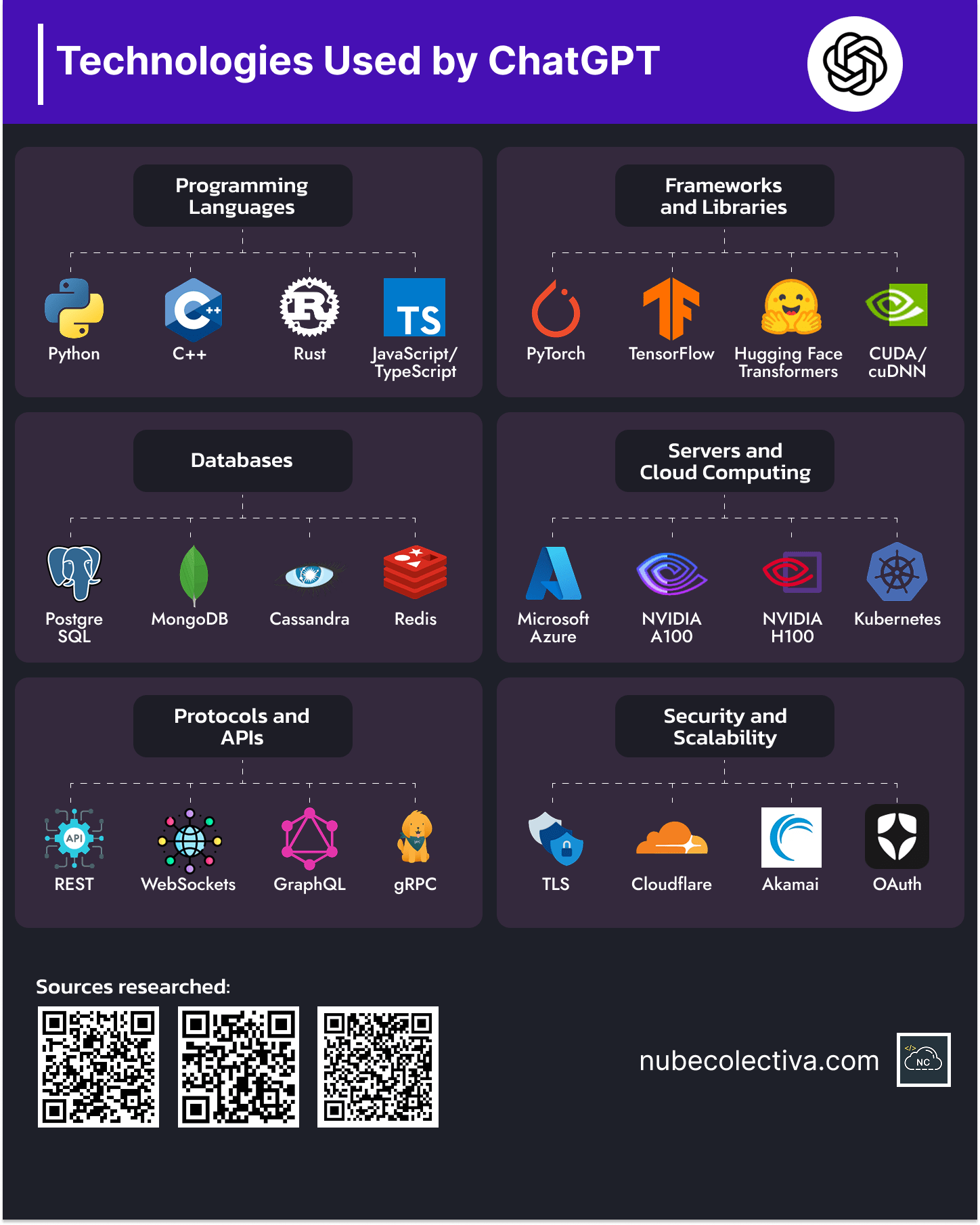
A picture is worth a thousand words, below I share an image with the technologies that ChatGPT uses:
Conclusion
By combining these diverse and powerful technologies, ChatGPT is able to deliver a highly responsive, scalable, and secure service. This technological stack is a testament to the complex engineering required to build and operate a leading AI product at a global scale.

Join Juan on Peerlist!
Join amazing folks like Juan and thousands of other builders on Peerlist.
0
9
0