

What is the Digital Personal Data Protection (DPDP) Act, and why does it matter for SaaS?
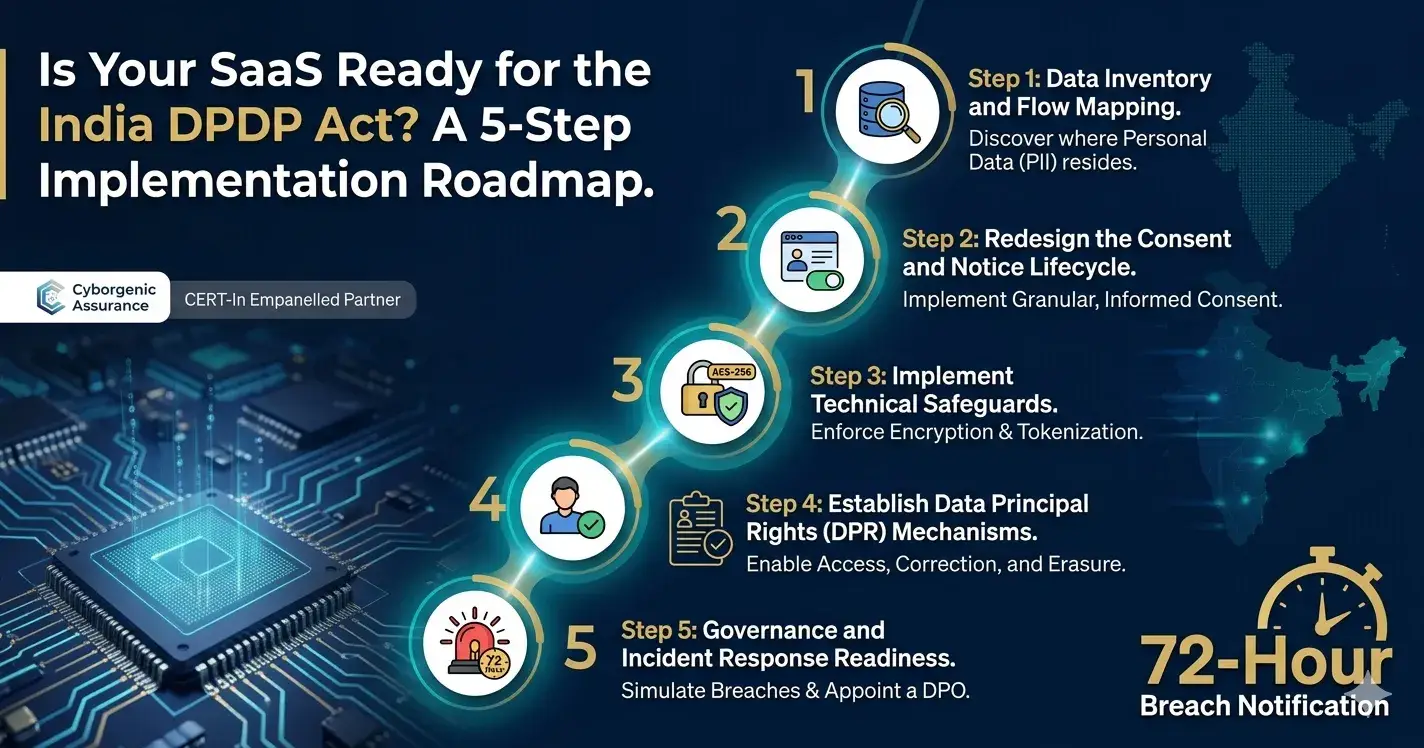
India’s DPDP Act, supplemented by the final DPDP Rules notified in November 2025, represents a seismic shift in how personal data is governed. For SaaS platforms—whether you are a Fintech based in Bengaluru or a global Enterprise serving Indian users—the Act applies to any processing of digital personal data within India or processing done outside India in connection with offering goods or services to Indian "Data Principals."
Unlike previous regulations, the DPDP Act is built on the principle of accountability. It is no longer enough to have a privacy policy; you must demonstrate that your technical architecture actively protects user rights and limits data processing to the specific purpose for which consent was granted.
Why is "Data Minimization" the most critical concept for CTOs?
One of the biggest hurdles for SaaS companies is the habit of "collecting everything and sorting it later." Under the DPDP Act, this is a major liability. You may only process personal data that is strictly necessary for a specified lawful purpose.
What this looks like for your engineering team:
API Scrubbing: Ensure your APIs aren't leaking more data than the frontend actually displays.
Retention Hard-Stops: Implement automated deletion workflows for data that has served its purpose or when a user withdraws consent.
A 5-Step Implementation Roadmap for SaaS Compliance
Navigating this transition requires a cross-functional effort between Legal, DevOps, and Product teams. Here is the Cyborgenic-approved roadmap to move from regulatory uncertainty to operational control.
Step 1: Data Inventory and Flow Mapping
You cannot protect what you don't know you have.
The Goal: Create a "Live Record of Processing Activities" (RoPA).
Actionable Step: Conduct a deep-dive data discovery session to map every touchpoint—from user sign-up and third-party SDKs to cloud storage and backups. Identify where "Personal Data" (PII) resides and categorize it (Financial, Biometric, Healthcare, etc.).
Step 2: Redesign the Consent and Notice Lifecycle
Consent under DPDP must be free, specific, informed, unconditional, and unambiguous.
The Goal: Replace "bundled" consent with granular, affirmative actions.
Actionable Step: Update your UI to provide notices in English and the 22 languages specified in the Eighth Schedule of the Constitution (where applicable). Implement a Consent Manager interface that allows users to withdraw consent as easily as they gave it.
Step 3: Implement Technical Safeguards (The "Security First" Pillar)
The Act mandates "reasonable security safeguards" to prevent personal data breaches.
The Goal: Cryptographic enforcement of data privacy.
Actionable Step: Implement AES-256 encryption at rest and TLS 1.3 in transit. For high-risk data (like fintech or healthcare), utilize tokenization to ensure that even if a database is compromised, the PII remains unreadable.
Step 4: Establish Data Principal Rights (DPR) Mechanisms
Users now have the right to access, correct, and erase their data, as well as the right to grievance redressal.
The Goal: Fulfill user requests within the 90-day window.
Actionable Step: Build a "Privacy Dashboard" where users can download their data in a machine-readable format (JSON/CSV) or request its deletion. Ensure your support team is trained to handle grievances within the prescribed maximum timelines.
Step 5: Governance and Incident Response Readiness
If a breach occurs, the clock starts immediately.
The Goal: Comply with the 72-hour notification rule to the Data Protection Board and affected users.
Actionable Step: Appoint an India-based Data Protection Officer (DPO) if you qualify as a Significant Data Fiduciary. Conduct quarterly "Breach Simulations" to test your dual-reporting clock (6 hours for CERT-In and 72 hours for DPDP).
How do "Significant Data Fiduciaries" (SDFs) differ in their obligations?
If your SaaS handles high volumes of sensitive data or poses a risk to public order, you may be designated as an SDF. This status brings additional meticulous oversight requirements:
Data Protection Impact Assessments (DPIAs): Mandatory reviews for high-risk processing.
Independent Audits: You must appoint an external auditor to verify your compliance annually.
Algorithmic Transparency: If you use AI for profiling or automated decision-making, you must be able to explain the "how" and "why" to regulators.
The Cyborgenic Advantage: Beyond Documentation
At Cyborgenic Assurance, we understand that for a CTO or IT Manager, compliance isn't just about legal text—it’s about system integrity. As a CERT-In empanelled partner, we bridge the gap between policy and code. Our auditors don't just read your manuals; we test your firewalls, audit your API endpoints, and validate your encryption keys.
Trust is the new currency of the digital economy. By following this roadmap, you aren't just avoiding fines; you are building a "Seal of Trust" that allows you to scale into the Indian market with confidence.
Ready to validate your DPDP posture?
The May 2027 deadline is approaching faster than it appears. Start with a Cyborgenic Gap Analysis to identify your most critical risks before they become liabilities.
Explore our Compliance & VAPT Services: https://cyborgenic.com/
SaaS companies must achieve India DPDP Act compliance by May 13, 2027. The implementation roadmap involves five key steps: data mapping, consent redesign, technical safeguards (encryption/tokenization), user rights fulfillment, and governance (appointing a DPO). Cyborgenic Assurance provides expert CERT-In empanelled auditing to help firms navigate these requirements and avoid penalties up to ₹250 Crores.
Join Jubed on Peerlist!
Join amazing folks like Jubed and thousands of other builders on Peerlist.
0
0
0