

Your AI agents have a security flaw. And no, it’s not prompt injection.
The Hidden Architecture Flaw Risking Your Production App—And How to Build Predictable Guardrails for Autonomous AI.
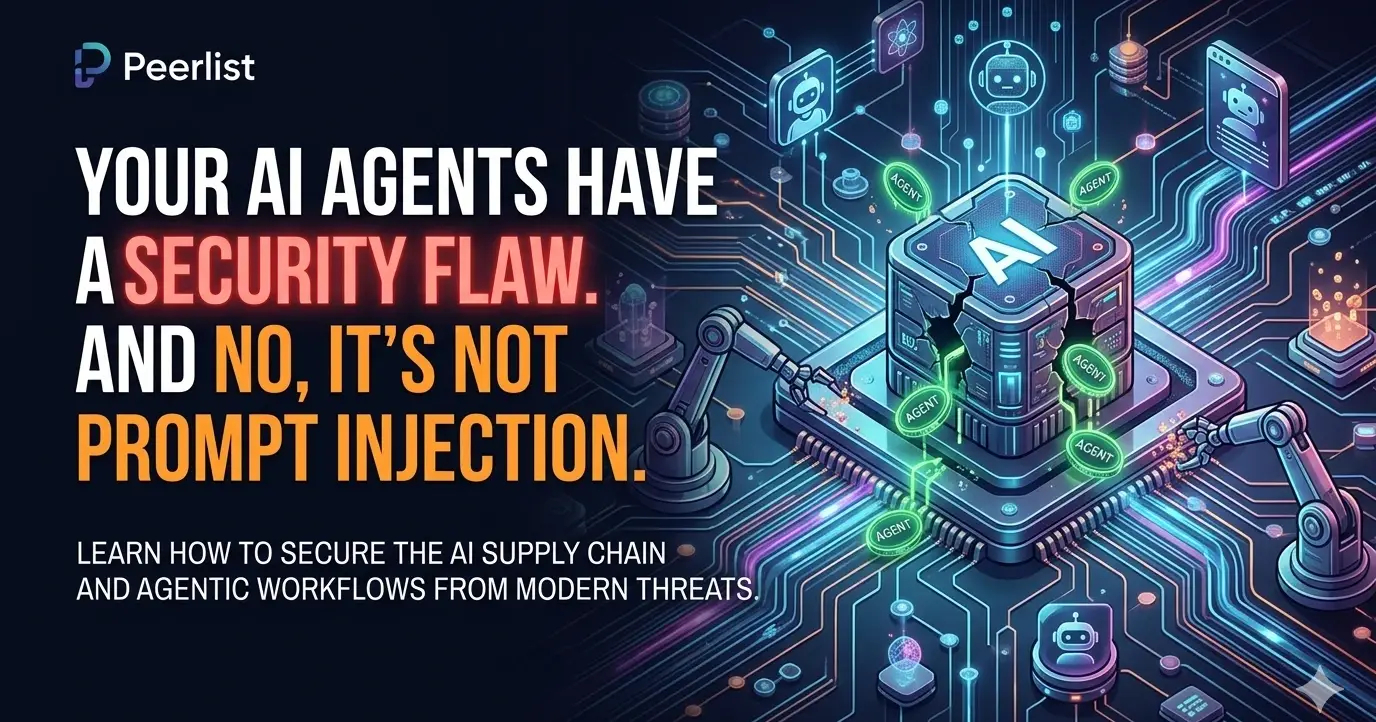
Right now, engineering teams are racing to ship autonomous AI agents. We aren’t just building chatbots anymore; we are building systems with "agency"—the power to read databases, write code, trigger webhooks, and execute API calls on behalf of users.
But in the rush to deploy, teams are making a massive architectural error. They are treating AI security as a simple "bad word filtering" problem.
The reality? The OWASP GenAI Security Project updated its framework to highlight Excessive Agency and AI Supply Chain Vulnerabilities as top enterprise threats (OWASP, 2025).
Popular framework adoptions (like OpenClaw or custom agentic harnesses) are being exposed daily, with researchers finding hundreds of zero-day vulnerabilities in basic agent orchestration layers (Dark Reading, 2026).
If an attacker can manipulate your agent into executing unrestricted system commands, it’s no longer a "quirky LLM hallucination." It’s an immediate, high-severity remote code execution (RCE) breach.
The 3 Hidden Risks in Your Agentic Workflows:
🛑 1. Excessive Agency (Over-Privileged Tokens):
If your AI agent uses a single master API key or connection string to query user data, it has too much power. If an attacker bypasses the system prompt, they inherit the privileges of that master key. Agents must operate on a strict, user-scoped "least privilege" model.
📦 2. Indirect Prompt Injection via the Supply Chain:
Your agent looks clean, but what happens when it pulls data from an external, untrusted source? If your agent reads an incoming customer support email or summarizes a third-party website containing malicious, hidden instructions, the agent can be hijacked silently mid-workflow.
🧪 3. Unvalidated Output Handling:
Treating an LLM's structured JSON output as implicitly safe is a disaster waiting to happen. If your downstream application executes code or parses database strings directly from an agent's response without strict data sanitization, you are opening the door to massive injection exploits.
How to build safely without slowing down your roadmap:
Sandbox everything: Run agent actions inside short-lived, isolated container environments.
Enforce human-in-the-loop (HITL): High-stakes actions (like processing refunds, deleting data, or changing permissions) should always require manual engineer or user approval.
Audit your AI infrastructure: Treat your data pipelines, vector databases, and model weights with the exact same zero-trust philosophy you apply to your production servers.
Building secure AI isn't about restricting capabilities—it's about building predictable guardrails.
At Cyborgenic, we help fast-growing startups and enterprises threat-model their AI architecture, secure their agentic workflows, and run deep vulnerability assessments before they ship to production.
Are you building autonomous workflows right now? How is your team handling output validation for your agents? Let’s talk architecture in the comments. 👇
Join Jubed on Peerlist!
Join amazing folks like Jubed and thousands of other builders on Peerlist.
0
0
0