

Agentic SDLC: Why Autonomous Testing is the New Strategic Core
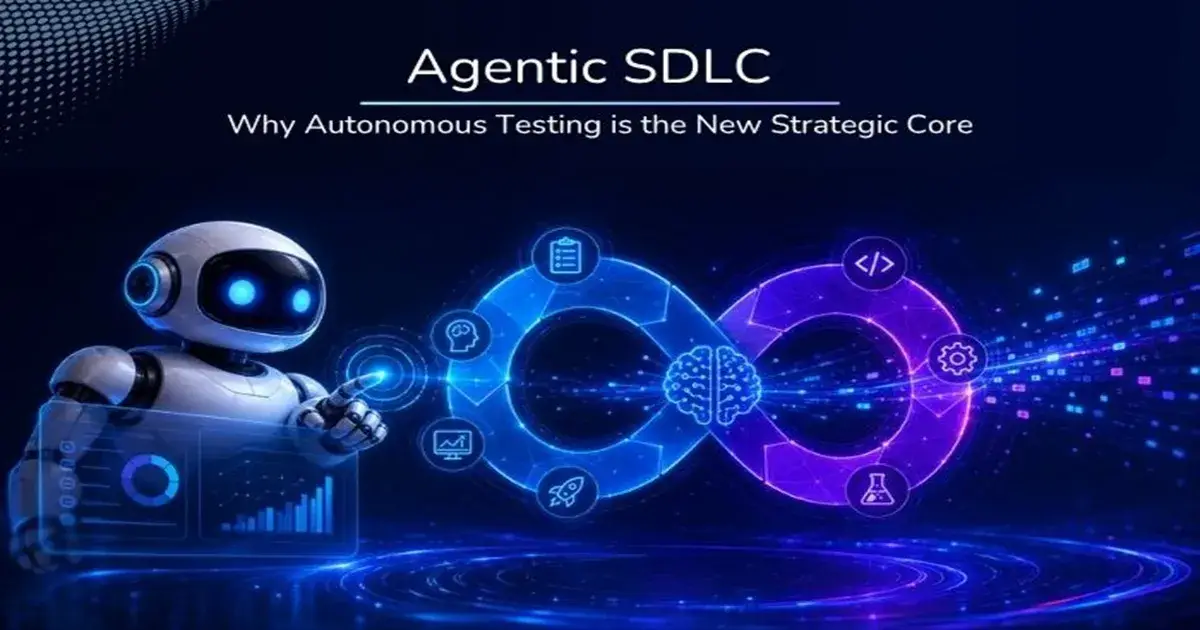
Software engineering has run straight into a volume mismatch. Generative AI tools enable developers to complete an average of 25% more tasks, leading to an influx of pull requests that overwhelms traditional verification mechanisms. When code production moves at machine velocity, relying on legacy manual script maintenance creates severe deployment blockages.
To eliminate this bottleneck, enterprise engineering is migrating toward the Agentic SDLC, a complete reorganization of software delivery centered around autonomous agent execution and multi-agent orchestration. At the absolute center of this transformation sits autonomous testing, establishing itself as the essential financial and operational core for modern software delivery.
The Economics of the Autonomous Lifecycle
The Agentic SDLC shifts engineering pipelines from static systems of record to dynamic systems of intelligence. Rather than running pre-scripted paths, autonomous testing engines interpret business intent directly from documentation, analyze code changes, map risk surfaces, and construct dynamic testing scenarios.
This transition targets key operational efficiencies across the enterprise:
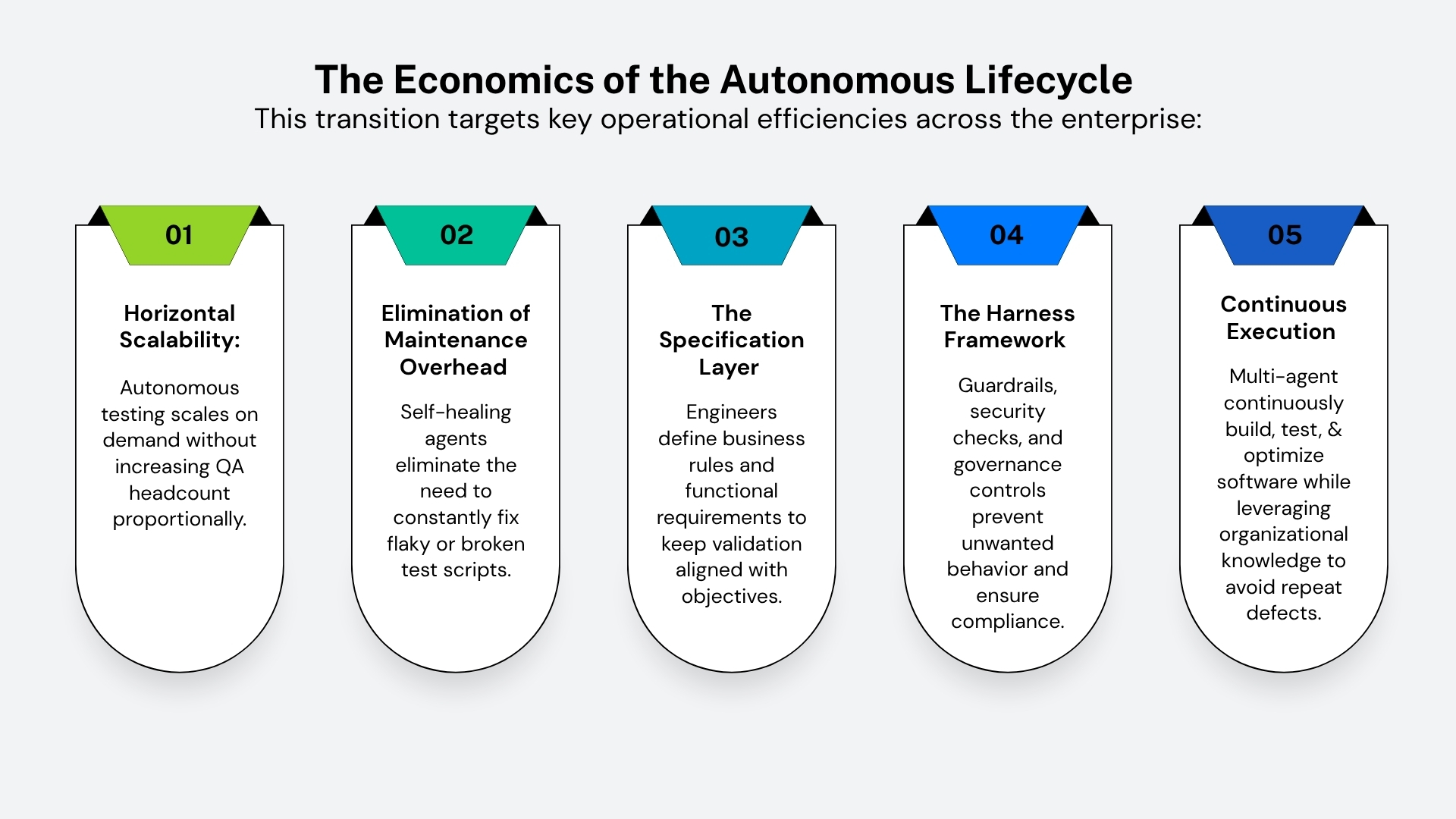
Horizontal Scalability: Instead of scaling QA headcount linearly to match increased development output, organizations deploy autonomous validation layers that scale horizontally on demand.
Elimination of Maintenance Overhead: In legacy environments, teams spend valuable cycles diagnosing flaky tests or fixing scripts that break with minor user interface changes. Autonomous agents eliminate this burden through dynamic self-healing.
The Specification Layer: Human engineers set precise functional intent and business rules, ensuring that the system always aligns with strategic goals.
The Harness Framework: Autonomous guardrails, linters, and security gates define strict operational limits, eliminating the risk of behavioral drift.
Continuous Execution: Multi-agent pods build, test, and optimize outputs in parallel, referencing organizational memory to prevent recurring defects.
De-Risking Code Generation: The Builder-Validator Chain
The primary risk of scaling software production with generative tools is the sharp increase in silent logic errors. Recent development analyses reveal that AI-assisted code contributions average 10.83 issues per pull request, compared to 6.45 for human engineers, a 1.7x defect rate. Traditional compilation checks fail to catch these anomalies because the code compiles perfectly, but violates underlying business requirements.
An orchestrated agentic pipeline isolates and mitigates this risk by establishing a strict builder-validator chain. This framework highlights how adopting agentic AI in software testing structure pairs code generation agents with completely independent verification agents working in tandem:
Requirement Ingestion
Autonomous systems pull business logic and acceptance criteria directly from project management platforms (such as Jira) before code generation begins.
Independent Test Derivation
Instead of writing tests based on completed code, which merely verifies what was written, including any embedded flaws, validation agents derive test coverage directly from the original functional criteria.
Semantic Verification
Code is executed and validated against these objective scripts. Decoupling creation from validation reduces failures in multi-agent planners and increases task success rates by more than 15%.
Seamless Pipeline Progression and DevSecOps Compliance
Continuous delivery requires pipelines that progress without manual intervention. When user interfaces or API models shift, traditional static test suites break, causing false positives that stall deployments. Autonomous testing engines remove this friction through automated script healing. Utilizing real-time observability, test agents analyze user interface modifications against structural blueprints, update the validation suites dynamically, and complete the verification loop without human intervention. This structural discipline extends directly into DevSecOps.
In parallel with functional validation, autonomous compliance agents perform vulnerability scanning, license audits, and access reviews. Because these agents operate under distinct machine identities and least-privilege service accounts, security protocols remain absolute. Shifting compliance checking to the earliest stages of execution prevents security flaws from reaching final human review, removing manual approval roadblocks.
Managing the Realities of Enterprise Implementation
Transitioning to autonomous testing provides substantial operational advantages alongside specific implementation hurdles that require deliberate mitigation.
Operational Advantages:
Optimized Cycle Times: Eliminating handoffs between isolated engineering teams accelerates software release velocity.
Minimized Production Escapees: Identifying complex logic defects during early development prevents costly failures from impacting live production environments.
Horizontal Scalability: Engineering leaders can expand validation capacity instantly by launching parallel agent pods rather than navigating lengthy recruitment cycles.
Implementation Hurdles
The Integration Gap: Integrating multi-agent frameworks into complex, legacy enterprise environments demands deep platform expertise. Organizations bridge this gap by collaborating with mature AI testing services to build resilient infrastructure.
Review Congestion: Generating assets at machine speed can overwhelm managers during final approval phases if human-in-the-loop governance checkpoints are poorly designed.
The Road to Governed Autonomy
The global agentic AI market is projected to expand significantly, climbing from $7.06 billion in 2025 to $93.20 billion by 2032 at a 44.6% compound annual growth rate. This growth highlights a broader transition from experimental tools to fully managed autonomous testing software factories built on three core pillars:
Centralized Quality Auditing: Organizations are implementing dedicated quality layers to monitor, audit, and log agent reasoning steps and tool calls, maintaining unalterable compliance trails.
Governed Human Autonomy: Engineering roles are shifting from manual execution to strategic boundary configuration, where humans define system constraints and review high-level exceptions.
Cross-Agent Ecosystems: Future software systems will rely on collaborative multi-agent environments in which internal verification systems discover and securely interact with external service agents across enterprise boundaries.
Navigating this transition successfully requires modernizing foundational agentic SDLC infrastructure. Relying on legacy manual processes in an era of accelerated code production introduces severe operational risk. Forward-looking enterprises are mitigating this by partnering with specialized QA engineering teams to build the resilient, governed automated systems required to protect software quality and maintain market velocity.

Join Kanika on Peerlist!
Join amazing folks like Kanika and thousands of other builders on Peerlist.
0
1
0