

What is Chaos Engineering and How Does It Improve System Reliability?
As a tester who has spent years in the trenches of quality assurance, I know the sinking feeling that comes with a production outage. We spend weeks on regression suites and automated scripts, yet systems still fail in ways we never scripted.
That is where Chaos Engineering comes in. It is not just another buzzword; it is a fundamental shift in how we perceive stability and how we, as testers, approach the concept of a "finished" product.
What is Chaos Engineering?
At its core, Chaos Engineering is the practice of testing a software system to establish confidence in the system’s capacity to withstand turbulent circumstances. As testers, we are generally educated to “check” against expected outcomes, the “if X then Y” reasoning.
But Chaos Engineering is about “exploring” systemic flaws. It’s the art of shattering things on purpose, so they hold tight when it counts the most. We introduce controlled faults, e.g., turning down a microservice, increasing network latency, or mimicking a region-wide cloud outage, and watch how the system responds.
The objective is to find out areas of failure before they become a consumer-facing event. For a software testing organization, this is a shift from discovering faults in code to validating the resilience of the entire ecosystem.
The Core Principles of a Chaos Experiment
To run an effective experiment, we must move beyond random "breakage" and follow a structured methodology that respects the production environment.
Defining the Steady State
Before we break anything, we need to understand what "normal" looks like. This includes tracking system parameters such as latency, error rates, and throughput. Without a baseline, we cannot assess the impact of our turmoil. In a professional QA engineering services setup, this entails having strong observability dashboards available before the first defect is introduced.
Creating a Hypothesis
We must ask precise technical questions, such as, "If we lose this database node, will the standby take over within 5 seconds without affecting user sessions?" A good experiment begins with a clear expectation of resilience, not a "let's see what happens" approach.
Introducing Real-world Variables
We simulate events that happen in the wild. This includes hardware failure, malformed responses from third-party APIs, or sudden traffic spikes. At this stage, integrating load testing services is vital. It allows us to see how the system behaves under the combined pressure of high traffic and infrastructure failure. It is one thing to survive a server crash when the site is idle; it is another to survive it during a Black Friday sale.
Measuring the Impact
We seek for differences between our steady state and the state of the experiment. This is where we find the "unknown-unknowns," or flaws that standard functional testing cannot detect since they only appear after complicated, multi-variable failures.
The Strategic Importance of Resilience
Modern QA is more than simply discovering problems in code; it's also about assuring service availability. This is why many firms are adopting an integrated strategy. While testing for resilience, we must also evaluate how automation and artificial intelligence (AI) in QA are transforming our operations.
By combining chaos principles with advanced automation, a software testing company can offer much higher levels of assurance than traditional methods alone. The integration of AI helps in predicting which areas of the infrastructure are most likely to fail, allowing us to target our chaos experiments more effectively.
Why Testers Must Embrace the Chaos
For those of us in QA engineering services, Chaos Engineering provides a seat at the table during architectural discussions. It changes our role from "gatekeepers" who say "no" to releases, to "resilience engineers" who help the system say "yes" to surviving failure.
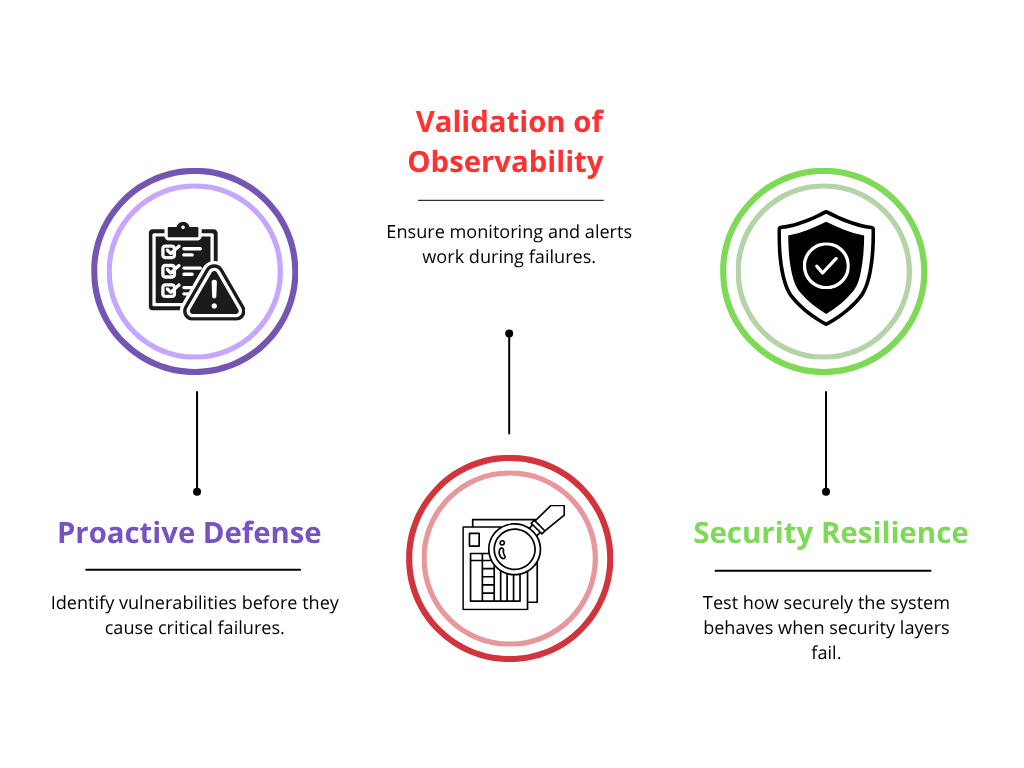
Proactive Defense
We find vulnerabilities during office hours, not during a 3:00 AM emergency call. This reduces the stress on the entire engineering team.
Validation of Observability
Chaos experiments test our monitoring and alerting systems. If we break something and the alarm doesn't go off, our monitoring is broken, too. This is a critical insight for any testing professional.
Security Resilience
By using security testing services alongside chaos, we can simulate what happens if a security layer fails. Does the system fail-securely, or does it leak data? This "Security Chaos Engineering" is a rapidly growing field.
Building a Failure-Resistant Culture
Implementing this practice requires a shift in mindset. We have to accept that failure is inevitable in distributed systems. Once we accept that, our job becomes making sure that failure doesn't matter to the end user.
Start Small: Don't start by breaking production. Start in a staging environment. Once you gain confidence and prove that your hypotheses are correct, move closer to the real environment.
Automate the Experiments: Just like regression testing, chaos should be part of the CI/CD pipeline. Continuous resilience is the goal.
Minimize the Blast Radius: Always have a "kill switch" to stop the experiment if the impact exceeds your threshold. The goal is to learn, not to actually cause an outage.
The Business Case for Chaos
The cost of downtime is staggering. According to market statistics, high-availability systems are no longer a luxury but a must-have for survival. Teams who do regular chaos experiments are 40% more likely to address production issues in under an hour. When you work with a company that provides specialist QA engineering services, you're not simply purchasing a test report; you're investing in a system that can resist the unpredictable nature of the modern internet.
For a modern software testing company, delivering chaos engineering as part of a package that includes performance testing, security testing, and other services is how you provide actual value. It exhibits a level of testing maturity that extends beyond the user interface to the application's core.
Final Thoughts
Chaos Engineering is about making the invisible visible. It forces us to look at the gaps between our services and the weaknesses in our infrastructure. For any tester looking to stay relevant, mastering these "turbulent" experiments is the next logical step in the evolution of quality.
By integrating chaos with existing load testing services and security testing services, we build systems that don't just work, they endure. We transition from hoping that nothing goes wrong to knowing that we are ready when it does. As the industry moves toward more complex, AI-driven architectures, the ability to orchestrate and learn from chaos will be the hallmark of a top-tier tester.

Join Kanika on Peerlist!
Join amazing folks like Kanika and thousands of other builders on Peerlist.
0
1
0