

Digital Twins for Software Testing: Improving Accuracy and System Reliability

The pressure to deliver software at high speeds has forced a shift in how quality assurance is approached. Traditional testing environments generally don't do a good job of reproducing the chaotic, unpredictable character of systems that are in use. This gap causes "works on my machine" problems and defects that come up after a release, which hurts user trust.
Digital twins in QA are a smart answer because they make dynamic virtual copies of software systems, which let teams recreate real-world situations with great accuracy.
Understanding the Architecture of a Digital Twin
A digital twin is more than a static simulation; it is a living data model that looks like a digital asset. This design in software engineering has three separate layers:
The Physical Entity: The actual software code, APIs, and underlying infrastructure.
The Virtual Entity: The twin itself, which exists as a data-driven model.
The Data Link: The bidirectional connection that ensures the twin stays updated.
This synchronization makes sure that the twin shows the system's current status, including its dependencies and performance problems. The design depends on constantly taking in new data. The virtual model becomes a very accurate copy of the real environment by taking data from production logs, user behavior patterns, and API response timings. This arrangement lets QA teams test things on the twin without putting the real app at risk of crashing.
Key Components of a Digital Twin
While the industry focuses on model outputs, AI-enhanced engineering is redefining innovation by shifting the focus toward the environment in which those models live. This is best realized through the deployment of Digital Twins. To function effectively within a professional software testing service provider framework, a digital twin must integrate several core technical components:
Real-time Data Stream: Being able to send live data to the twin is the most important part. This includes server logs, reaction times for APIs, and trends of how users interact with the site.
Predictive Modeling Engines: These use past data to predict how the system might behave in hypothetical scenarios, such as a sudden rise in traffic or a database failure.
Behavioral Synchronization: This part makes sure that the logic of the real program is mirrored in the virtual copy. When a new update is sent to production, the copy must quickly show the changes.
Feedback Loops: A digital twin needs to get information back to the people who made it. Based on models done in virtual space, these loops help make the code better.
Scalable Infrastructure: The twin needs a cloud-native backend that can grow or shrink depending on how complicated the simulation is in order to model big settings.
Without these components, the virtual replica cannot provide meaningful insights into system reliability. The quality of the test setting often limits how accurate tests can be. This problem can be solved by digital twins in QA, which create a copy that changes along with the product.
Why Digital Twins Matter in Software Testing
System reliability is significantly boosted when teams can predict failures before they happen. By running "what-if" scenarios on a digital twin, a software quality engineering team can identify exactly where a system might break under stress.
Precision: Testing against live-mirrored data sets instead of static databases.
Risk Mitigation: Identifying architectural weaknesses before a single line of code reaches production.
Cost Efficiency: Reducing the need for expensive, physical staging environments that are hard to maintain.
This proactive approach moves testing from a reactive bug-fixing exercise to a strategic process. It ensures the software remains stable as it scales to meet growing user demand.
Different Types of Digital Twins
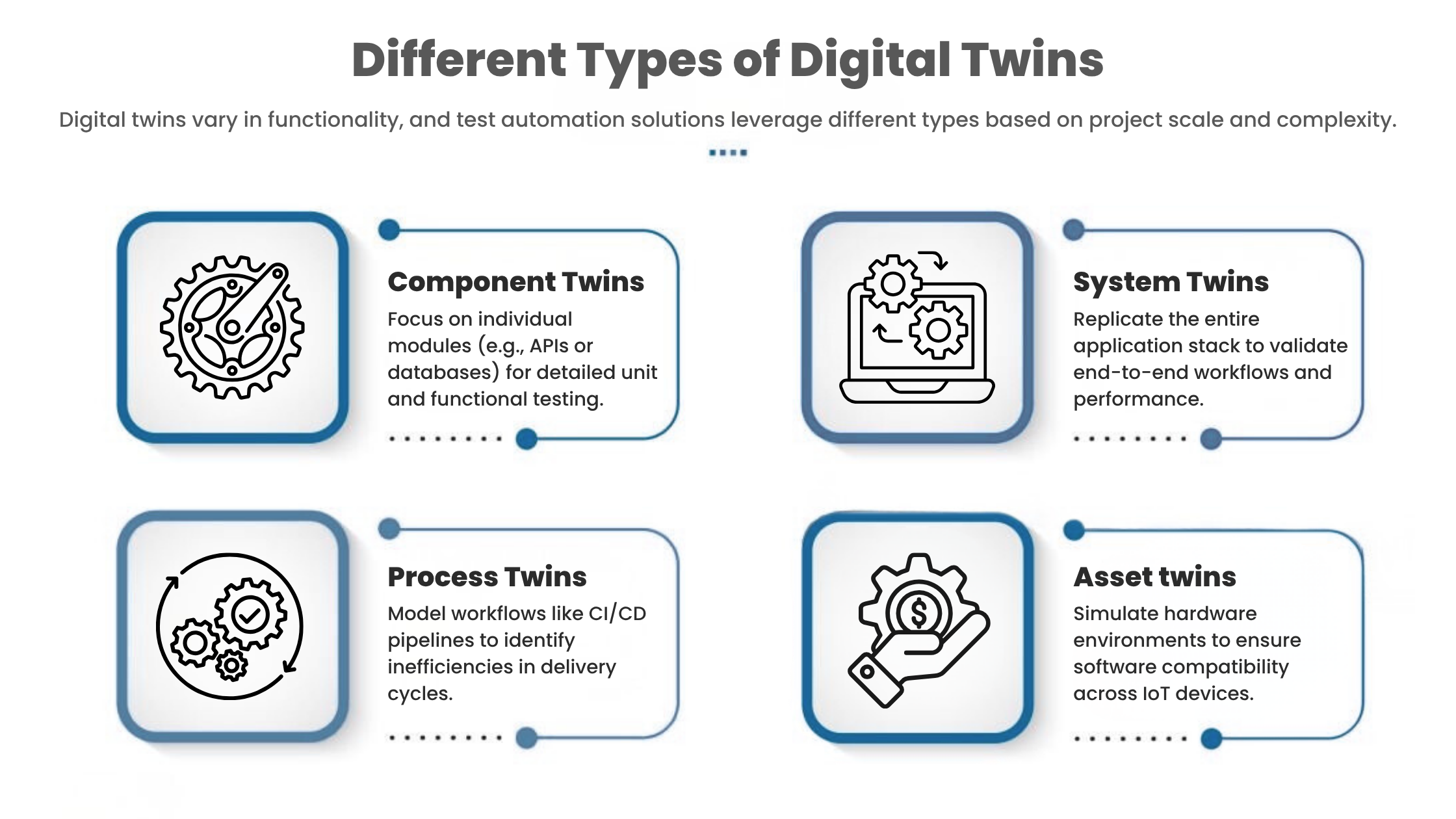
Not every digital twin does the same thing. A test automation solution could use one of the following, depending on the size of the project:
Component Twins: These look at only one portion of the application, such as a database module or an API. They are used for in-depth unit and functional testing.
System Twins: These copies include all the parts of the application stack. They are great for testing from start to finish and keeping an eye on performance since they illustrate how different modules work together.
Process Twins: These show how work gets done in a company. A process twin for a software testing service provider can look like the CI/CD pipeline to find delays in the delivery cycle.
Asset twins: These are the hardware that works with the software in sectors that use a lot of IoT. Testing the program on a virtual hardware copy makes sure it works with all versions of the device.
Implementation of Digital Twins in Software Testing
To start using digital twins in QA, you need a clear plan. The first step is to figure out what the twin will do. Trying to copy a full business system all at once might be too much to handle. It's best to start with a vital part that has had problems with performance in the past. Once the scope is set, the team has to:
Set up the data pipelines that will keep the twins in sync.
Choose the correct tools that can work with the twins' API.
Run scripts and keep track of the outcomes in the virtual world.
Use the twins' insights to improve the test cases.
The QA team uses the information that the twin starts to collect to improve the tests. This generates a feedback loop in which the twin helps make the tests better, and the tests help verify that the twin is correct. This integration eventually becomes a key part of how QA engineering services are delivered.
Bringing AI-Powered Testing into the Picture
Digital twins and artificial intelligence coming together will shape the future of quality assurance. A twin gives you the setting, and AI gives you the logic to go around it. AI algorithms may look at the huge volumes of data that digital twins in QA create and find patterns that a human tester would not see. When these two things work together, the system may test itself by finding its own weak areas and developing tests to check them.
This method eliminates the problems that come with manually maintaining scripts and static test settings. It lets you keep checking things in a way that keeps up with the speed of today's DevOps cycles. Businesses that use these models will find it easier to address the problems that arise during the installation of intricate software.
Companies may be able to reach a level of accuracy that was not possible before by shifting toward a model where digital twins in QA are the standard. This modification ensures that every release is based on extensive testing and data-driven insights. The tester's role moves from detecting defects to building systems that will be stable over time and give users the greatest experience possible.

Join Kanika on Peerlist!
Join amazing folks like Kanika and thousands of other builders on Peerlist.
0
0
0