

Playwright MCP vs CLI: Choosing the Right Architecture for Agentic Testing
Playwright MCP vs CLI
In the shifting landscape of automated quality assurance, the rise of agentic testing has introduced a pivotal architectural debate: Playwright MCP vs CLI. As organizations integrate Large Language Models (LLMs) to handle complex test scenarios, choosing how these agents interact with the browser impacts both the balance sheet and the reliability of test suites.
For a software testing company aiming to lead in AI-driven testing, understanding these two interfaces is not just about technical preference; it is about building a scalable foundation for software testing services.
Defining the Contenders: MCP and CLI
To grasp the distinction, we need to see how an AI agent perceives and operates in a web browser.
Playwright MCP (Model Context Protocol)
The Model Context Protocol (MCP) is a common bridge. It broadcasts the browser state, including the accessibility tree, DOM structure and console logs, straight into the LLM's context window. It gives you a high-detail feed of everything that happens on the screen. This gives the AI a thorough grasp of the layout of the page and the interactions between elements, which is useful for exploratory testing when the agent needs to reason about the UI.
Playwright CLI
The Playwright CLI is called "Precision." Instead of stuffing the full page structural information into the AI’s memory, it utilizes the browser as a remote terminal. It stores page snapshots as compact YAML files on the local disk and offers the agent basic file locations and references to elements. The agent reads the details only when needed. This keeps the “conversation” between the AI and the browser lean and on point.
Context vs. Commands: A Real-World Execution Example
Consider a standard e-commerce checkout flow: searching for a product, adding it to a cart, and verifying the total.
The CLI Approach (Command-Based)
The agent issues direct shell commands. It opens the URL, takes a snapshot, and receives a list of element IDs.
Action: The agent identifies the search bar as e1.
Command: playwright-cli fill e1 "gaming laptop."
Result: The action is performed, and the agent moves to the next step. Because the state lives on the disk, the memory usage remains low.
The MCP Approach (Context-Driven)
The agent receives the full accessibility tree of the page for every turn.
Interaction: The agent parses the massive payload of the entire page to find the search bar.
Result: Each step adds thousands of tokens to the context window. After many steps, the agent might lose track of the original testing goal because the window is saturated with DOM data.
Business Benefits and Efficiency Benchmarks
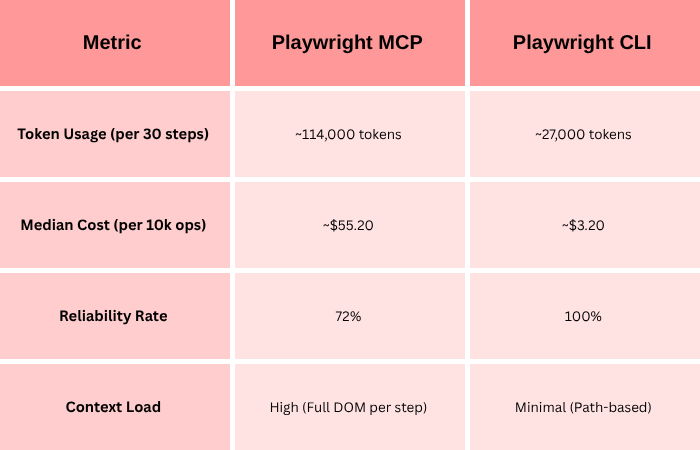
Adopting the right architecture directly correlates with the ROI of test automation services. Recent 2026 benchmarks reveal significant performance gaps that business leaders should keep in mind:
Drastic Cost Efficiency
The financial implications are clear. CLI-based execution offers a 4x to 17x reduction in token usage. For an enterprise running thousands of daily test sessions, this eliminates massive overhead in API costs for AI testing services. High token consumption in MCP often leads to rate limiting or context window exhaustion, which stalls productivity.
Operational Scalability
CLI agents maintain stability over long sessions. Since they are not bogged down by "context bloat," they can execute 50+ steps without performance degradation. This makes them ideal for large regression suites that cover deep user journeys.
Faster Feedback Loops
CLI commands are direct shell executions. While MCP requires the LLM to reason over a large payload for every click, CLI interactions are nearly instantaneous. In a DevOps environment, faster execution means quicker deployments and a more agile development lifecycle.
Addressing Challenges with Strategic Solutions
While CLI offers superior efficiency, certain environments require specific strategies to overcome limitations.
Challenge: Sandboxed Environments
Some AI agents operate in restricted environments without filesystem access, making CLI unusable because it cannot save or read local snapshots.
Solution: Use Playwright MCP for these specific exploratory tasks. It allows the agent to function purely via API calls without needing local disk permissions.
Challenge: Complex UI Logic
If a page is highly dynamic and unpredictable (like a real-time data dashboard), an agent might struggle with a "minimal" command approach.
Solution: Implement a Hybrid Strategy. Use CLI for stable, repetitive flows (Login, Search) and switch to MCP for short, exploratory bursts where seeing the full accessibility tree is vital for decision-making.
Challenge: Maintenance of AI Locators
AI-generated selectors can sometimes be fragile when the UI changes.
Solution: Leverage the self-healing capabilities of MCP-based agents. They can analyze DOM changes in real-time to update broken selectors, lowering the long-term maintenance costs for software testing services.
The Strategic Importance for QA Leaders
For those providing software testing services, the shift toward agentic testing is a fundamental change in how we ensure quality. The choice between MCP and CLI defines the architecture of your testing "brain."
Reliability
CLI provides a more deterministic path for agents, reducing the chances of hallucinations where the AI clicks the wrong element because it was overwhelmed by a large DOM.
Code Generation
CLI is better suited for generating actual test scripts. Since it records actions as discrete commands, it can translate those into code that human testers can review and maintain.
Choosing the Right Path
The decision for your engineering team depends on the environment and the scale of the project:
Choose Playwright CLI if
You use coding agents with terminal access, you prioritize cost-per-test, or you run large-scale regression suites in CI/CD pipelines. Read our guide on the Playwright Test Automation Framework to learn more about how to set up and optimize this environment.
Choose Playwright MCP if
Your agent is in a restricted sandbox, you perform short exploratory sessions, or you need the agent to perform deep reasoning about a complex page structure. Check out our analysis of Software Testing with AI Agents and MCP for a deeper look at this architecture.
The Strategic Takeaway
If you are looking for test automation services that prioritize rapid scaling and cost control, Playwright CLI is the clear winner. Its ability to offload browser state to the disk ensures that your AI agents remain focused, affordable, and capable of handling long, complex user journeys without losing focus to context bloat.
On the other hand, Playwright MCP is still a good option for AI testing services that specialize in deep investigation, early test discovery, and self-healing logic. It delivers a level of semantic comprehension that is crucial when your program undergoes big UI overhauls.
Final Recommendation
For most enterprise-grade software testing services, a hybrid approach is the most effective:
In your everyday CI/CD workflows, regression suites, and high-volume automation, when token efficiency is critical, deploy the CLI.
For exploratory sessions, debugging flaky tests, and creating the first test plans that the CLI will eventually execute, use MCP.
With the help of these technologies, combined with their architectural capabilities, you'll move beyond basic automation into a sustainable, intelligent testing environment that keeps pace with current software delivery.

Join Kanika on Peerlist!
Join amazing folks like Kanika and thousands of other builders on Peerlist.
0
4
0