

The Rise of Self-Healing Test Automation Frameworks
Self-Healing Test Automation Frameworks

Software development teams encounter a chronic problem: brittle testing. You spend hours building scripts, only to see them break the moment a developer changes a button's ID or a CSS class. This cycle of "create, fail, fix" wastes resources. In reality, industry research reveals that roughly 73% of test automation programs fail to produce the desired return on investment, sometimes crushed beneath the weight of maintenance.
The solution rests on a move toward intelligence. Self-healing test automation has emerged as a stabilizing factor in quality assurance. It claims to alleviate the maintenance overhead that affects typical Selenium or Appium scripts. By leveraging powerful algorithms and machine learning, these frameworks can detect changes in the application interface and adjust without human interaction. This paper discusses the mechanics, advantages, and tools driving this transition, letting you decide if this technology suits your QA approach.
Understanding Self-Healing Test Automation
At its heart, self-healing test automation refers to the capacity of a testing framework to automatically repair itself when a test fails due to UI changes. Traditional scripts rely on static locators—specific locations or IDs that tell the automation tool where to click or enter text. If those IDs change, the script fails.
Self-healing tools function differently. They do not rely on a single locator. Instead, they collect many properties of an element throughout the recording step. This comprises the element's ID, class, text, location relative to other components, and tag name. This data generates a unique "fingerprint" or object model.
During execution, if the primary locator fails, the system checks the Document Object Model (DOM). It uses AI-driven test automation to compare current page components against the stored fingerprint. The technique provides a likelihood score to possible applicants. If an element matches with a high enough confidence level (say, 95%), the test interacts with that element and saves the new location for future runs. This whole thing unfolds in a flash, practically unnoticed by anyone, ensuring the pipeline stays healthy.
Why Traditional Test Automation Falls Short
Scripts for static automation are inflexible. They require that the application being tested stay unchanged. However, contemporary approaches to software development, such as Agile and DevOps, promote regular upgrades. React, Angular, and Vue.js are examples of dynamic front-end frameworks that frequently provide dynamic element IDs that vary with each build.
If the ID changes to #submit-btn-456, a conventional script searching for #submit-btn-123 would fail. Next, the QA engineer must open the code, locate the updated ID, update the script, and run the suite again. The time spent on this "maintenance nightmare" is precious. According to Forrester, 60% of QA executives cite maintenance as their top bottleneck.
Teams frequently discover they spend more time repairing existing tests than developing new ones. This flips automation's value proposition. Automation slows down releases rather than increasing them. Test suites are neglected, and manual testing becomes more common when automation testing services that rely solely on these fragile techniques are unable to keep up with rapid release cycles.
Key Benefits of Self-Healing Test Automation
The QA process can be improved in quantifiable ways by implementing a self-healing approach.
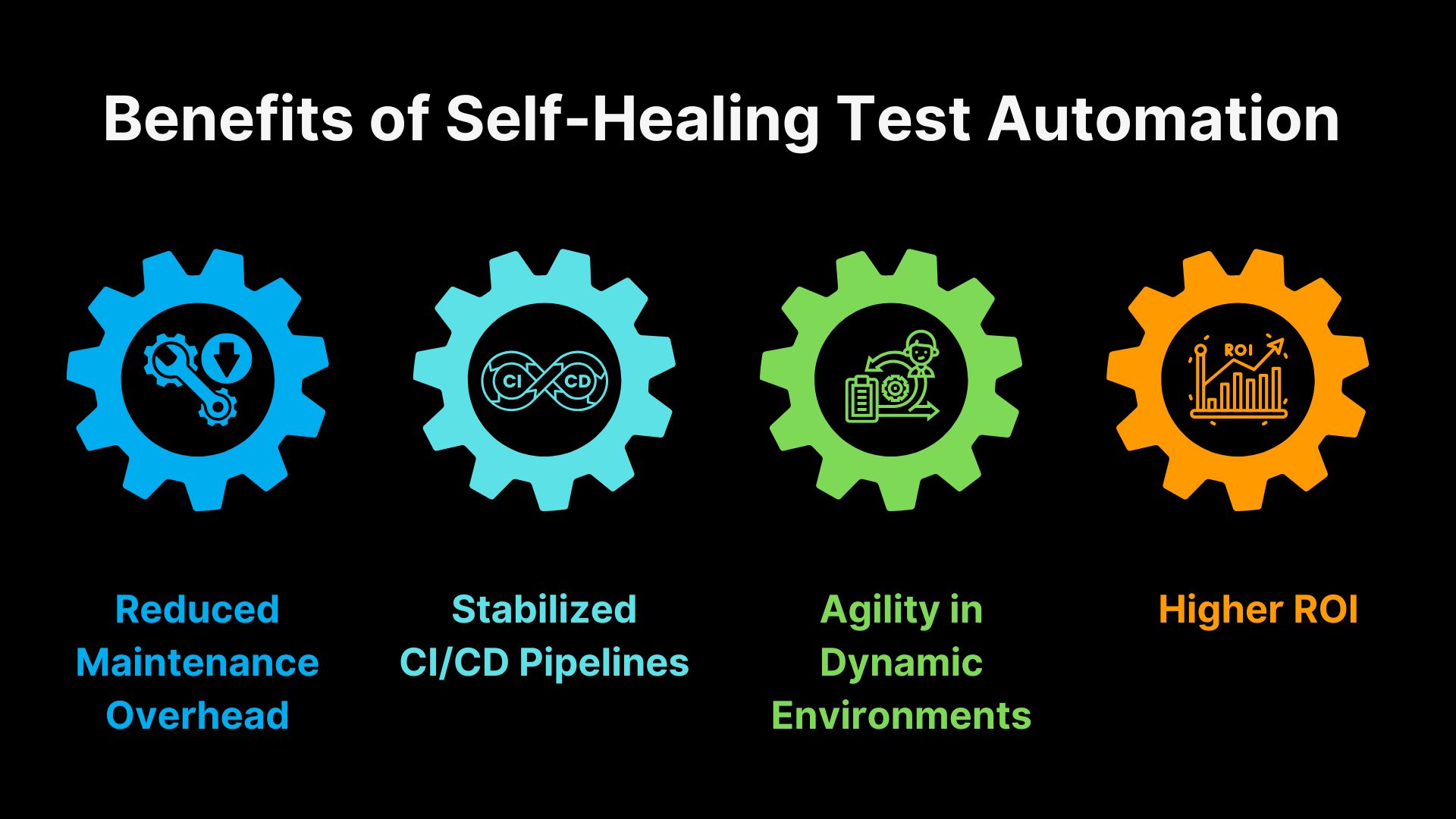
Reduced Maintenance Overhead: The most direct impact is the reduction in script maintenance. According to Capgemini's World Quality Report, self-healing can save maintenance work by as much as 70%. Testers may concentrate on more complicated cases since scripts automatically adjust to small UI changes.
Stabilized CI/CD Pipelines: Continuous Integration suffers from flaky testing. Developers become frustrated when deployment is blocked due to a build problem brought on by a renamed button. These false negatives are avoided by self-healing systems. Instead of a stop error, the team receives a report indicating that a location was modified when the build is successful.
Agility in Dynamic Environments: New applications are created every day. QA teams can stay in sync with developers thanks to self-healing technologies. The test suite changes along with the user interface. For teams that use continuous delivery, this alignment is essential.
Higher ROI: AI solutions may have a greater setup cost at first, but they save a substantial amount of man-hours over time. Without waking up to hundreds of failures brought on by a single CSS update, teams may perform thousands of tests every night.
Popular Tools and Frameworks Supporting Self-Healing
When selecting the right stack, it is helpful to review the best automation testing tools available in the market to see which ones offer native self-healing capabilities versus those that require plugins.
AccelQ
This platform offers a codeless approach. It uses a "Universe" concept to map interactions and element dependencies. AccelQ’s self-healing engine analyzes the application structure to find elements even when attributes shift, making it a strong choice for complex enterprise apps.
TestRigor
Known for its plain English command structure, TestRigor focuses on user perspective rather than code implementation. It identifies elements by how they appear to a human (e.g., "click 'Cart'"). If the underlying code changes but the visual label remains, the test passes.
BrowserStack
Famous for its device cloud, BrowserStack now integrates low-code automation with self-healing agents. These agents intercept "Element Not Found" exceptions and resolve them in real-time using alternative selectors.
DogQ
A newer player focusing on simplicity for non-technical users. It employs visual analysis to track element changes, ensuring that tests remain robust even without deep coding knowledge.
Solutions from EPAM
Large consultancies like EPAM often build custom self-healing wrappers or integrate open-source libraries (like Healenium for Selenium) into their automation testing services to provide these capabilities to clients.
Internal teams looking to upgrade their stack can also explore various automation testing services that specialize in implementing these modern tools.
Challenges and Considerations
Self-healing is powerful, but it is not a magic wand. Teams must acknowledge certain limitations.
False Positives: There is a risk that the AI might select the wrong element. If a "Delete" button disappears and the AI clicks a "Cancel" button because it looks similar, the test might pass technically but fail functionally. You must review the "healed" logs regularly to verify accuracy.
Execution Speed: The analysis process takes time. While typically fast, analyzing the entire DOM to find a replacement element adds latency compared to a direct ID hit. For suites with thousands of tests, this can add up.
Cost: Commercial tools with advanced AI capabilities often come with licensing fees that exceed free open-source libraries like vanilla Selenium.
Over-Reliance: Teams might become lazy with best practices. Relying on the tool to fix poor locator strategies is a bad habit. You should still aim for stable attributes (like data-testid) whenever possible.
Future of Self-Healing Test Automation
The trajectory of AI testing services points toward even greater autonomy. We are moving past simple locator healing. The next generation of tools will likely feature "Self-Generating" capabilities.
Generative AI will analyze user stories or manual test cases and write the automation scripts from scratch. If a flow changes entirely, the AI won't just heal the locator; it might rewrite the logic of the test step. Natural Language Processing (NLP) will allow testers to write intent-based instructions, leaving the execution details entirely to the AI engine.
We will also see better integration with visual testing. Tools will combine DOM data with pixel-matching technology to understand not just where an element is, but how it looks, catching visual regressions that functional scripts might miss.
Conclusion
The era of fragile test scripts is ending. Self-healing test automation provides a necessary layer of resilience for modern software teams. By reducing maintenance costs and keeping CI/CD pipelines green, these tools allow QA engineers to focus on finding bugs rather than fixing scripts.
Whether you build a custom solution using open-source libraries or adopt a commercial platform like AccelQ or TestRigor, the move toward AI-driven test automation is a strategic imperative. Agile teams cannot afford to be slowed down by broken selectors.
To stay competitive, evaluate your current testing maturity. If maintenance consumes more than 20% of your testing time, investigating self-healing solutions is a smart move. For teams seeking expert guidance in this transition, BugRaptors provides comprehensive automation testing services and AI testing services to help you build a robust, future-proof quality strategy.

Join Kanika on Peerlist!
Join amazing folks like Kanika and thousands of other builders on Peerlist.
0
4
0