

Test Pyramid 2.0 in Practice: Leveraging AI to Optimize QA Strategy
The traditional testing hierarchy, which has a wide base of unit tests, a middle layer of service tests, and a small peak of UI tests, was a useful guide for delivering old applications. As distributed systems and microservices grow more common, this model's static nature causes problems.
Test Pyramid 2.0 is a technological improvement that changes from predefined execution pathways to a dynamic five-layer validation environment. Engineering teams go from detecting bugs reactively to a predictive quality model that works with fast CI/CD cycles by adding AI in QA and using DevSecOps concepts.
The Evolution: Why Traditional Pyramids Are Crumbling
For over a decade, the classic pyramid emphasized a rigid volume-based approach. However, several technical shifts have rendered the original model insufficient for modern engineering:
Microservices Complexity: Traditional pyramids assume a monolithic structure. In distributed systems, the "middle" layer is where most failures occur, yet the original model keeps this layer thin.
The "Maintenance Tax": Manual script maintenance in traditional frameworks often exceeds the time spent on new feature development. Brittle UI selectors lead to constant test failure regardless of actual code quality.
Velocity Gaps: Standard automation cannot keep pace with generative AI-driven development. As code production accelerates, manual test authoring becomes the primary deployment blocker.
Security Silos: Legacy models treat security as a post-deployment phase. This lack of integration leads to late-stage discovery of vulnerabilities, increasing remediation costs exponentially.
Understanding Test Pyramid 2.0: A Granular Technical Shift
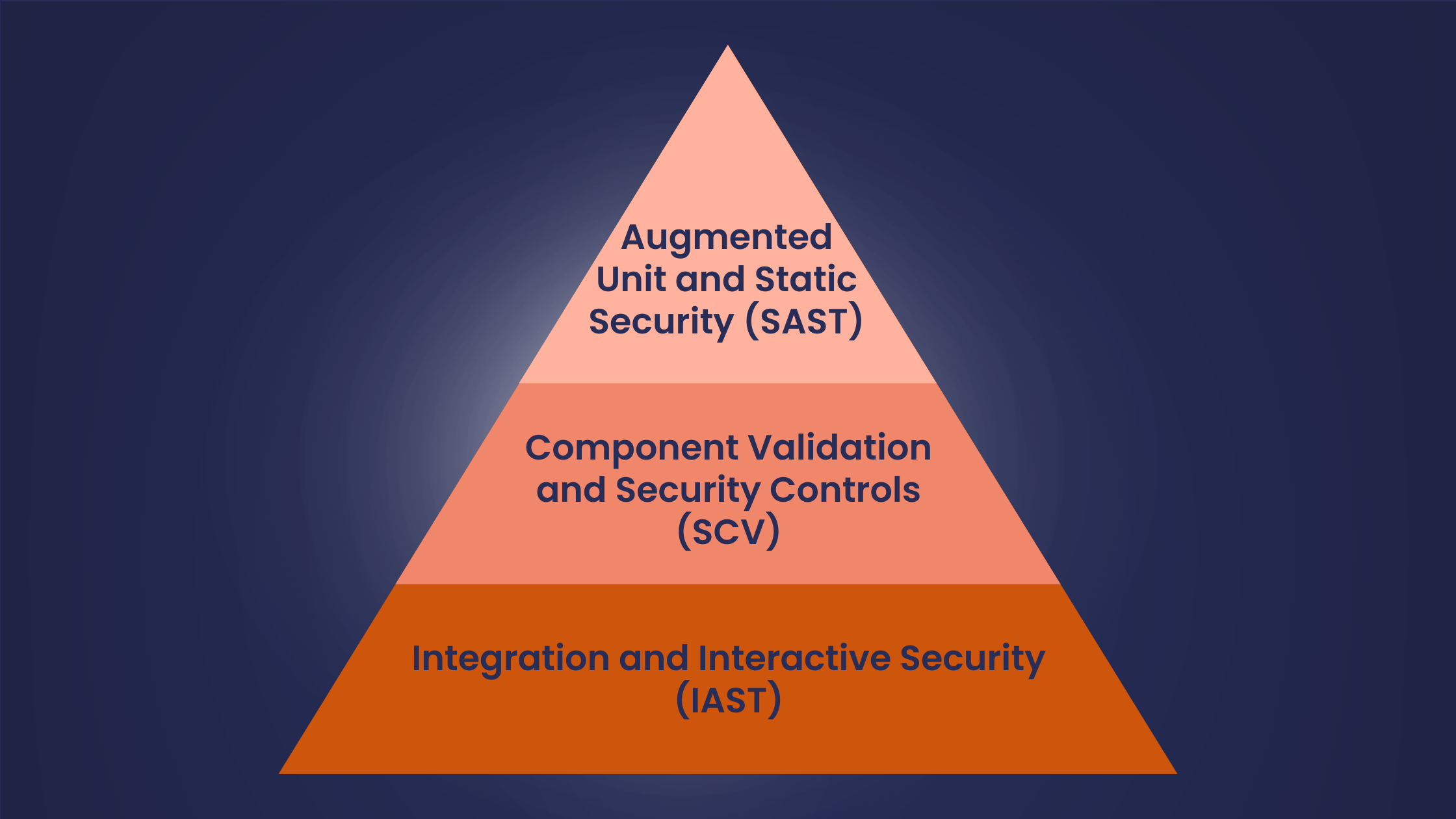
The 2.0 framework departs from the three-tier model by expanding into five granular layers. This structure treats the pyramid as an elastic ecosystem where security and quality are verified simultaneously at every stage.
Layer 1: Augmented Unit and Static Security (SAST)
At the base, AI-enhanced software engineering tools analyze code syntax to automate unit test generation. Research indicates that LLM-based frameworks such as ChatUniTest can achieve significantly higher code coverage than traditional evolutionary algorithms.
In this layer, Static Application Security Testing (SAST) is integrated to scan source code for injection risks and hard-coded secrets. AI reduces the signal-to-noise ratio here by adjudicating static analysis alerts and providing context-aware rationales for vulnerability detection.
Layer 2: Component Validation and Security Controls (SCV)
The second layer focuses on individual modules and their internal logic. Test Pyramid 2.0 utilizes AI for test case prioritization and agentic orchestration to balance test loads.
This layer adds Security Controls Validation (SCV), which checks that enforcement points, such as rules for data management and access control, work as they should. Using Policy-as-Code (PaC) at this level makes sure that security measures are strong before they get to the integration stage.
Layer 3: Integration and Interactive Security (IAST)
The intermediate layer is in charge of how services talk to each other. AI finds old or broken integration tests by keeping an eye on service registrations and upgrading them when they need to be.
Here is Interactive Application Security Testing (IAST), which uses both static and dynamic analysis to find security holes in operating applications. This establishes a feedback loop where the test automation solution watches the application in real time to find problems that would be overlooked if they were looked at alone.
Leveraging AI to Optimize Your QA Strategy
A successful strategy focuses on reducing the feedback loop between code commit and deployment. Integrating AI in QA into the testing lifecycle targets specific technical inefficiencies.
Predictive Test Selection (PTS)
In high-velocity environments, running a full regression suite for every minor pull request is inefficient. AI-driven systems use impact analysis to map code changes to specific test cases. By calculating the probability of failure from historical commit data, the Test Pyramid 2.0 engine selects a subset of tests that maximizes coverage of the modified code. This minimizes resource consumption while maintaining high confidence for the release.
Automated Flakiness Detection and Resolution
Test flakiness, in which tests fail inconsistently without code changes, undermines the pyramid's reliability. AI models analyze execution logs to differentiate between infrastructure issues and genuine application defects. By isolating flaky tests for asynchronous review, the system ensures that the primary build pipeline remains stable, preventing alarm fatigue among developers.
Generative Test Data Synthesis
Testing complex business logic requires diverse datasets. Manually managing these is a significant overhead for any software testing service provider. AI leverages generative models to create valid, anonymized test data on demand. These pipelines ensure that integration tests in the middle layer of the pyramid are executed against fresh, relevant data, reducing the risk of false positives due to data exhaustion.
Autonomous UI Exploration and Self-Healing
Traditional automation scripts break when UI elements undergo minor attribute changes. AI-enhanced QA engineering services incorporate self-healing mechanisms that use computer vision to identify components by their visual context. Furthermore, autonomous agents explore the UI to find unmapped paths or edge cases that manual scripts might overlook, turning the "top" of the pyramid into a robust discovery layer.
Technical Excellence in QA Engineering Services
To move to a 2.0 model, QA engineering services need to be delivered differently. Engineers stop maintaining scripts by hand and instead focus on constructing the infrastructure that AI needs to make decisions.
Model Training and Tuning: Engineers choose the training sets that AI uses to find security patterns and parts of applications.
Observability Integration: Connecting test findings with production data to improve risk-scoring algorithms.
Risk-Based Prioritization: Keeping a list of applications to help set security levels depending on how likely and serious a failure is.
Conclusion: Future-Proofing Quality
Test Pyramid 2.0 is the technological answer to how complicated current software is. Using AI in QA helps teams get rid of the significant expenses of maintaining traditional automation and instead focus on strategic coverage.
For businesses that want to grow, it's important to choose a software testing service provider that knows how to deal with these technical changes. The focus is still on constructing a pyramid that is both quick and smart as the industry goes toward autonomous testing.
Using these sophisticated methods makes sure that your quality plan meets the technical standards needed for current engineering.

Join Kanika on Peerlist!
Join amazing folks like Kanika and thousands of other builders on Peerlist.
0
0
0