

🚀 Serving the Same Content to Humans 👨💻, Search Engines 🌐, and AI Crawlers🤖 — the Right Way
A practical approach to rendering web content differently for users, Google, and AI—without breaking SEO rules
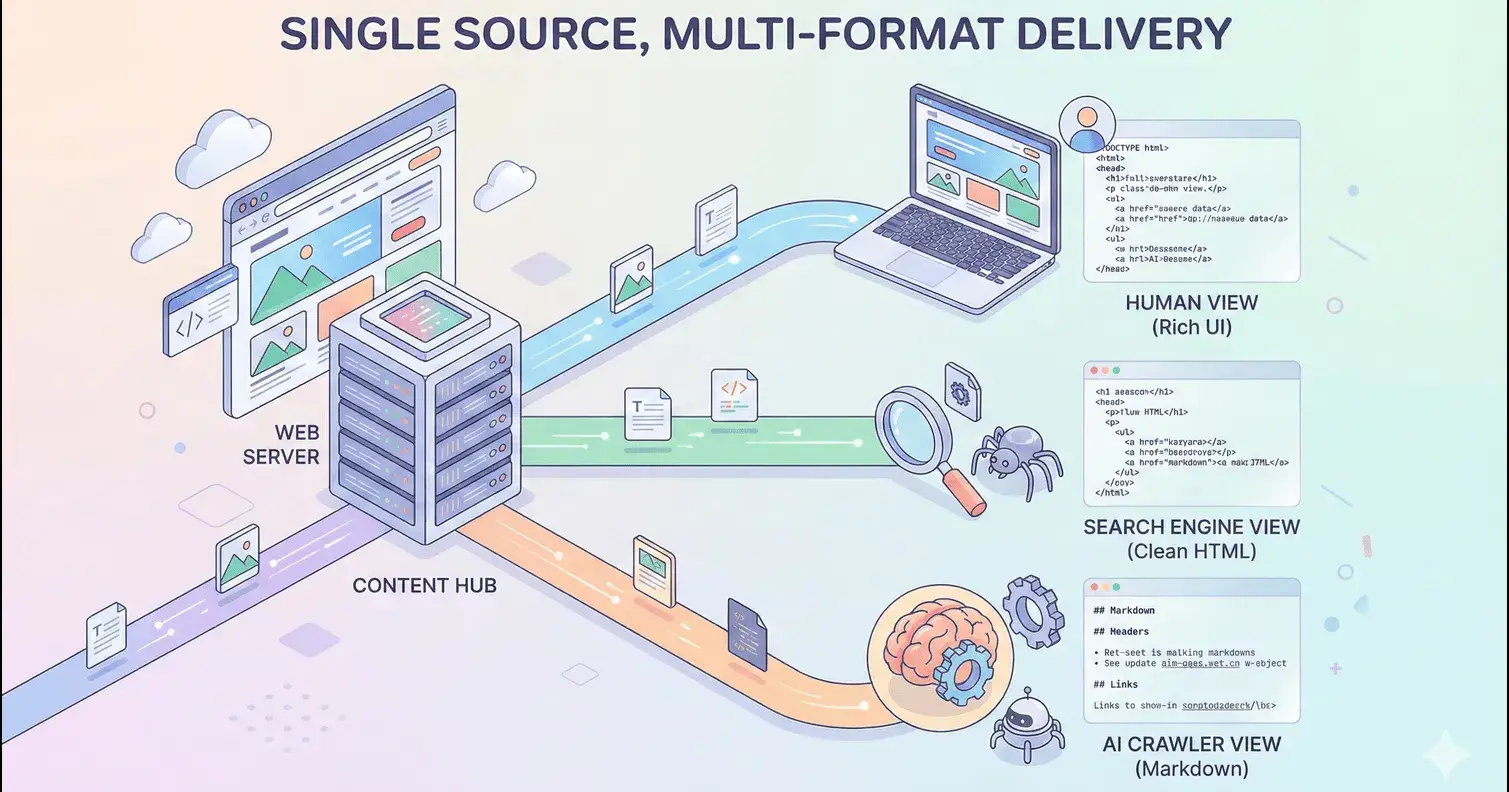
When we build websites, we usually think about human users first—design, images, interactions, and layout.
But today, the web is read by more than just humans.
Search engines crawl our pages to index and rank them.
AI crawlers read our content to understand, summarize, and reuse it.
The problem is that humans, search engines, and AI crawlers do not read the web the same way.
Serving the exact same UI-heavy page to all of them often leads to poor SEO and weak machine understanding.

The Problem with a Single UI-Heavy Page
A typical web page contains:
Images
Buttons
Layout containers
JavaScript-driven interactions
This works great for humans, but machines care about content clarity, not UI.
What goes wrong?
Search engines must parse unnecessary UI elements before reaching the core text.
Important information may be hidden behind JavaScript interactions.
AI crawlers struggle to extract clean, structured information.
Exam articles, tutorials, or Q&A content become harder to interpret.
In short:
👉 The content exists, but machines don’t read it efficiently.
The Core Idea: Same Content, Different Presentation
The solution is not to create different content—but to present the same content differently.
Humans → Rich UI (images, buttons, interactions)
Search Engines → Clean, fast, text-focused HTML
AI Crawlers → Structured Markdown
As long as the meaning and data remain the same, this approach is SEO-safe and future-proof.
A Simple, Practical Example
Let’s take a very simple example:A math question page.
project/ .
├── index.html
├── style.css
├── script.js
└── content.md
index.html (Human View + Bot View)
<!DOCTYPE html>
<html lang="en">
<head>
 <meta charset="UTF-8">
 <title>Math Question</title>
 <link rel="stylesheet" href="style.css">
</head>
<body>

<!-- Human-friendly UI -->
<div id="user-view">
 <h1>Math Question</h1>
 <img src="math.png" alt="Math illustration">
 <p><strong>Question:</strong> What is 8 + 4?</p>
 <button onclick="showAnswer()">Show Answer</button>
 <p id="answer" class="hidden">Answer: 12</p>
</div>

<!-- Search-engine-friendly view -->
<div id="bot-view">
 <h1>Math Question</h1>
 <p>Question: What is 8 + 4?</p>
 <p>Answer: 12</p>
</div>

<script src="script.js"></script>
</body>
</html>
style.css
#bot-view {
 display: none;
}

.hidden {
 display: none;
}

img {
 width: 200px;
}
script.js
function showAnswer() {
 document.getElementById("answer").classList.remove("hidden");
}

const ua = navigator.userAgent.toLowerCase();

if (ua.includes("googlebot") || ua.includes("bingbot") || ua.includes("ai")) {
 document.getElementById("user-view").style.display = "none";
 document.getElementById("bot-view").style.display = "block";
}
Why this works
Humans see images and interaction.
Search engines immediately see question and answer.
No content mismatch — only presentation changes.
Markdown for AI Crawlers
AI systems prefer clean, structured text.
Instead of forcing them to parse HTML UI, we provide a dedicated Markdown version.
content.md
# Math Question

## Question
What is 8 + 4?

## Answer
12

## Explanation
Adding eight and four results in twelve.
AI crawlers can directly consume this file without noise.
Achievements
Faster and clearer crawling for search engines
Better content understanding by AI systems
Same data served in multiple formats
Improved SEO clarity without cloaking
Simple implementation using plain web technologies
Conclusion
The web is no longer read by humans alone.
Search engines and AI crawlers consume content differently, and designing only for UI is no longer enough.
By separating content from presentation, we can:
Keep users happy with rich interfaces
Help search engines index content faster
Make our content AI-readable and future-ready
This approach is simple, safe, and practical—and it fits perfectly into modern web development.

Join Kashyap on Peerlist!
Join amazing folks like Kashyap and thousands of other builders on Peerlist.
0
8
0