

What You Can Do in the First 30 Seconds to Hook a New User
(And Make Them Stay)
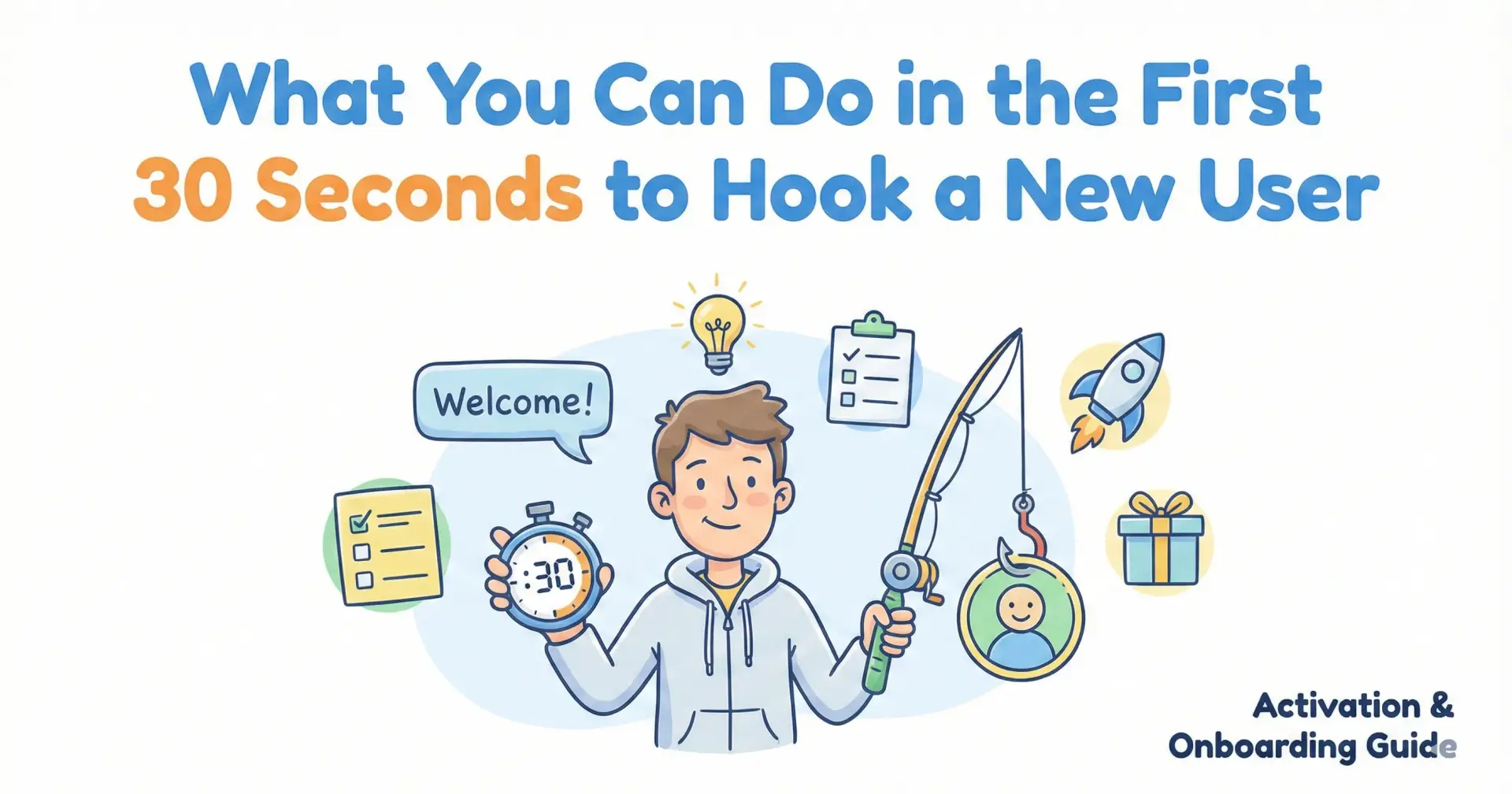
You Don’t Get a Second First Impression
A user opens your product for the very first time.
You have:
No trust yet
No emotional connection
No habit
No patience
And exactly 30 seconds before one of two things happens:
✅ They feel progress
❌ Or they disappear forever
Most founders obsess over:
Features
Pricing
Ads
Roadmaps
But very few obsess over what the user feels in the first 30 seconds.
And yet…
That first half-minute decides your activation rate, retention curve, virality, and lifetime value.
Why Most Users Never Come Back
Let’s be brutally honest.
Most products lose users not because they’re bad
but because they’re confusing, slow, or emotionally flat at the start.
Common founder mistakes:
Asking for too much information upfront
Explaining everything instead of showing value
Forcing users into tutorials
Making users “work” before they feel reward
The result?
❌ Low activation
❌ High bounce rate
❌ Churn in the first session
❌ Paid users who never become real users
Your onboarding isn’t just a setup step.
It’s your most important growth surface.
You Don’t Need a Better Product, You Need a Better First 30 Seconds
You don’t need:
More features
Better UI
Or a bigger marketing budget
You need one thing:
A designed moment of perceived success inside the first 30 seconds.
When users feel:
“This is fast”
“This is simple”
“This is useful”
“This already worked for me”
They stay.
The first 30 seconds is where trust is either created or lost forever.
The 5-Layer 30-Second Hook System
Every product that nails first impressions follows the same five invisible layers:
Instant Clarity – “What is this?”
Immediate Win – “I already did something valuable.”
Low Friction – “This feels effortless.”
Emotional Signal – “This feels good.”
Future Pull – “I want to come back.”
We’ll break each down in detail.
Layer 1: Instant Clarity (0–5 Seconds)
“What is this and why should I care?”
If your user needs to think in the first 5 seconds, you’ve already lost them.
Great Examples:
Stripe: “Payments infrastructure for the internet.”
Notion: “One workspace. Every team.”
Zoom: “Video conferencing that just works.”
No clever metaphors.
No buzzwords.
No guessing.
Founder Mistake:
Trying to look “smart” instead of being understood instantly.
Actionable Rules:
Your headline should explain your product to a 12-year-old
One sentence. One value. One outcome.
Layer 2: Immediate Win (5–15 Seconds)
“Let me succeed before you teach me.”
People don’t want onboarding.
They want progress.
Great Examples:
Duolingo: You complete a lesson in under 60 seconds.
Canva: You instantly edit a template without learning design.
Notion: You select a template and already have a working system.
The fastest way to hook a user is to help them win quickly.
Founder Mistake:
Making users configure, verify, connect, and learn before they ever feel success.
Actionable Rules:
Show output before asking for effort
Let users “touch the value” immediately
One task. One click. One result.
Layer 3: Low Friction (15–20 Seconds)
“This feels easy. I can do this.”
Friction destroys momentum faster than bad UI.
Great Examples:
Spotify: “Sign up with Google” → instantly plays music
Slack: “Create workspace” → inside chat in seconds
Figma: Click link → editing without an account
Every extra field you add before value is a conversion killer.
Founder Mistake:
Mandatory phone numbers
Long forms
Forced email verification
Complex setup
Actionable Rules:
Let users explore before they commit
Delay friction until the user is emotionally invested
Use progressive profiling instead of front-loading forms
Layer 4: Emotional Signal (20–25 Seconds)
“This feels good, not robotic.”
Humans don’t attach to products through logic alone.
They attach through:
Delight
Relief
Confidence
Hope
Identity
Great Examples:
Duolingo’s mascot celebrates your win.
Grammarly says, “Nice work!”
Headspace uses calm, human language.
Microcopy matters. Tone matters. Emotion matters.
Founder Mistake:
Designing only for functionality, not for feeling.
Actionable Rules:
Replace robotic confirmation messages
Add encouragement after small actions
Use warm, human microcopy
Layer 5: Future Pull (25–30 Seconds)
“I should come back to this.”
Great products don’t end the first session.
They open a loop.
Great Examples:
Duolingo: “Start a streak tomorrow”
Notion: “Your workspace will evolve as you add more”
Trello: “Your first board is ready, add your next task”
They don’t say goodbye.
They create expectation.
Founder Mistake:
Ending the first session with silence.
Actionable Rules:
Show what’s next
Tease future progress
Make the return obvious and rewarding
The Psychology Behind the First 30 Seconds
Your onboarding works because it activates three deep psychological triggers:
Competence: “I can do this.”
Progress: “I already moved forward.”
Identity: “This feels like me.”
If your product activates all three, retention becomes natural.
Examples,
Duolingo
Value in 60 seconds
Streaks create habit
Emotional feedback reinforces use
Canva
No tutorials
No barriers
Immediate creative result
Figma
No software install
Live collaboration from second one
Sharing equals distribution
Spotify
Zero onboarding friction
Immediate personalization
Emotional pull via music
These companies didn’t “onboard.”
They activated emotion + output + momentum instantly.
Common First-30-Second Killers
If your product has any of these, your growth is leaking:
❌ Forced tutorials
❌ Too many fields
❌ Empty dashboards
❌ No visible progress
❌ Boring copy
❌ No next step
Users don’t leave because your product is bad.
They leave because nothing meaningful happened quickly enough.
The Founder’s 30-Second Activation Playbook
Ask yourself these 10 brutal questions:
What happens in the first 3 clicks?
How fast does the user see output?
Can a user succeed without creating an account?
Do I show value or explain value first?
Is my first success visual?
Do I celebrate small wins?
Is my first screen emotionally neutral or positive?
Do I show what’s next before the user exits?
Can a user describe my product in 1 sentence after 30 seconds?
Would I stay if I saw this for the first time?
How to Fix Your First 30 Seconds (Step-by-Step)
Step 1: Record First-Time User Sessions
Use:
Hotjar
FullStory
Microsoft Clarity
Watch:
Where users hesitate
Where they drop
Where they smile
Step 2: Redesign for “Time-to-First-Win”
Compress:
Setup
Forms
Verification
Explanations
Step 3: Add Emotional Feedback
Encouraging microcopy
Visual progress
Friendly language
Step 4: Open a Loop
Tease benefits
Tease future payoff
Tease identity growth
Why the First 30 Seconds Is Your Real Marketing Channel
Here’s the truth most founders miss:
Your onboarding experience is your most powerful growth asset.
Better than:
Ads
Influencers
Campaigns
Content
Because:
It works 24/7
It compounds
It converts trust into habit
Fix your first 30 seconds and every traffic source becomes 2–3× more effective.
The First 30 Seconds Is Where Growth Is Born
You don’t win users with:
More copy
More ads
More features
You win them with:
Speed
Simplicity
Progress
Emotion
Momentum
If your first 30 seconds feel powerful,
your product becomes addictive in the healthiest way possible.
The fastest way to grow is not to shout louder
it’s to make your first impression unforgettable.
If you’re building a product and your users don’t “feel it” in the first 30 seconds, you’re leaving growth on the table.
That’s exactly why tools like MyCMO help founders:
Design better onboarding messages
Create activation-focused copy
And build momentum without ads
Go get it before you lose 100s of your valuable customer...

Join Kishor on Peerlist!
Join amazing folks like Kishor and thousands of other builders on Peerlist.
0
13
0