

How Freelance Developers Can Use AI Monitoring to Protect Their Reputation
You built the app. You deployed it. The client is happy. And then three days later you get a message that starts with: "Hey, is everything okay with the site?"

That's the moment every freelance developer dreads finding out something broke from your client instead of catching it yourself. It doesn't matter how good your code is. It doesn't matter how many hours you put in. In that moment, you look like you weren't paying attention.
The good news: this is entirely preventable. And it takes about two minutes to set up.
The Real Risk Freelancers Face in Production
When you work in-house, a broken app is a team problem. There's an ops person, a QA team, someone else whose job it is to catch fires.
When you're freelancing, you are the team. Every project you ship lives or dies on your reputation and silent failures are reputation killers.
Here's what makes them particularly brutal:
They're invisible until they're not. A checkout that returns a 500 error doesn't announce itself. An API that starts timing out at scale doesn't send you an email. A memory leak that only surfaces after 2,000 requests doesn't care that it's Friday evening.
Your clients notice before you do. Users complain to the client. The client texts you. You spend the next four hours apologizing and debugging simultaneously a terrible combination.
The damage compounds. It's not just the bug. It's the gap between when it broke and when you found out. A bug caught in 5 minutes is a non-event. The same bug discovered three days later is a trust conversation.

The Solution: Proactive AI Monitoring
Traditional monitoring tools were built for teams. Sentry, Datadog, New Relic they're powerful, but they assume you have time to stare at dashboards and parse stack traces. As a freelancer managing multiple client projects, you don't.
What you need is something that watches for you and not just alerts you when something breaks, but tells you why and how to fix it.
That's exactly what DeepTracer does.
When an error spikes or an anomaly is detected, DeepTracer's AI agent automatically:
Pulls related logs, traces, and recent deploy history
Correlates the signals to identify the root cause
Assesses impact ,how many users were affected, what's at risk
Surfaces a plain-English explanation with a concrete fix suggestion
The whole process takes 30 to 90 seconds. You get an alert that says something like:
"23 checkout failures in the last hour, all returning 500 on POST /api/checkout. Root cause: missing STRIPE_WEBHOOK_SECRET env var after your 2:41 PM deploy."
Not a stack trace. Not a log dump. An answer
Setting Up DeepTracer on a Client Project
The setup is intentionally minimal. Here's how to add it to a Next.js project:
Step 1: Install the SDK
bash
npm i @deeptracer/nextjsStep 2: Wrap your Next.js config
typescript
// next.config.ts
import { withDeepTracer } from '@deeptracer/nextjs'

export default withDeepTracer({
 key: process.env.DEEPTRACER_KEY
})
Step 3: Add your key to environment variables
DEEPTRACER_KEY=your_key_hereThat's it. Your AI monitoring agent is live.
From this point, DeepTracer runs ambient health checks every 5 minutes, monitors error rates, tracks API performance, and has an investigation ready the moment something goes wrong all without you lifting a finger.
For non-Next.js projects, DeepTracer supports React, Node.js, Express, Bun, and any Vercel-deployed app via log drains. Python and Go SDKs are coming soon.
How to Present Monitoring as Added Value to Clients
Here's something most freelancers don't realize: production monitoring isn't just a tool for you. It's a selling point.
When you pitch or onboard a new client, you can say:
"Once we deploy, I'll have an AI monitoring agent watching the app 24/7. If anything breaks, I'll know about it — and have a root cause — before you do."
That sentence alone justifies a higher rate. It signals professionalism. It tells the client you're not just a coder who ships and disappears you're someone who owns the outcome.
A few ways to frame it:
During proposal: Include "production monitoring setup" as a line item in your scope of work
During handoff: Show the client the DeepTracer dashboard — it's a visual proof that you care about what happens after launch
For ongoing retainers: Monthly monitoring is a natural add-on service. You're already getting the alerts — charging for that coverage is completely reasonable

Clients who've never worked with a developer who monitors proactively will remember it. It's one of the simplest ways to stand out.
Pricing: Free Plan for Freelancers, Easy Upgrade When You Need It
DeepTracer's free plan is genuinely useful for freelancers:
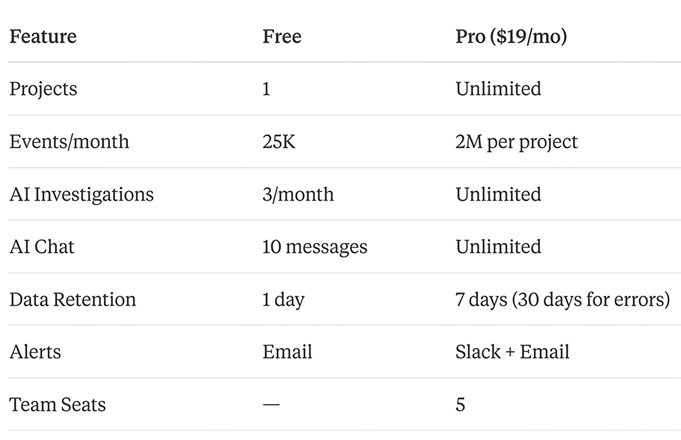
For a single active client project, the free plan covers you. For anyone managing two or more live projects or billing monitoring as a service Pro at $19/month pays for itself the first time it catches a silent failure before your client does.
One Last Thing
The developer who gets a panicked client message is not a bad developer. They're just an unmonitored one.
The tools exist. The setup takes two minutes. The free plan costs nothing.Your reputation is worth more than that.
Start monitoring for free → deeptracer.dev

Join Gautam on Peerlist!
Join amazing folks like Gautam and thousands of other builders on Peerlist.
1
14
3