

Motivation Is a Trap (And What Actually Works Instead)
There is a version of yourself that shows up when you feel motivated.
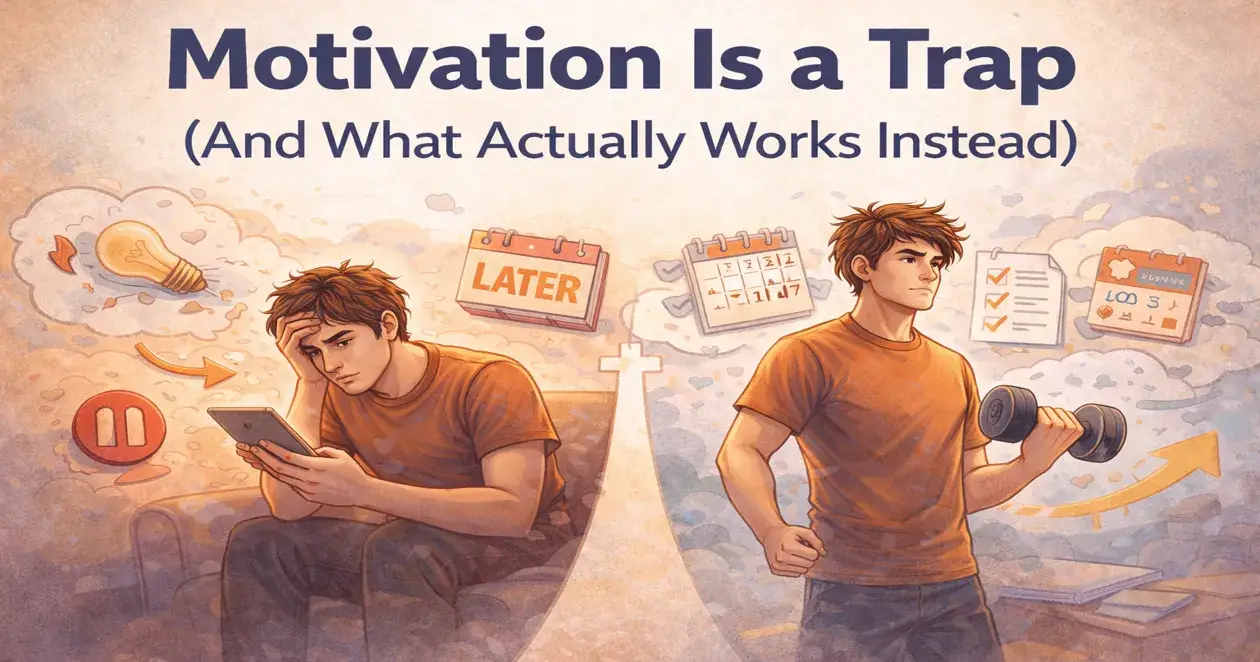
Motivation Is a Trap (And What Actually Works Instead)
There is a version of yourself that shows up when you feel motivated.
In that state, everything seems clear. You think about your goals and feel a strong pull toward them. You imagine the person you want to become, and for a moment, it feels not only possible — but close. You plan. You decide. You promise yourself that this time will be different.
And in that moment, you believe it.
You wake up early. You start the workout. You open the laptop. You take action with a kind of energy that feels almost effortless.
But then, slowly, something changes.
The next day is a little harder. The day after that, even more. The same actions that felt natural now feel heavy. You begin to negotiate with yourself. You delay. You skip once, telling yourself it doesn’t matter.
And before long, you’re back where you started.
This is the cycle most people live in.
Not because they lack ambition.
Not because they don’t care.
But because they are relying on something that was never meant to carry them.
The Problem With Motivation
Motivation feels like a solution.
But in reality, it behaves more like a trigger.
It appears suddenly, often after exposure to something inspiring. A video, a conversation, a moment of reflection. It gives you energy, direction, and a temporary sense of certainty.
But motivation is unstable by nature.
It is influenced by your mood, your sleep, your environment, your stress levels, even by things you are not consciously aware of. It rises and falls without asking for your permission, and most importantly — it does not stay.
Yet most people build their entire approach to growth around it.
They act when they feel motivated, and stop when they don’t.
From the outside, this looks like inconsistency.
From the inside, it feels like failure.
But the failure is not personal.
It is structural.
Why Motivation Keeps Letting You Down
The deeper issue is not that motivation disappears.
The issue is that it was never designed to be consistent.
Motivation is useful for starting something. It can push you out of inertia. It can help you take the first step.
But it cannot sustain repetition.
And repetition is where all real change happens.
When you rely on motivation to act, you create a fragile system — one that only works under specific emotional conditions. The moment those conditions change, the system breaks.
And since those conditions always change, the outcome becomes predictable.
Start → stop → restart → stop again.
Over time, this pattern erodes your trust in yourself.
Not because you are incapable — but because you are operating without a stable foundation.
The Hidden Cost of Waiting to Feel Ready
There is another layer to this trap that is less obvious.
When you rely on motivation, you begin to wait.
You wait until you feel ready.
You wait until you feel energized.
You wait until the moment feels right.
And while you are waiting, nothing happens.
Days pass. Opportunities pass. Potential remains unused.
You tell yourself that you will act when the feeling returns.
But what you are really doing is giving control of your life to a temporary emotional state.
And that state is unreliable.
What Actually Works Instead
If motivation is not the answer, then what is?
The answer is not more willpower.
It is structure.
A system that does not depend on how you feel, but on what you do.
A system that continues to function even when motivation is low, energy is limited, and resistance is high.
At the core of this system are three simple principles.
1. Reduce Action to Something Small and Clear
One of the reasons people rely on motivation is because their actions are too big.
When a task feels overwhelming, you need motivation to begin. Without it, the resistance is too strong.
But when the action is small and clearly defined, something changes.
Instead of:
“I need to work out for an hour”
It becomes:
“I will do one set”
Instead of:
“I need to build a business”
It becomes:
“I will complete one task”
Small actions remove the need for motivation.
They lower the barrier to entry.
And once you start, continuation becomes easier.
2. Replace Decisions With Rules
Motivation thrives in environments where you constantly decide whether to act.
“Should I do it today?”
“Do I feel like it?”
“Maybe later?”
Each decision creates friction.
Each decision opens the door to avoidance.
Rules remove that friction.
“I train every Monday, Wednesday, and Friday.”
“I work on this for 30 minutes every day.”
No negotiation. No debate.
You don’t ask how you feel.
You follow the rule.
Over time, this creates consistency — not because you feel like acting, but because you no longer rely on feeling.
3. Focus on Repetition, Not Intensity
Motivation pushes you toward intensity.
You want to do more. Go harder. Move faster.
But intensity is difficult to sustain.
Consistency, on the other hand, compounds.
Doing something small every day will always outperform doing something big occasionally.
Because repetition builds identity.
Every time you act, you reinforce who you are becoming.
Not in theory — in reality.
From Motivation to Identity
The goal is not to eliminate motivation.
It is to stop depending on it.
Motivation can still exist. It can still give you energy at times. But it becomes a bonus — not a requirement.
What replaces it is identity.
You are no longer someone who acts when you feel like it.
You are someone who acts because that is what you do.
The shift is subtle, but powerful.
Because identity does not fluctuate the way motivation does.
Final Thought
Motivation is not the enemy.
But it is a poor foundation.
If you build your progress on it, you will always be at the mercy of how you feel.
And feelings change.
What actually works is structure.
Small actions. Clear rules. Consistent repetition.
It may not feel as exciting.
But it works — even on the days when nothing else does.
And those are the days that matter most.

Join Lev on Peerlist!
Join amazing folks like Lev and thousands of other builders on Peerlist.
0
0
0