

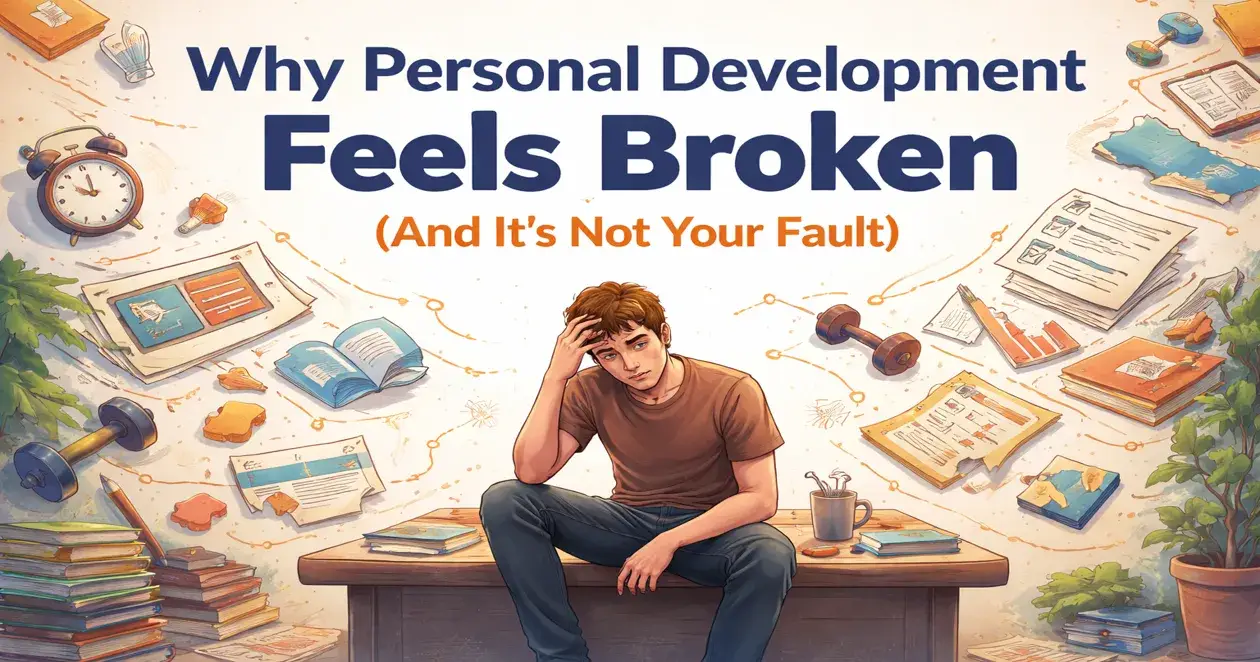
Why Personal Development Feels Broken (And It’s Not Your Fault)
There is a moment almost everyone experiences when they step into the world of personal development.
There is a moment almost everyone experiences when they step into the world of personal development.
At the beginning, everything feels exciting. You discover new ideas, new perspectives, new possibilities. You listen to a podcast that makes you feel like you can completely change your life. You read a book that seems to explain everything you’ve been missing. You watch a video that gives you clarity and direction.
For a short time, you feel different.
More focused. More capable. More in control.
And then, slowly, it fades.
The habits you wanted to build don’t stick. The routines you planned don’t last. The version of yourself you imagined starts to feel distant again. You find yourself back in the same patterns, wondering what went wrong.
And almost automatically, the conclusion forms:
“Maybe I’m the problem.”
But that conclusion is wrong.
Not emotionally wrong. Structurally wrong.
Because the issue isn’t your effort, your intelligence, or your potential.
The issue is that the system you’ve been using to grow was never designed to create real, lasting change.
The Illusion of Progress
One of the most deceptive aspects of personal development is how real it feels in the moment.
You consume something meaningful, and it creates an immediate emotional shift. You feel motivated. You feel aware. You feel like you understand something important.
That feeling is powerful — but it’s also misleading.
Because feeling like you’re progressing is not the same as actually progressing.
Understanding an idea does not mean you’ve developed the skill behind it. Listening to someone explain discipline does not make you disciplined. Agreeing with a concept does not mean you can apply it under pressure, consistently, over time.
What you experience in those moments is a kind of cognitive satisfaction — your brain recognizes a useful idea, and it rewards you with a sense of clarity.
But clarity without structure leads nowhere.
And that’s where the system begins to break.
A World Without Order
If you think about any environment where people reliably improve, one thing is always present: structure.
In school, subjects are divided into levels. In sports, training follows a progression. In games, characters develop through clearly defined skill trees.
You always know two things:
Where you are
What comes next
Now compare that to personal development.
There is no agreed path. No sequence. No clear progression.
You might work on confidence one day, productivity the next, communication after that, and mindset somewhere in between. You jump between topics depending on what content you encounter, what mood you’re in, or what problem feels most urgent at the moment.
It feels flexible. It feels free.
But in reality, it’s chaotic.
Because skills in life are not independent. They are interconnected. They build on each other.
Trying to develop advanced communication without basic self-awareness is like trying to run before learning how to stand properly. Working on discipline without understanding your beliefs and patterns is like building on unstable ground.
Without structure, effort becomes scattered.
And scattered effort rarely leads to meaningful progress.
The Motivation Trap
Another hidden flaw in the personal development world is its heavy reliance on motivation.
Most content is designed to make you feel something immediately — inspired, driven, energized.
And it works.
For a moment.
But motivation is not stable. It rises and falls based on your mood, your energy, your environment, your sleep, your stress levels. It is one of the least reliable forces you can build a system on.
Yet many people unknowingly do exactly that.
They act when they feel motivated, and stop when they don’t.
Over time, this creates a cycle:
motivation → action → fatigue → stop → repeat
From the outside, it looks like inconsistency.
From the inside, it feels like failure.
But again — the problem isn’t you.
It’s that you were taught to rely on a temporary state instead of a stable system.
Real progress doesn’t come from peaks of motivation. It comes from systems that continue to function even when motivation is low.
Knowledge Without Application
There is also a quieter problem, one that doesn’t feel like a problem at all.
You are learning.
Constantly.
You are exposed to more knowledge than any generation before you. You understand concepts your past self wouldn’t even recognize. You can explain ideas about mindset, habits, discipline, communication.
And yet, your daily behavior often doesn’t reflect that knowledge.
This creates a strange gap.
You know more — but you’re not necessarily becoming more.
Because knowledge, by itself, does not transform you.
Transformation comes from repetition. From doing the same action again and again until it becomes automatic. Until it becomes part of who you are.
But repetition is not exciting. It doesn’t feel like discovery. It doesn’t give you that same immediate reward that learning something new does.
So you keep consuming instead of practicing.
And the gap stays open.
Invisible Progress
There is one more piece that makes everything even harder.
In most areas of life, progress is invisible.
If you go to the gym for a week, your body doesn’t change dramatically. If you practice communication for a few days, your conversations don’t suddenly become effortless. If you work on discipline, there is no immediate signal telling you that you are improving.
Compare that to a game.
In a game, progress is always visible. You gain experience points. You level up. You unlock new abilities. You see exactly how far you’ve come and what you’ve earned.
That visibility creates engagement. It keeps you going.
In real life, you might actually be improving — but because you can’t clearly see it, it feels like nothing is happening.
And when it feels like nothing is happening, most people stop.
Not because they are lazy.
Because the feedback loop is broken.
The Real Reason It Feels Broken
When you combine all of these elements, the picture becomes clear.
You are trying to grow in an environment where:
Information is endless, but unorganized
Skills are important, but not structured
Motivation is emphasized, but unreliable
Knowledge is abundant, but rarely applied
Progress exists, but is invisible
Of course it feels broken.
It is broken.
Not because personal development doesn’t work.
But because the way it is delivered to most people makes consistent progress almost impossible.
What Actually Needs to Change
The solution is not to consume more.
Not to try harder.
Not to wait for the “right moment.”
The solution is to change the way growth itself is structured.
Real development begins when three things align:
First, there is a clear path.
Not endless options, but a sequence. Skills broken into smaller parts, arranged in a way that makes sense, where each step prepares you for the next.
Second, there is repetition.
Not occasional effort, but consistent action. Small, manageable practices done daily, until they become automatic.
Third, there is visible progress.
Not vague feelings, but clear indicators that show you you’re moving forward, even when the changes are small.
When these elements are present, something shifts.
Growth stops feeling random.
Consistency stops feeling forced.
And progress becomes something you can rely on, not something you hope for.
Final Thought
If you’ve ever felt like personal development isn’t working for you, it doesn’t mean you lack discipline, intelligence, or potential.
It means you’ve been trying to grow in a system that was never designed for real growth.
Once you move from scattered information to structured progression, from motivation to systems, from learning to practice…
everything changes.
Not instantly.
But predictably.
And for the first time, it feels like you’re not just trying to improve your life — you’re actually building it.

Join Lev on Peerlist!
Join amazing folks like Lev and thousands of other builders on Peerlist.
0
18
1