

Why You Start Strong and Quit (The Real Reason No One Talks About)
There is a pattern that repeats itself in almost every area of life.
Why You Start Strong and Quit (The Real Reason No One Talks About)
There is a pattern that repeats itself in almost every area of life.
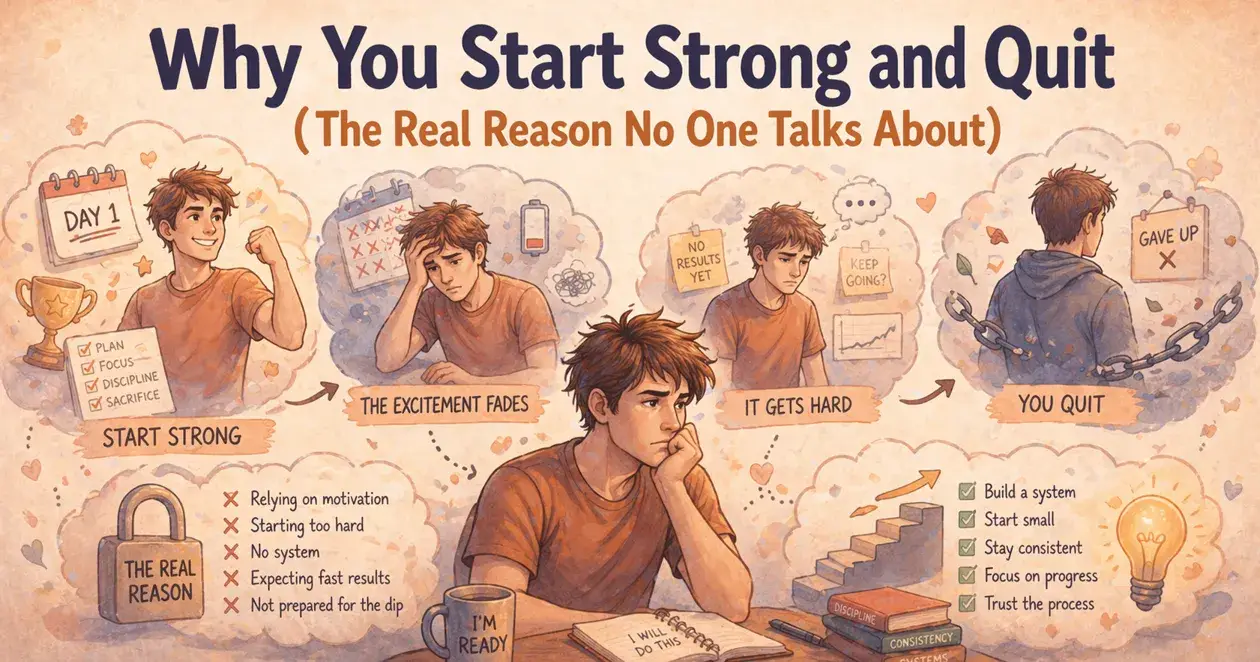
You start something new — a workout routine, a business idea, a habit, a plan — and in the beginning, everything feels aligned. You have energy, clarity, and a strong sense of direction. You commit. You act. You push forward with intensity.
For a short period of time, you become the person you’ve been trying to be.
And then, slowly, it begins to fade.
The consistency weakens. The effort becomes inconsistent. The structure disappears. What once felt natural starts to feel heavy. You skip a day, then another, and before long, the thing you started with so much conviction becomes something you no longer do at all.
At that point, most people reach for the same explanation:
“I lack discipline.”
But that explanation, while common, is not accurate.
Because if you truly lacked discipline, you wouldn’t have started strong in the first place.
The real reason is deeper — and more structural.
The Hidden Phase No One Prepares You For
Almost everything you start begins in a state of emotional momentum.
You are excited. You are clear. You feel committed.
This initial phase is powerful, but it is also temporary.
What most people don’t realize is that every process of growth includes a second phase — one that is far less appealing, and almost never talked about.
The phase where the excitement is gone, but the work remains.
The phase where nothing feels new anymore.
Where the results are not yet visible.
Where the actions feel repetitive and sometimes meaningless.
This is the point where most people stop.
Not because they are incapable.
Because they were never prepared for this phase to exist.
The Problem Isn’t Starting — It’s Transitioning
Starting is easy.
Starting happens when motivation, clarity, and emotion are aligned. It is driven by energy, not structure.
But continuing requires something else entirely.
It requires the ability to transition from emotional action to structured action.
From doing something because you feel like it…
to doing something because it is part of a system.
Most people never make that transition.
They stay dependent on the same force that helped them start — and when that force disappears, so does their consistency.
Why Intensity Works Against You
Another reason people quit is because they start too hard.
In the beginning, you want to prove something — to yourself or to others. You push beyond what is sustainable. You aim for intensity instead of stability.
And for a short time, it works.
But intensity creates pressure.
It demands energy. It demands focus. It demands emotional involvement.
And over time, that pressure becomes difficult to maintain.
So instead of building a system you can repeat, you build a version of effort that only works under perfect conditions.
When those conditions disappear, the system collapses.
The Emotional Drop
There is also a psychological shift that happens after the beginning.
At first, everything feels meaningful. Every action feels like progress. You are aware of what you are doing and why it matters.
But as repetition begins, that feeling fades.
The actions become normal.
And when something becomes normal, it stops feeling important — even if it is.
This creates a dangerous illusion:
Because it no longer feels meaningful, you assume it no longer is.
So you stop.
Not realizing that you were closest to real progress at the moment you walked away.
The Lack of Visible Progress
In the early stages, your perception of progress is driven by emotion.
You feel like you’re moving forward.
Later, when emotion fades, the only thing that can keep you going is visible progress.
But in most cases, progress is slow and not immediately noticeable.
This creates a gap.
You are working… but you can’t clearly see the result yet.
And without visible feedback, the mind begins to question the value of the effort.
“Is this even working?”
That question alone is enough to break consistency.
The Real Reason No One Talks About
The real reason people start strong and quit is not lack of discipline.
It’s that they build their effort on unstable foundations:
emotion instead of structure
intensity instead of sustainability
clarity without a system
action without repetition
When those foundations collapse, the behavior collapses with them.
And because this happens repeatedly, people begin to doubt themselves.
When in reality, they were never given a system that could survive beyond the beginning.
What Actually Changes the Outcome
The solution is not to try harder next time.
It is to start differently.
Instead of asking:
“How can I stay motivated?”
You ask:
“How can I make this sustainable when motivation disappears?”
This changes everything.
You begin smaller.
You remove unnecessary intensity.
You define clear, repeatable actions.
You focus on consistency over performance.
And most importantly, you expect the difficult phase.
You don’t interpret it as failure.
You recognize it as part of the process.
From Excitement to Stability
Real progress begins the moment you stop chasing the feeling of the start.
And start building something that works without it.
Something that continues even when it feels ordinary.
Something that does not rely on emotional highs.
Something that you can repeat on your worst days, not just your best ones.
Because the truth is simple:
Anyone can start strong.
Very few know how to continue when nothing feels strong anymore.
And that is where real change happens.
Final Thought
If you keep starting and stopping, it doesn’t mean something is wrong with you.
It means you’ve been building on something that cannot last.
Once you shift from intensity to consistency, from emotion to structure, from starting to sustaining…
the pattern breaks.
And for the first time, you don’t just begin.
You continue.
And that is what actually changes your life.

Join Lev on Peerlist!
Join amazing folks like Lev and thousands of other builders on Peerlist.
2
6
0