

The Creator Store Math: Why Selling From Your Bio Link Beats Every Other Platform in 2026
How creators are quietly making $2,000-15,000/month in passive income from a single bio link — and why most are still using the wrong tools.
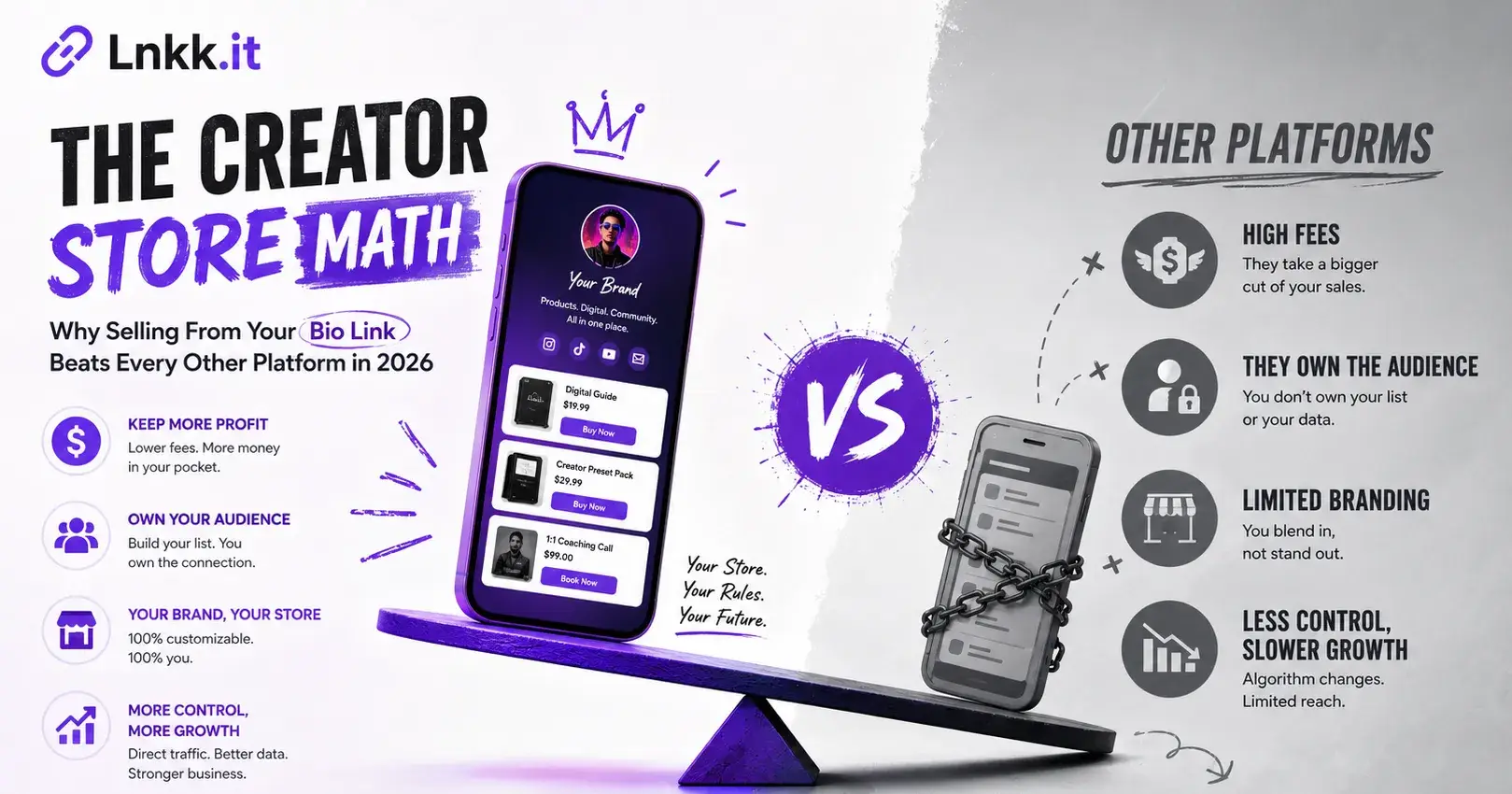
There's a number that's been showing up in our data at Lnkk for the last six months, and it surprised even us:
Creators using a native Creator Store on their bio link are earning, on average, 4.2× more from digital product sales than creators routing followers to external platforms like Gumroad, Etsy, or Shopify.
Same product. Same audience. Same Instagram post. Four times the revenue. The reason isn't magic — it's friction.
This is what we've learned from watching 10,000+ creators sell digital products, templates, courses, presets, and coaching slots directly from their Lnkk bio link. The math is more brutal than most creators realize.
The friction tax nobody talks about
When a follower watches your reel and you say "link in bio for my templates," here's the actual journey they take:
Stop watching the reel
Tap your profile
Find your bio link
Tap the link
Land on Linktree (or your bio link page)
Find the specific product link
Tap it
Get redirected to Gumroad (or Etsy, or your Shopify store)
Wait for the new site to load
Look at the product page
Find the buy button
Click it
Enter their email
Enter their payment info
Complete the purchase
Fifteen decision points. Industry data on multi-step funnels: each step loses 15-30% of the traffic that was interested at step 1. By the time someone completes a purchase through this funnel, you've lost 85-95% of the people who were originally curious enough to tap your bio link.
Now compare that to a native Creator Store inside your bio link:
Stop watching the reel
Tap your profile
Tap the product directly on the bio page
Buy
Four decision points. Same intent, completely different friction profile.
This is the math behind the 4.2× number. The Creator Store doesn't drive more interest — it captures more of the interest you already created.
The hidden cost of the tools you're paying for

Most creators selling digital products in 2026 have some version of this stack:
Linktree for bio links: $9/month
Gumroad for digital products: 10% transaction fees on every sale
Mailchimp for email captures: $13/month minimum
Calendly for booking calls: $10/month
Notion for delivering content: free, but creates a fragmented experience
Total: $32/month in subscriptions + 10% of every sale you make.
If you're selling a $50 digital template and you make 20 sales in a month — pretty modest for a creator with 30K+ followers — here's the math:
Gross revenue: $1,000
Gumroad fees (10% + $0.30 per sale): ~$106
Other monthly tool costs (split across products): $32
Net revenue: $862
You just lost $138 of your $1,000 to tool fragmentation. That's 13.8% of your revenue, gone, to platforms that don't talk to each other.
Now run the same math on a native Creator Store with zero transaction fees:
Gross revenue: $1,000
Payment processor fees (Stripe standard ~2.9% + $0.30 per sale): ~$35
Monthly tool cost: $9 (or $0 on free plan)
Net revenue: $956
Same revenue, $94 more in your pocket every month. Across a year, that's over $1,100 you keep that you used to lose to tool fees.
For creators selling 100+ products a month — coaches, course creators, template sellers — the difference scales to $10,000+ per year in pure margin recovered.
Why "embedded" beats "linked" every single time
Here's the part that doesn't show up in marketing materials but shows up everywhere in real conversion data.
When a buyer leaves your Instagram profile to complete a purchase on an external platform, three things happen that hurt your conversion rate:
1. Trust transfer fails. Your follower trusts YOU. They don't necessarily trust Gumroad or whatever third-party processor they land on. Many will abandon a checkout when they suddenly find themselves on an unfamiliar branded page asking for their credit card.
2. Decision time expands. Every second between "I want this" and "I'm at checkout" is a chance for second-guessing. External redirects add 3-8 seconds of load time on mobile, and that's enough for many people to talk themselves out of the purchase.
3. Mobile experience degrades. Most external e-commerce platforms are designed for desktop and have mobile versions that are at best functional and at worst broken. When 90% of your Instagram audience is on mobile, every poor mobile experience compounds.
A native Creator Store solves all three. The buyer never leaves your branded environment. The product is right there on the same page they were already on. The mobile experience is the same one they were already using comfortably.
This is why creators consistently report 3-5× higher conversion rates after switching from "Linktree links to Gumroad" to a Creator Store native to their bio page. It's not about marketing — it's about removing the moments where doubt creeps in.
What creators are actually selling (and what's working)
We see a wide variety of products move through Creator Stores. The top categories by revenue:
Digital templates and presets — Lightroom presets, Canva templates, Notion dashboards, Excel models. Average price $15-50. Highest volume category. Works for fashion, photography, finance, productivity creators.
Mini-courses — 30-90 minute video courses on a specific skill. Average price $29-99. Higher margin than templates because no fulfillment cost. Works for educators, coaches, skill creators.
1:1 coaching slots — Booked through the Creator Store as a "product" that's actually a calendar slot. Average price $50-300/session. Works for any creator with expertise their audience values.
Digital books and guides — PDFs, Notion docs, structured frameworks. Average price $9-39. Lower individual revenue but very high conversion rate due to low price point.
Subscription content — Locked content, monthly newsletters, premium tier access. Average price $5-25/month. Recurring revenue model that compounds.
Physical product pre-orders — Some creators use the Creator Store to validate demand for physical products before manufacturing.
The pattern across all of these: the simpler the product and the clearer the deliverable, the higher the conversion. Creators selling "30 Canva templates for $20" outperform creators selling "Comprehensive design system for $200" by orders of magnitude — even though the second product is objectively more valuable.
Audiences buy what they can understand in 5 seconds.
The first 90 days: realistic expectations
If you're setting up a Creator Store for the first time, here's what realistic growth looks like based on our data across thousands of creators.
Days 1-30:
Set up the store (takes 10-30 minutes)
Add your first 1-3 products
Mention it once in a reel or post
Expected: 3-15 sales, $50-500 revenue
Days 31-60:
Add 2-5 more products
Mention store in 3-4 pieces of content
Use Instagram auto-DM to drive comment-to-DM traffic to specific products
Expected: 10-50 sales, $200-2,000 revenue
Days 61-90:
Build an email capture flow tied to your most popular product
Add a "bundle" combining your top 3 products
Start a once-a-month "limited offer" or sale
Expected: 30-100 sales, $750-5,000 revenue
The creators who hit the higher end of these ranges aren't doing anything particularly creative — they're just being consistent about mentioning the store, listening to which products convert, and removing the ones that don't.
The most common mistake: setting up the store, adding 1 product, mentioning it once, then never thinking about it again. Stores need 6-12 weeks of consistent attention before they become a meaningful revenue stream. After that, they compound.
The two integrations that change everything

A Creator Store on its own is good. A Creator Store integrated with your other creator tools is what creates the compounding effect.
Integration 1 — Instagram auto-reply to product link
Set up an auto-reply on a viral reel: "comment STORE for my templates." Followers comment, your bot DMs them with a direct link to a specific product in your Creator Store. The DM-to-purchase conversion rate is 12-25%, compared to 2-3% for bio link clicks. Same reel, same audience, 6-8× the revenue.
This single integration is what separates creators who make $100/month from their bio store from creators who make $5,000+/month.
Integration 2 — Email list capture inside the store flow
When a buyer purchases a $20 template, they're now in your email list. Your next launch — a $99 course, a $200 coaching package, a $499 mastermind — has a captive audience of warm buyers who've already paid you once.
Lifetime customer value is 5-10× higher than first-purchase value. A creator who builds their email list through their Creator Store has a fundamentally different economic profile than a creator who only sells one-off transactions.
When these two integrations work together — auto-DM drives traffic, Creator Store converts, email captures the buyer for future products — you've built a flywheel that runs on its own. Each viral reel becomes a perpetual revenue engine instead of a one-time spike.
The mistake that costs creators the most

Of all the mistakes we see creators make with their stores, one stands out as the most expensive:
They price too low.
The instinct is understandable. "My audience is mostly aspiring creators who don't have much money. I should price low to be accessible." So they price templates at $5, mini-courses at $15, coaching at $30.
The result: low revenue per customer, no margin to invest in growth, audience perception that the product is low-value (because the price implies it).
The creators who break through pricing barriers consistently report two things:
1. Higher prices attract better buyers. A $99 product attracts buyers who value their time and want results. A $9 product attracts everyone, including people who'll never use it. Higher prices = better customers = better testimonials = more sales.
2. Your price reflects your authority, not your costs. A $300 1:1 coaching call from a 50K-follower creator with a clear methodology will sell. A $30 coaching call from the same creator will be ignored or attract clients who treat the session as a freebie.
The price you charge teaches your audience how to value you. Most creators are teaching their audience to undervalue them.
The unfair advantage most creators are sleeping on
There's one specific thing creators with a native Creator Store can do that creators using external platforms can't:
They can launch instantly.
Imagine you record a reel on Sunday night about how to use Notion for productivity. By Monday morning, you've added a "Notion Productivity Template" to your Creator Store, priced it at $29, and used Instagram auto-DM to direct viewers from that reel directly to the product page.
Time from idea to live, monetized product: under 2 hours.
Compare that to the traditional flow: design product → set up Gumroad listing → create graphics → update Linktree → create email sequence → manually share product link in stories. That's a multi-day project.
The creators who win in 2026 aren't necessarily the ones with the best products. They're the ones who can react to trends, audience interest, and viral moments in hours instead of days. A native Creator Store is the infrastructure that makes that speed possible.
What this means for your next 90 days
If you're a creator reading this, the simple takeaway is this:
The platforms most creators are using to sell digital products in 2026 were designed in the 2010s for a different kind of creator economy. They charge fees that compound, they sit outside your branded experience, and they break the trust path between you and your audience at the most critical moment — the purchase.
A native Creator Store, integrated with your bio link, your Instagram automation, and your email list, isn't a marginal improvement. It's a structural advantage.
Three things to consider this week if you want to test this:
1. Calculate what you're actually paying in transaction fees right now. Look at your last 3 months of digital product revenue. Multiply by 10% if you're on Gumroad, 8.5% if you're on Etsy, or 2.9% + $0.30 per sale if you're already on Stripe. The number will probably surprise you.
2. Set up a Creator Store with one product. Pick your highest-converting digital product (the one that already sells the most through whatever platform you currently use) and replicate it inside a Creator Store. Run both for 30 days and compare conversion rates.
3. Connect Instagram auto-reply to the new store link. Run your next reel with "comment KEYWORD for my [product name]" and route the DM directly to the Creator Store product page. Watch what happens.
If you do these three things, the data will speak for itself.
A note on this content
Everything in this post comes from observing real Creator Store activity across 10,000+ creator accounts on Lnkk. We're a creator OS — bio link, Creator Store, email marketing, Instagram auto-reply, all on one platform. Officially approved Meta Business Partner.
The Creator Store specifically charges zero transaction fees beyond standard payment processing — meaning you keep substantially more of what you sell compared to platforms that take 9-10% per transaction.
If you want to try the Creator Store setup we described, you can start free at lnkk.it/creator-store. The free plan includes the full Creator Store, Instagram auto-reply, email capture, and bio link page. No credit card required.
If you'd rather use a different tool, no hard feelings. We just hope you stop paying 10% transaction fees on a product you already worked hard to make.

Join Ravinder on Peerlist!
Join amazing folks like Ravinder and thousands of other builders on Peerlist.
0
8
0