

Case Study Analysis:
Solving Slow Change Management in Medical Devices with Product Lifecycle Intelligence
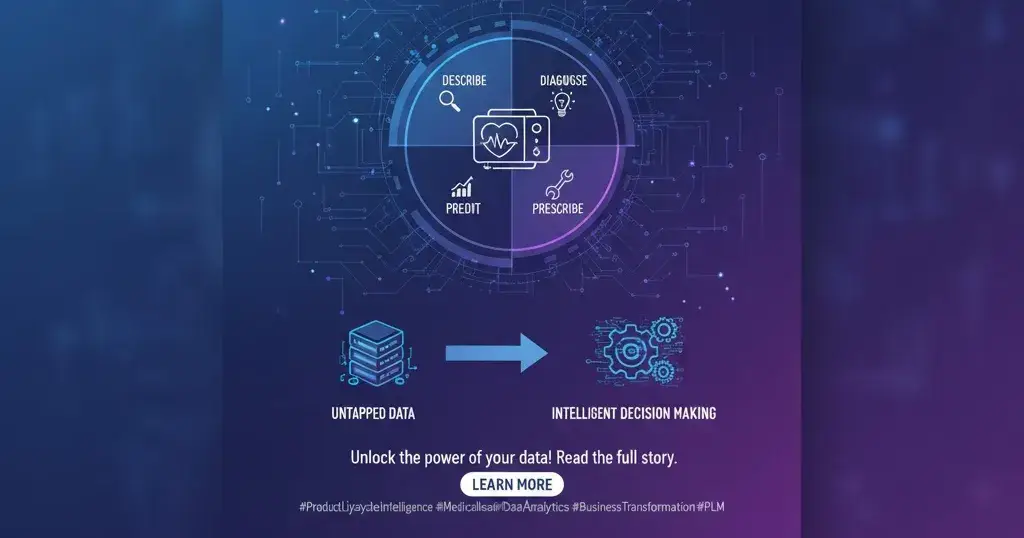
1. The Challenge: Untapped Data in Enterprise Systems
A fundamental paradox exists within many modern enterprises: they are data-rich but insight-poor. Sophisticated systems like Product Lifecycle Management (PLM) meticulously collect years of structured data, yet this asset often remains dormant. As one analysis notes, many organizations find that "you have years of high valued structured data but much of its value is untapped and inaccessible."
This gap between data accumulation and data activation represents a critical missed opportunity. To bridge this divide, a new category of technology has emerged, designed to unlock the intelligence hidden within these complex systems.
2. The Solution: Introducing Product Lifecycle Intelligence (PLI)
Product Lifecycle Intelligence (PLI) is a technology that brings advanced analytics and machine learning directly to a company's PLM system.
The core functionality of PLI is designed to analyze existing data through four distinct, escalating capabilities:
Function
Description
Describe
Provides current and historical insights based on the available data.
Diagnose
Identifies root causes and correlations within the data to explain why things are happening.
Predict
Uses machine learning models to forecast future outcomes.
Prescribe
Recommends specific improvements and actions to optimize future results.
Ultimately, the goal of PLI is to elevate a company's core systems. It transforms PLM from a simple "data management tool" into an "intelligent decision making system" that delivers value across the entire enterprise.
To illustrate how these four capabilities translate into tangible business outcomes, we will now analyze a case study from a leading medical device manufacturer.
3. In Focus: The Medical Device Manufacturer Case Study
This case study centers on a leading medical device manufacturer and its struggle with a common operational bottleneck.
3.1. The Problem: Long Cycle Times
In the highly regulated medical device sector, long change management cycles introduce significant business risk, delaying the implementation of critical product updates, impeding responses to regulatory feedback, and slowing the pace of market-ready innovation. The company's primary challenge was precisely this issue:
long change management cycle times
This operational inefficiency was a direct barrier to agility and continuous improvement.
3.2. The PLI-Powered Intervention
By applying PLI to the data within their existing enterprise systems, the manufacturer was able to take a systematic, data-driven approach to solving the problem. The PLI system performed three key actions:
Uncovered the root cause of long change management cycle times.
Predicted how long the change management process will take.
Prescribed process changes to speed up cycle times.
3.3. The "Aha!" Moment: The Source of Insight
The most critical lesson from this case study is where the insights originated. The analysis, predictions, and recommendations were generated by leveraging data that was "previously sitting unused." This proves that the solution was not found in collecting new data, but in intelligently activating the information the company already possessed.
This success, achieved by activating existing data, is not an isolated incident. It highlights the broader applicability of PLI in solving fundamental business challenges across an enterprise.
4. Broader Impact: The Value of Data-Driven Decisions
While this case study focused on change management, the principles of PLI can be applied across various industries to address a range of core business objectives. The technology can be used to solve for four key areas:
Quality and Compliance: Analyzing historical data to identify patterns that predict potential quality issues before they occur and to ensure robust adherence to industry regulations.
Speed: As demonstrated by the case study's focus on cycle times, PLI can optimize workflows to dramatically accelerate time-to-market for new products and process changes.
Cost: Identifying hidden inefficiencies in product data, predicting potential cost overruns in projects, and recommending changes to reduce operational expenses.
Growth: Uncovering opportunities for innovation, product line extensions, and market expansion by analyzing patterns in historical product and customer data.
5. Conclusion: Key Lessons from the Case Study
This analysis provides three primary takeaways for understanding the transformative power of modern enterprise analytics:
Activate, Don't Just Accumulate: The most valuable insights often reside in data you already possess. The strategic imperative is to shift focus from mere data collection to intelligent data activation.
Evolve from Record-Keeping to Recommendation: PLI exemplifies the evolution of enterprise systems from passive data repositories to active decision-making engines that can describe, diagnose, predict, and prescribe.
Intelligence Drives Tangible Outcomes: As the case study proves, applying analytics to core processes directly addresses critical operational bottlenecks, converting hidden data into measurable improvements in speed, efficiency, and agility.

Join Mohammad ASAAD on Peerlist!
Join amazing folks like Mohammad ASAAD and thousands of other builders on Peerlist.
1
5
0