

The Innovation Constraint:
How Artificial Scarcity Drives Breakthrough Performance
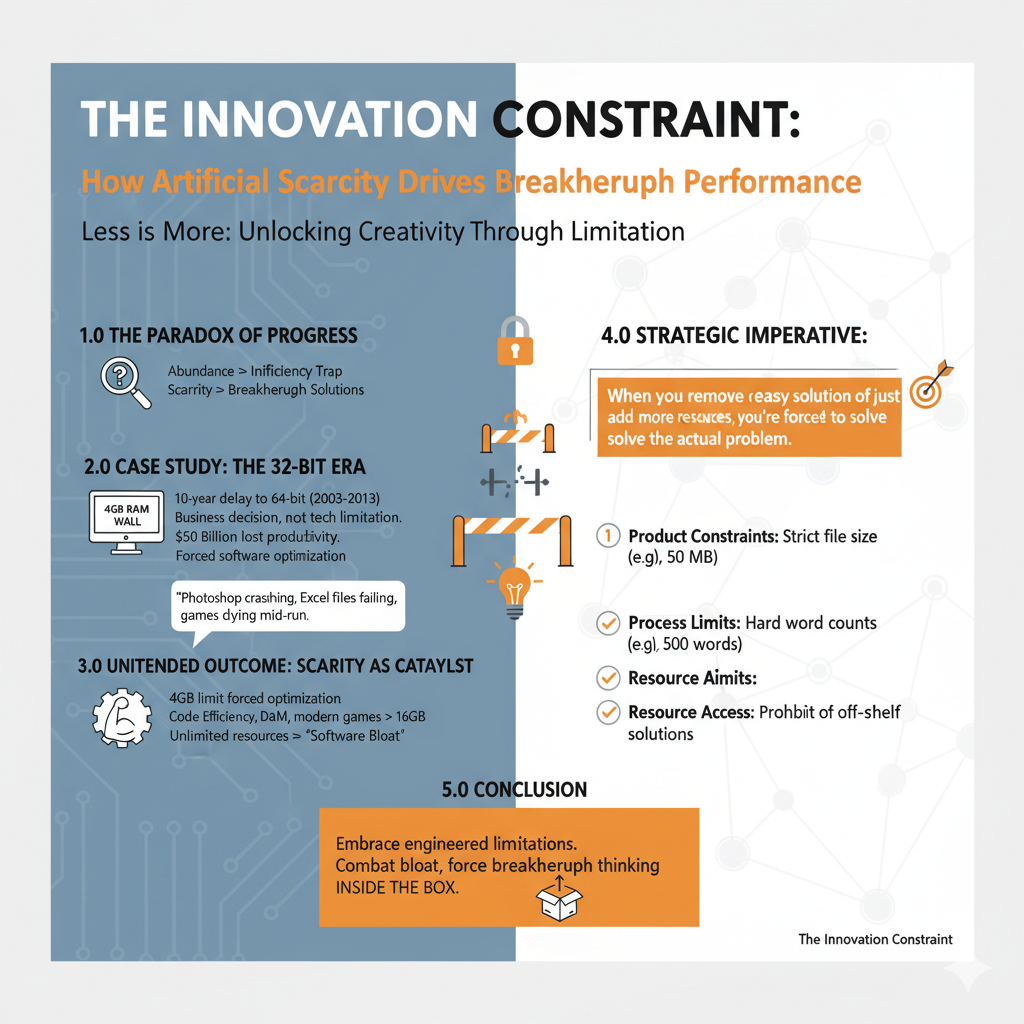
1.0 Introduction: The Paradox of Progress
In the pursuit of progress, the modern business mantra often equates more with better: more funding, more personnel, more resources. We operate under the default assumption that abundance is the primary fuel for innovation. This paper argues for a counterintuitive and far more potent truth: genuine, breakthrough innovation is often born from limitation, not from an abundance of resources. For leaders navigating complex and competitive landscapes, understanding this paradox is not merely an intellectual exercise; it is a strategic imperative.
This paper will prove that by strategically implementing 'artificial constraints,' businesses can escape the trap of inefficiency that often accompanies plentiful resources, fostering a culture of hyper-efficiency and unlocking novel solutions. To deconstruct this thesis, we will analyze one of the most significant, yet strategically undervalued, periods in modern computing history: the deliberately delayed transition from 32-bit to 64-bit architecture. This case study provides a compelling, large-scale demonstration of how a hard resource ceiling forced an entire industry to achieve a level of optimization that abundance later eroded. We will now explore the specific decisions that created this environment and the remarkable outcomes they unintentionally produced.
2.0 Case Study: The Artificially Prolonged 32-Bit Era
The nearly decade-long delay in the mainstream adoption of 64-bit computing serves as a perfect real-world experiment in the effects of resource constraints on a global scale. Though superior 64-bit technology was available as early as 2003, with companies like Intel possessing working chips and Microsoft releasing a 64-bit version of Windows XP in 2005, the industry actively suppressed its adoption. The artificiality of this constraint is proven by the market data: after its 2005 release, less than 1% of users adopted the 64-bit operating system.
This delay was not a technical oversight but a calculated business decision to prioritize short-term revenue protection and market stability over the immediate deployment of superior technology. Key industry players recognized that a widespread upgrade would involve immense costs associated with retraining staff, rewriting entire software ecosystems, and devaluing their existing 32-bit product inventories. The commercial impact of this decision was significant, costing businesses an estimated sum of over $50 billion in lost productivity from the direct consequences of insufficient memory.
"Photoshop crashing, Excel files failing, games dying mid-run."
The central constraint of this era was the infamous 4-gigabyte RAM "wall"—the maximum amount of memory a 32-bit system could address. While this limitation was a daily source of frustration for users and a tangible cost for businesses, it also created an unintended forcing function for software developers. The critical insight from this period is understanding how forcing an entire generation of developers to hit that wall accelerated software optimization in ways unlimited resources never could have.
3.0 The Unintended Outcome: Scarcity as a Catalyst for Excellence
Understanding the developer response to the 32-bit constraint is strategically vital, as it reveals the core mechanism by which scarcity drives innovation. Faced with the hard 4GB RAM ceiling, developers could not resort to the easy solution of simply using more memory to solve performance challenges. The 4GB wall was more than a technical hurdle; it was a psychological forcing function that eliminated the option of brute-force solutions, compelling a shift in mindset from resource acquisition to resource optimization. Developers were forced to innovate at a more fundamental level, mastering techniques in code efficiency, data compression, and algorithmic optimization.
The results of this forced discipline are striking. Video games developed in 2008, operating within the confines of 3GB of usable RAM, often achieved a level of visual and performance quality that rivals modern titles that consume over 16GB. Developers had no choice but to become geniuses of optimization, squeezing every ounce of performance from every megabyte of memory.
In stark contrast, the subsequent era of 64-bit abundance demonstrates the corrosive effect of unlimited resources. Once the RAM ceiling was effectively removed, a phenomenon known as "software bloat" exploded. With no memory constraints to enforce discipline, development practices grew lax. The pressure to optimize vanished, leading to inefficient code. A modern web browser with a few tabs open can easily consume 8GB of RAM—a clear indicator that the absence of constraints can lead to waste, not progress. This stark juxtaposition leads us from the consequences of abundance to the strategic application of its opposite: deliberate scarcity.
4.0 The Strategic Imperative: Engineering Constraints for Modern Business
The primary takeaway for the modern executive is that this dynamic can, and should, be replicated intentionally. The strategic engineering of constraints is a core competency for innovation leadership. This historical analysis reveals a counterintuitive axiom for modern strategists: resource abundance is often the enemy of true problem-solving.
"When you remove the easy solution of just add more resources, you're forced to solve the actual problem."
This principle can be translated into a set of powerful, actionable directives that introduce beneficial scarcity into the creative process. Business leaders can begin by implementing the following types of artificial constraints:
Impose Product Constraints: Mandate a strict file size limit (e.g., 50 MB) for a new application. This compels engineering teams to scrutinize every feature and dependency, forcing elegance and efficiency.
Establish Process Limits: Enforce a hard word count (e.g., 500 words) on key reports. This forces ruthless prioritization and eliminates strategic ambiguity.
Restrict Resource Access: For a key project, prohibit the use of external libraries or off-the-shelf solutions. This compels the team to build from first principles, forging a deeper understanding of the core problem.
These tactical examples demonstrate how engineered limitations can be applied across an organization, paving the way for a more robust and innovative culture.
5.0 Conclusion: Innovation Inside the Box
The history of the 64-bit transition is therefore a parable for the modern enterprise: the most significant competitive advantages are often forged not when resources are plentiful, but when they are purposefully constrained. The 4GB RAM wall, while economically costly in the short term, inadvertently fostered a generation of developers who mastered the art of optimization out of sheer necessity.
This whitepaper’s central thesis is that artificial constraints are not obstacles to be avoided, but powerful tools to be wielded. They strip away the easy, superficial solutions that mask deeper problems, combat the inefficiency and bloat that accompany abundance, and force the "breakthrough thinking" that organizations need to gain a true competitive edge. The challenge for today's business leaders is clear: dare to challenge the default assumption that more is always better. Instead, embrace the strategic power of limitation and discover the remarkable innovation that can be unlocked by learning to think—and create—inside the box.

Join Mohammad ASAAD on Peerlist!
Join amazing folks like Mohammad ASAAD and thousands of other builders on Peerlist.
0
8
0