

How Dental Data Annotation Enables AI Models for Better Patient Care?
The Critical Role of Dental Data Annotation in Advancing AI Systems
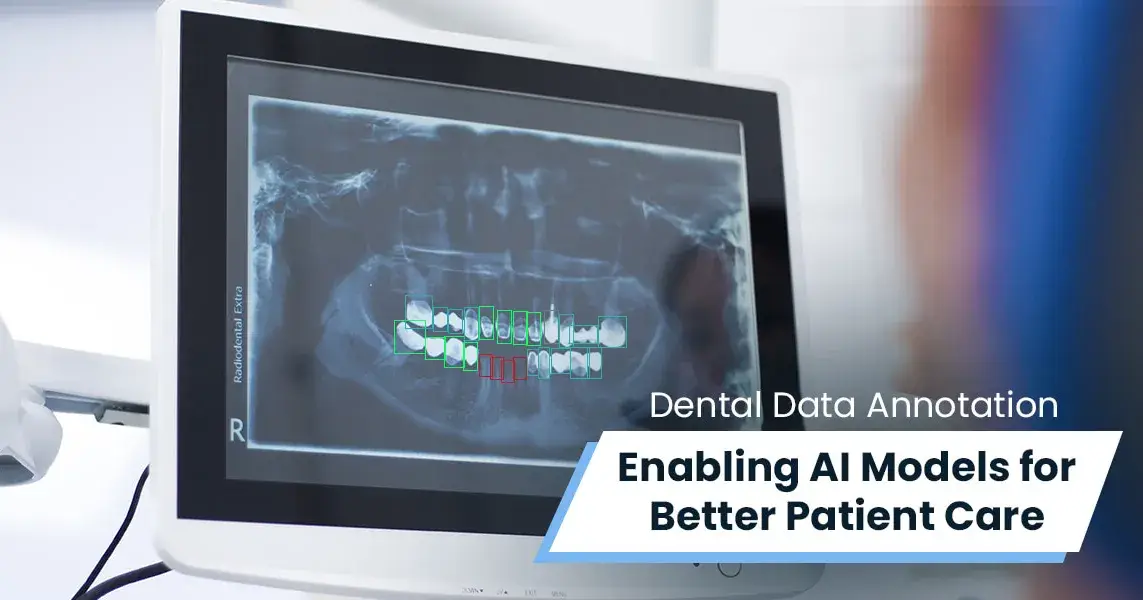
Artificial intelligence (AI) in medicine is rapidly transforming healthcare, impacting patients’ lives on an unprecedented scale. Dentistry is no exception. AI in dentistry refers to the use of artificial intelligence technologies—such as machine learning (ML), computer vision, deep learning, and natural language processing—to assist dental professionals in diagnosis, treatment planning, and patient care.
AI is redefining how oral care is delivered, i.e., when equipped with AI-powered tools, oral healthcare providers and dentists can analyze diagnostic images and detect anomalies earlier. Dentists can now identify issues more quickly and precisely than ever before by utilizing AI systems that use deep learning and computer vision.
Since accurate tooth labeling is critical for algorithms to assess and process complex dental imagery properly, professionals must map information to individual teeth using various dental notation systems. In this context, data annotation companies take on the tedious task of labeling dental data with precision and consistency. They employ dental specialists as domain experts since they have knowledge of medical terminologies used in dental treatments.
Let's examine dental data annotation more closely and see how important annotated datasets are for the development of AI systems.
What is dental data annotation, and why is it important?
Making AI systems for dentistry begins with annotating dental images and marking their specific dental parts and diagnostic traits. Annotating dental data is laborious and time-consuming because dental anomalies vary from cavities, loose teeth, and ruptures to periodontal diseases.
Some dental diseases, such as plaque buildup, enamel wear, gum inflammation, and misalignment, often present minor image differences. Precise annotation of these dental features holds key information, whereas a missed label means incomplete training data. Therefore, continuous evaluation from human experts is necessary to avoid such errors and inconsistencies in training data.
AI models cannot distinguish between healthy teeth and dental disorders without high-quality annotations, so they cannot be used in a clinical setting. The quality of the datasets has a significant effect on how well AI models can identify dental cavities.
What is the importance of quality dental data annotation?
Quality data annotation directly correlates with model performance, generating more accurate and faster diagnoses. The more precise the annotation, the better the effectiveness of AI-powered diagnostic tools. They can identify bone issues and other oral diseases much better, more accurately, and quickly than traditional methods alone.
When taught on well-annotated data, machine learning systems acquire the capability to analyze vast amounts of dental images and extract valuable insights rather than just studying them manually. AI technologies work better with human dentists training the model to render more accurate diagnoses. Moreover, human involvement can lower expenses and enhance long-term patient engagement.
A machine can identify probable oral health issues if the training data includes an in-depth look at the patient's medical history, symptoms, or other relevant information.
Despite this, a model may still not fully meet the standards of care that a dental professional can provide. Over-reliance on technology also requires caution to protect patient privacy and confidentiality. Human supervision helps overcome this challenge, making treatment more consistent and secure, which is an additional benefit. They help maintain standardization, which is essential because it ensures that patients obtain the same care no matter which dentist they see and reduces disparities in how dentists interpret things.
What Tools Are Best for Dental Data Annotation?
Several specialized tools are available for labeling dental images, each designed to handle different unstructured and structured data types. Using them to annotate dental images enables the creation of quality datasets for training dependable dental prediction and diagnostic models. Such a modular tool can display generated annotations and be programmed to allow human operators or subject-matter experts to rectify annotations, if necessary, reinforcing accurate decisions.
Professional annotation companies like Cogito Tech work alongside specialized medical annotation tools to advance dental AI applications. These tools enable the creation of labeled datasets essential for training predictive models. For example, the annotation applies an object detection model combined with a feature extraction system to identify tooth-related features.
3D Slicer - A free, open-source platform for dental CBCT and volumetric segmentation, offering flexible project management with collaborative annotation.
V7 Darwin - A high-performance annotation tool with DICOM support for dental X-rays and 3D imaging. It includes role-based permissions for secure medical data handling.
CVAT (Computer Vision Annotation Tool) - An open-source platform that supports polygons, polylines, cuboids, and masks. It is ideal for labeling tooth boundaries.
These tools help create high-quality training datasets for AI models used in diagnostics, treatment planning, and automated dental disease detection. The best tools speed up the task using automated pre-annotation and human verification. They also protect the patient's privacy at every step of the annotation process.
Why Invest in Dental Data Annotation Services?
Investing in dental data annotation services provides several advantages over in-house annotation efforts. These services comprise intraoral cameras, panoramic X-rays, bitewing X-rays, cone beam CT (CBCT), and intraoral scans. Thus, complex dental data are turned into structured data, giving models an understanding of clinical requirements that would be expensive to develop internally.
Professional services also ensure that datasets are varied and include patients with different backgrounds and dental problems. They also annotate them with expert engineers to ensure consistency in every dental practice. Without specialized knowledge and resources, performing well on performance metrics is challenging.
Additionally, outsourcing annotation allows dental practices and research institutions to focus on their core work while advancing their AI development projects and receiving high-quality training data. The professional annotation services often incur less expense than training internal teams and maintaining annotation infrastructure.
How Can Dental Data Annotation Enhance AI Models?
High-quality dental data annotation improves the performance of AI models by giving them clear examples of what they should see and sort. AI algorithms must use the right datasets with lots of annotations to work well.
AI models can learn complicated patterns in dental images that might be hard for people to find all the time if the datasets are well-annotated. This includes small cavities that form early on, changes in the anatomy of root canals, and changes in bone density that show periodontal disease. Certified dental professionals or trained annotators label images by identifying:
Individual teeth (using the FDI or universal numbering system).
Detecting cavities or caries.
The need for fillings, crowns, and implants.
Root canals and pulp chambers.
Gingival lines and bone levels are used for periodontal assessment.
The presence of orthodontic brackets or prosthetic elements is also taken into account.
Consistent annotation creates a common diagnostic standard, which helps dental AI models perform reliably regardless of imaging equipment or environment. Furthermore, a comprehensive approach to dental annotation allows AI models to provide more detailed diagnostic information beyond simple detection, including treatment recommendations and prognosis prediction.
Enhancing the Human Touch
Dental data annotation enhances AI-driven diagnosis and accelerates treatment planning, and its primary value lies in supporting rather than replacing clinical knowledge.
Here are some strategies to leverage human expertise and uphold ethical standards in the development of dental AI systems:
Human-in-the-Loop (HITL): Keep dentists as the final decision-makers, as AI outputs should guide, not dictate, clinical choices.
Transparent AI Models: Ensure explainability so dental professionals can understand how AI arrived at a recommendation.
Data Privacy & Security: Use anonymization, encryption, and strict compliance with HIPAA/GDPR to protect patient records.
Bias-free Training Data: The annotated training datasets must undergo regular audits, i.e., checking that they cover patients of different ages, genders, and backgrounds, so the model doesn’t overfit to one group.
Patient Communication: Encourage dentists to explain AI’s role, reinforcing that technology supports their expertise rather than replacing it.
Conclusion
Dental data annotation aims to make medical AI systems intelligent and dependable. When the foundational training data is reliable and compliant, deployment and performance will be easy and seamless. Quality data supports qualitative output, and AI in dentistry works best when backed by high-quality data. It should be viewed as a supportive tool for dentists, not a substitute for their professional skills. It enables dentists to make faster and more accurate diagnoses because the inaccuracies that may result in claim denials must be taken care of by integrating AI in dentistry.
With all of its benefits and applications, there is still a risk that the model may incur errors, like when a new case comes up; in that case, continuous innovation and human supervision are always advisable. This idea also applies to annotating dental images; consequently, AI data providers offer services to ensure the smooth implementation of machine learning algorithms that enhance dental treatment efficiency.
Looking to get in touch with such a provider? Leave a comment!

Join Matthew on Peerlist!
Join amazing folks like Matthew and thousands of other builders on Peerlist.
0
0
0