

Top Medical Image data provider for building a Radiology AI model
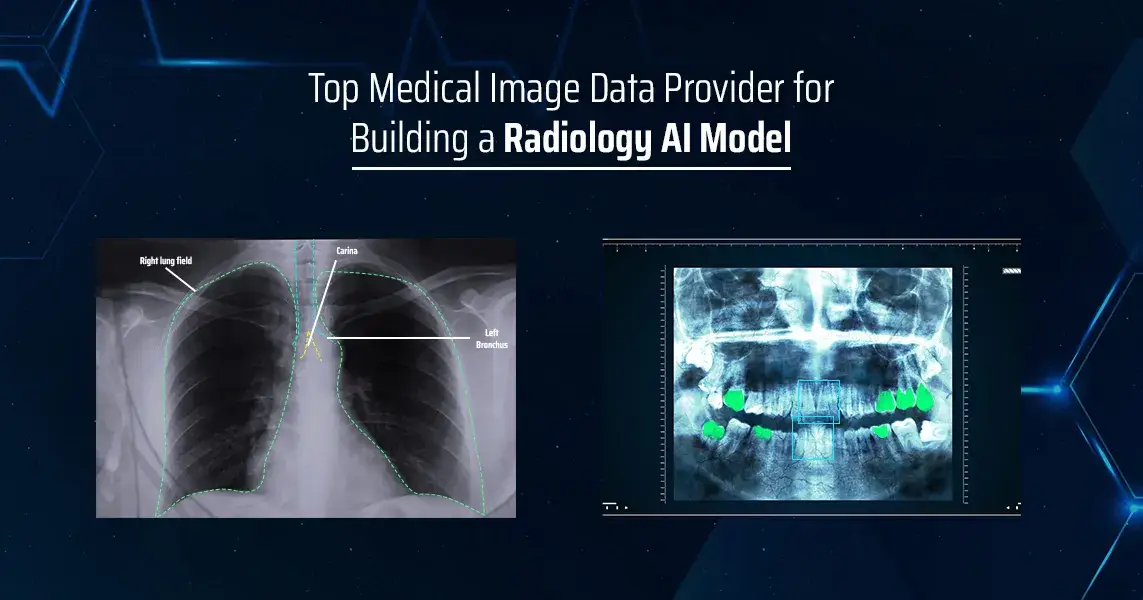
In medical imaging, Artificial Intelligence (AI) has brought rapid transformation by enabling faster, more accurate diagnostics. The evolution is expected to continue in 2026, with AI platforms driving image analysis through machine learning and deep learning. It strengthens radiologists' and medical professionals' capabilities, improving patient outcomes.
However, these AI systems are only as good as the training data that supports them. This is where medical data providers step in. A specialized medical image data provider plays a crucial role in converting raw imaging datasets, such as MRI, CT, X-ray, ultrasound, and pathology slides, into structured, expertly annotated training data. This blog explores the importance of medical image annotation, the role of a data provider, steps to select top medical image data companies, and more.
Why Accurate Medical Image Annotation Matters?
Medical image annotation is important because it enables AI to diagnose diseases, identify patterns, and personalize treatment plans. Let’s check its significance in detail:-
Medical data is far more complex than generic image labeling.
Structured annotations are integral for edge-case detection, supervised learning, and model interpretability.
Need for expert knowledge to understand clinical context and modality differences, such as MRI, CT scan, ultrasound, and X-ray.
Strict adherence to regulatory and privacy standards (HIPAA, GDPR, FDA-aligned workflows).
Criteria for Selecting a Medical Image Data Provider
Before reviewing the providers, outline what enterprises should look for:
Clinical expertise, including the presence of board-certified radiologists, subject-matter experts, and domain specialists, should be the top priority.
The second factor is whether the service provider delivers annotation depth in 2D & 3D semantic segmentation, volumetric labeling, and more.
The company must adhere to global regulatory and security standards, such as GDPR, HIPAA, ISO 27001, SOC 2, and ISO 9001, to ensure secure, compliant data handling.
High dataset throughput without compromising quality.
Leading Medical Image Data Providers for Radiology AI
Here is a curated list of trusted medical image data providers who enable high-precision, compliant, and scalable datasets for building advanced radiology AI models.
1. Cogito Tech
Cogito Tech is a leading company delivering enterprise-grade medical image labeling. The team is backed by deep domain expertise and strict compliance standards. Image annotation solutions help detect anomalies and diseases in medical imaging data, including X-rays, MRIs, CT scans, and ultrasounds.
Strengths
2D/3D segmentation, volumetric labels
Board-certified medical experts
DICOM-aware workflows
GDPR, HIPAA, FDA, ISO-compliant pipelines
2. Anolytics
Anolytics helps improve medical diagnosis by organizing real-world healthcare information, including ECG readings, lab results, doctor’s notes, pathology images, and clinical recordings.
Capabilties
Medical image annotation for X-ray, CT, MRI, ultrasound, and pathology data
Semantic segmentation, polygon, and bounding box labeling for disease detection
DICOM and multi-format radiology data processing
HIPAA & GDPR-compliant data handling
3. Labelbox
Labelbox is an AI data annotation platform that enables teams to label, manage, and validate medical imaging datasets at scale. It supports complex annotation workflows with built-in quality control, collaboration tools, and version tracking for enterprise use.
Features
Unified platform for medical image annotation and dataset management
Support for 2D/3D labeling, bounding boxes, segmentation, and keypoints
Collaboration tools for annotator teams and reviewer workflows
Integration with DICOM workflows and PACS systems
4. Scale AI
Scale AI is a well-known provider of high-quality image labeling. The team combines automated pre-labeling with expert human review. Scale AI can support complex radiology tasks such as segmentation and clinical annotation of DICOM, CT, MRI, and other imaging modalities.
Capabilities
2D and 3D annotation tools for radiology imaging, such as MRI and CT scans
HIPAA-compliant environments with audit trails and PII redaction
Diagnostic criteria workflows (e.g., BI-RADS scoring for mammograms)
5. Aidoc
Aidoc provides AI solutions that detect critical findings in CT scans, such as intracranial hemorrhage and pulmonary embolism. The platform integrates directly into radiology workflows, prioritizing urgent cases for faster clinical response.
Features
Multi-condition emergency detection
Regulatory-cleared algorithms
Seamless PACS integration
6. Expert.ai
Expert.ai offers medical data services centered on semantic annotation and domain-specific language understanding. The platform combines textual and visual features to yield more transparent, clinically interpretable outcomes.
Strengths
Semantic layer annotation
Explainable models
Regulatory context focus
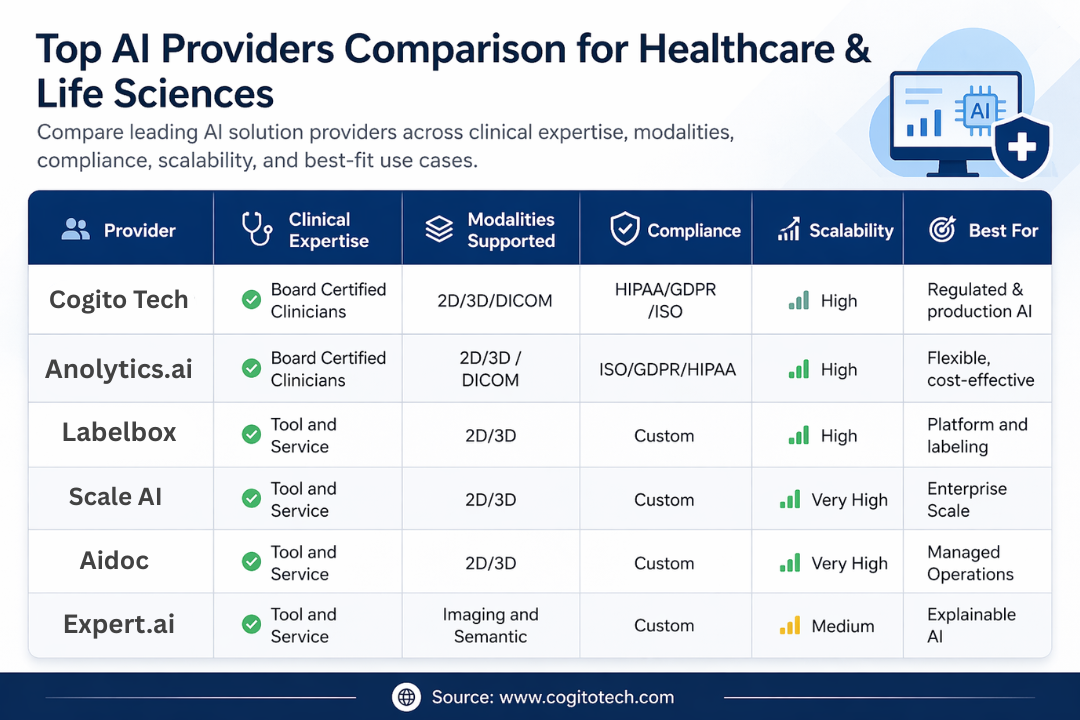
Feature Comparison
How to Choose the Right Image Data Provider for your Radiology AI Project?
Before you hire an image data partner, check out the questions below:-
Do you need clinical annotation expertise?
Your AI model requires medically accurate labeling, clinical context, or diagnostic precision.
Is regulatory compliance important (HIPAA, FDA)?
It becomes more crucial, especially when handling patient data or preparing for clinical validation and regulatory submission.
Are you labeling multimodal data (text + imaging)?
If your AI integrates reports, EHR text, and imaging together, multimodal expertise is essential.
Do you require a platform + service, or just a service?
Choose a platform and service for workflow control and visibility; use only the service if you prefer full outsourcing.
What’s your scaling and turnaround requirement?
High-volume or time-sensitive projects demand scalable teams, structured workflows, and strict SLAs.
Conclusion
High-quality imaging data is the backbone for a successful radiology AI model. There are many image data service companies; choosing the best one hinges on factors such as scalability, compliance, domain expertise, and output quality. The above-mentioned companies and platform leaders represent the current top tier of medical image data solutions. Select the right one to ensure your radiology AI system is reliable, accurate, and ready for real-world clinical use.

Join Matthew on Peerlist!
Join amazing folks like Matthew and thousands of other builders on Peerlist.
0
0
0