

AWS Request Response flow — Simple words
AWS Request Response flow
When a user enters a website URL, the request first goes to DNS, where Route 53 resolves the domain into the correct AWS endpoint. The request then reaches CloudFront, which serves cached content from the nearest edge location if available, reducing latency. Before moving further, AWS WAF and Shield inspect the request to block malicious traffic and protect against DDoS attacks. The request then enters the Virtual Private Cloud, which isolates the infrastructure inside a secure network. An Application Load Balancer distributes the traffic across multiple EC2 instances to prevent overload. These instances run inside an Auto Scaling Group, which automatically adjusts capacity based on traffic demand. The application processes the request and checks Redis in ElastiCache for frequently accessed data. If the data is not in cache, the application queries Amazon RDS or Aurora for persistent storage. Static files such as images and documents are stored in S3 and can be delivered through CloudFront. Finally, CloudWatch monitors the entire system to ensure performance, scalability, security, and high availability.
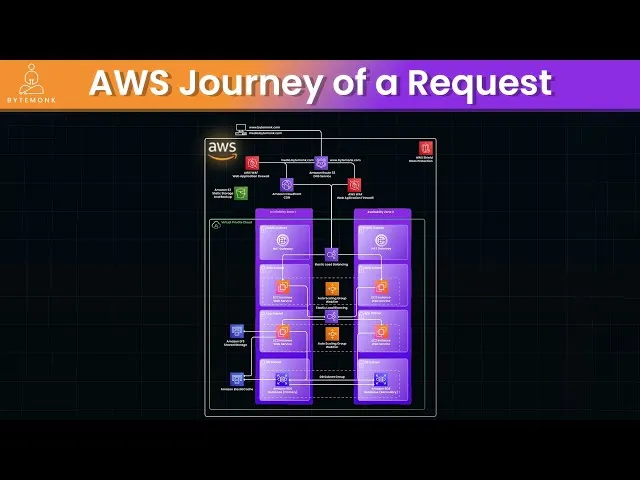
A user request first resolves through Route53 DNS, then passes through CloudFront for caching. Security is enforced via WAF and Shield before entering the VPC. Traffic is distributed using an Application Load Balancer across EC2 instances managed by Auto Scaling. The application processes the request, interacts with ElastiCache for caching and RDS/DynamoDB for persistent storage. Static assets are served from S3, and the entire system is monitored using CloudWatch for metrics, logs, and alarms.

Join Pranav on Peerlist!
Join amazing folks like Pranav and thousands of other builders on Peerlist.
0
1
0