

I Tracked Gumroad’s Hidden Signals — And Built GumRadar to Make Them Visible

I was just trying to understand why some creators were quietly making money while others disappeared without a trace.
As a developer and a marketer, I spend most of my time watching systems instead of opinions. Platforms rise and fall quietly long before Twitter notices. Trends don’t announce themselves — they leave data trails.
And Gumroad left a lot of them.
Yet no one was collecting those signals into something creators could actually use.
That gap became GumRadar.
Press enter or click to view image in full size
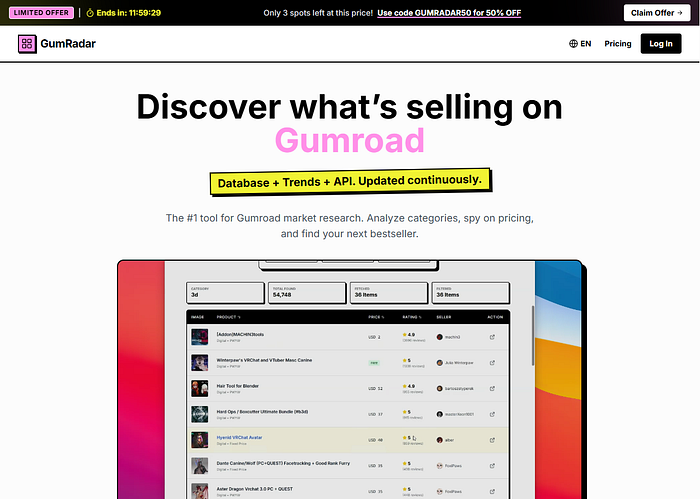
Everyone Talks About Gumroad. Almost No One Measures It.
Search the internet and you’ll see the same questions repeated endlessly:
What is Gumroad?
Is Gumroad still worth it?
Gumroad fees vs Etsy fees
Gumroad pricing and reviews
Gumroad login issues
Gumroad app, Gumroad store, Gumroad account
Gumroad vs Payhip, Sellfy, Lemon Squeezy, Ko-fi
Gumroad VRChat avatars
Gumroad Procreate brushes
Gumroad prompts, Blender assets, digital products
https://gumradar.com/gumradar-hero-free-gumroad%20videos.mp4
Reddit debates.
YouTube opinions.
Medium think pieces.
But here’s what was missing:
Actual trend data.
Not anecdotes. Not screenshots. Not “I heard.”
No one could answer:
Is Gumroad revenue rising or falling?
Which categories are growing fastest?
Where are creators migrating from — and to?
Why do people complain about Gumroad fees, yet still choose it?
So I decided to stop guessing.
Gumroad Is Not Just a Storefront — It’s a Signal Layer
Once you step back, Gumroad looks very different.
It’s not competing with Shopify.
It’s not trying to be Etsy.
It’s not even really an “ecommerce platform” anymore.
Gumroad is a signal layer for the digital creator economy.
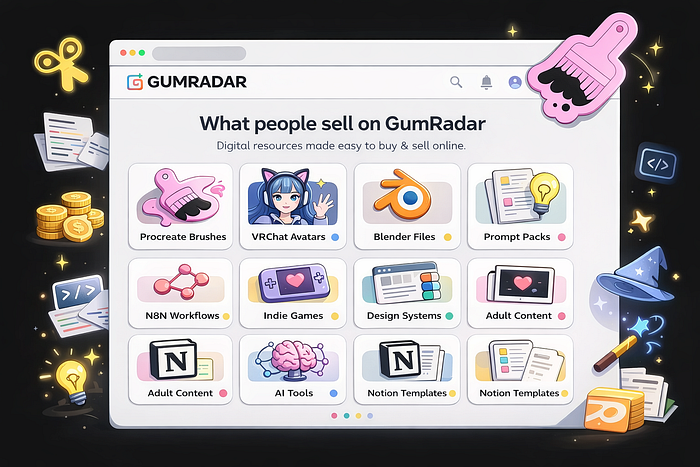
On Gumroad, people sell:
Press enter or click to view image in full size
form gumradar
Procreate brushes
VRChat avatars
Blender files
Prompt packs
N8N workflows
Indie games
Design systems
Adult content
AI tools
Notion templates
These aren’t impulse buys.
They’re knowledge, assets, identity, and utility.
And when creators choose Gumroad over Etsy, Payhip, Sellfy, Lemon Squeezy, Ko-fi, Jinxxy, Whop, or Itch.io — that choice leaves a trace.
Multiply that by tens of thousands of creators, and patterns emerge.
That’s where GumRadar starts.
From Side Script to Trend Database
GumRadar didn’t begin as a “product.”
It began as a personal attempt to understand:
Press enter or click to view image in full size
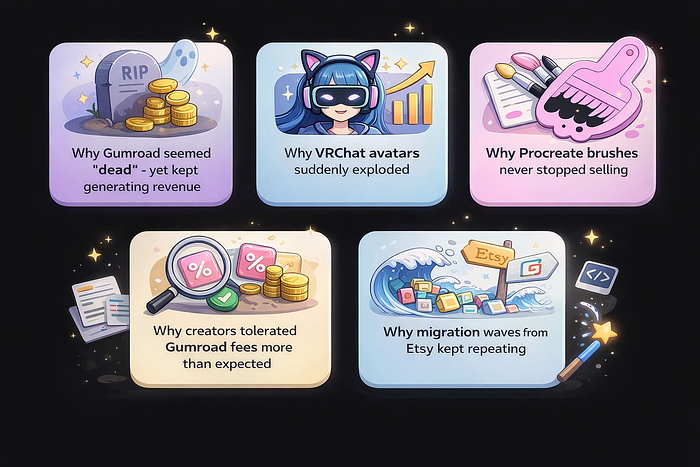
Why Gumroad seemed “dead” — yet kept generating revenue
Why VRChat avatars suddenly exploded
Why Procreate brushes never stopped selling
Why creators tolerated Gumroad fees more than expected
Why migration waves from Etsy kept repeating
What started as a script turned into:
A structured dataset
Historical trend tracking
Category-level growth analysis
Revenue movement signals
Not to expose creators.
But to understand momentum.
Gumroad Is Quietly Rising — Again
One of the biggest misconceptions about Gumroad is that it “fell off.”
It didn’t.
It simply stopped shouting.
While people argued about Gumroad pricing and reviews, the platform continued doing one thing extremely well:
Let individuals sell digital products with almost no friction.
And now the signals show:
Gumroad revenue trends rising again
Creator accounts increasing
High-growth niches outperforming expectations
Indie creators choosing simplicity over feature bloat
This isn’t hype.
It’s directional data.
And direction matters more than noise.
Why I Built GumRadar
I built GumRadar for people like me:
Developers
Who want to see where tools, workflows, prompts, and assets are actually moving.Creators
Who want data-backed insight instead of platform myths.Marketers & indie founders
Who need early trend signals — not post-hoc explanations.
GumRadar doesn’t promise shortcuts.
It provides context.
Because the real edge isn’t knowing what sells.
It’s knowing when something starts selling — and why.
Data Compliance Is Not Optional
This matters to me, so I’ll say it clearly:
GumRadar is built with data compliance and creator respect as non-negotiables.
No private data
No personal earnings exposure
No invasive scraping
No individual creator profiling
Only:
Aggregated trends
Public signals
Historical movement
Category-level insights
The creator economy doesn’t need another extraction tool.
It needs clarity.
The Bigger Picture
Gumroad is not alone.
Platforms like:
Lemon Squeezy
Ko-fi
Payhip
Sellfy
Jinxxy
Whop
are all responding to the same shift:
Creators want control.
Audiences want direct access.
And data determines who adapts fastest.
GumRadar exists to make that shift visible.
Final Thought
I didn’t build GumRadar because Gumroad is perfect.
I built it because the digital product economy deserves transparency.
If you’re building, selling, or analyzing digital products —
If you care about trends before they become crowded —
If you believe data should empower creators, not exploit them —
Welcome to GumRadar.
— Girff

Join Girff on Peerlist!
Join amazing folks like Girff and thousands of other builders on Peerlist.
0
7
0