

AI Workers Are Changing the Way Companies Scale
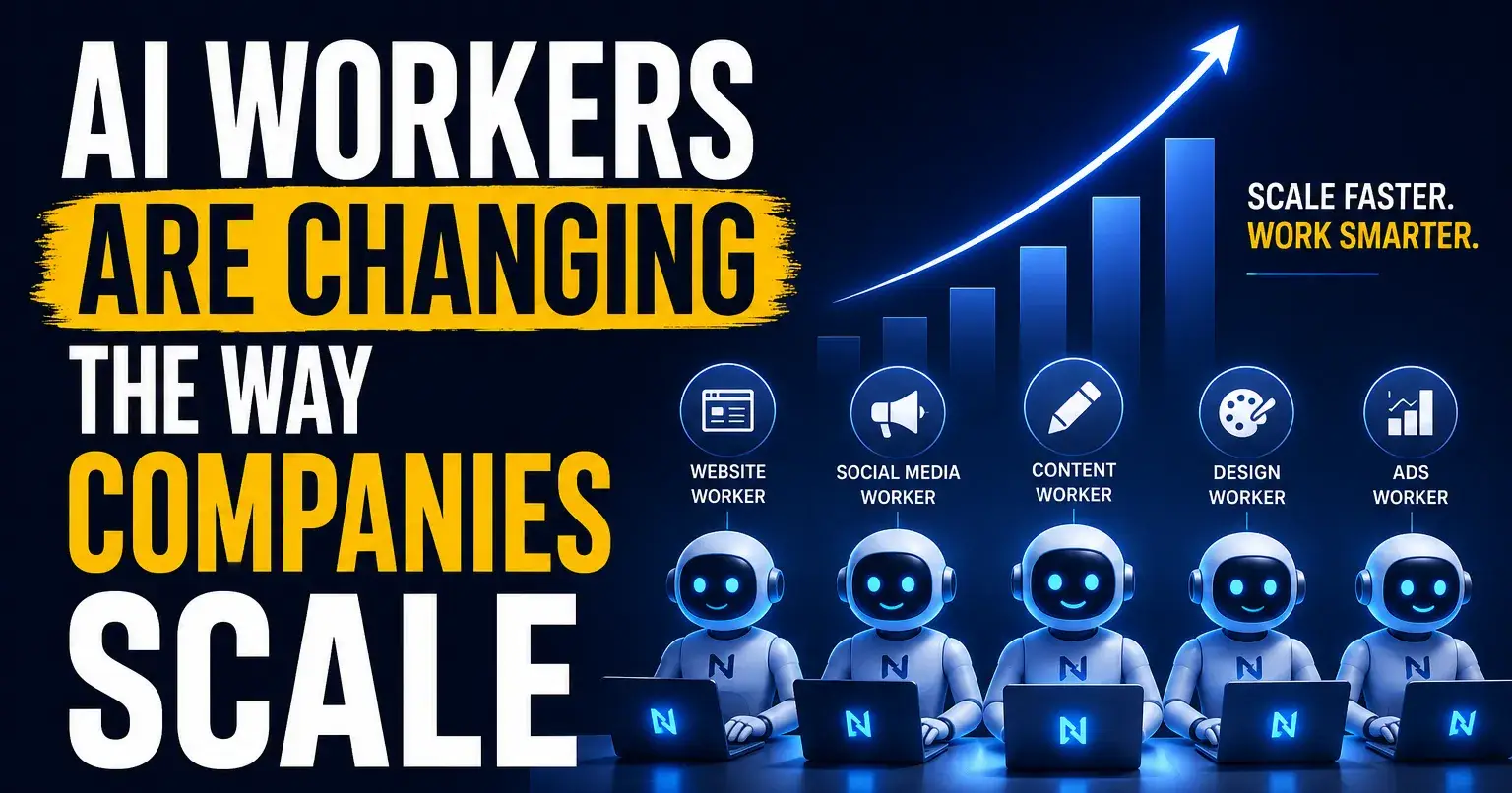
Scaling a business has always meant hiring more people, spending more on resources, and managing increasingly complex operations. For most companies, growth was directly tied to headcount. That model is rapidly breaking down, and AI workers are at the centre of this shift.
Businesses across industries are rapidly adopting AI to improve efficiency and competitiveness. According to a Gallagher survey, AI adoption among global businesses reached 63% in 2026, rising from 45% in 2025. Meanwhile, regular AI use among frontline employees climbed to 74% globally in 2026, up from 51% the previous year. The companies leading this charge are not simply cutting costs — they are fundamentally rethinking how work gets done.
In this guide, you will learn what AI workers are, why businesses are adopting them at scale, how they are being deployed across industries, what real-world results look like, and how platforms like Ndovesha AI are helping businesses build AI-powered workflows that actually deliver results.
Table of Contents
TL;DR
What Are AI Workers?
Simple Definition
How AI Workers Operate
Examples of AI Workers in Action
Why Businesses Are Adopting AI Workers
Key Benefits of AI Workers for Business Scaling
Real-World Use Cases by Department
How to Deploy AI Workers: A Practical Workflow
How Ndovesha AI Helps You Scale with AI Workers
Traditional Scaling vs AI-Powered Scaling
Common Mistakes When Deploying AI Workers
The Future of AI Workers
Frequently Asked Questions
Key Takeaways
Final Thoughts
TL;DR
AI workers are autonomous systems that handle real business tasks — from marketing and customer service to operations and content creation — allowing companies to scale without proportionally increasing costs or headcount. Key points:
AI workers handle content creation, customer support, lead generation, data analysis, and campaign execution
Key benefits: faster output, lower operational costs, 24/7 availability, and consistent quality
Best approach: deploy AI workers to handle volume tasks while humans focus on strategy and relationships
Companies that adopt early will compound their advantage as AI capabilities continue to advance through 2026 and beyond
What Are AI Workers?
Simple Definition
AI workers are autonomous or semi-autonomous AI-powered systems capable of understanding instructions, reasoning through complex tasks, and executing multi-step workflows — performing functions that previously required human employees to complete manually.
Featured Snippet Definition: AI workers are intelligent software systems that can independently plan, execute, and complete business tasks — from writing content and responding to customers, to analyzing data and managing campaigns — allowing companies to scale operations without scaling headcount.
Recent advancements in AI agents are making these systems increasingly capable of handling complex business processes with minimal supervision. What was once only possible with large teams can now be accomplished through well-configured AI systems operating continuously in the background.
How AI Workers Operate
Unlike simple automation tools that follow fixed rules, AI workers use large language models and reasoning capabilities to interpret goals, adapt to context, and make decisions dynamically. They can receive a high-level objective such as "generate this week's social media content" or "respond to all new customer enquiries" and work through the steps required to complete it without step-by-step human instruction.
The distinction between an AI agent and an AI worker is important: where an agent completes a task and exits, an AI worker has an ongoing role, identity, access policies, and a reporting hierarchy. AI workers are designed to behave more like real employees — they can handle entire processes, collaborate, adapt, and finish the job without constant human supervision.
Examples of AI Workers in Action
Marketing AI workers that plan, write, and schedule content campaigns
Customer service AI that resolves support tickets and handles live chat
Sales AI that qualifies leads, sends follow-up emails, and books appointments
Operations AI that processes data, generates reports, and flags anomalies
Creative AI workers that produce graphics, video scripts, and ad creatives
Research AI that gathers competitive intelligence and market data
Finance AI that processes invoices, flags irregularities, and summarises spend
Why Businesses Are Adopting AI Workers
The traditional model of scaling ,hire more people, train them, manage them, and absorb the associated costs, has always been slow, expensive, and difficult to reverse. Companies are looking for new ways to improve productivity without dramatically increasing costs.
Several forces have accelerated the adoption of AI workers specifically. AI capabilities have matured rapidly, systems that once could only generate text can now plan projects, interact with software tools, manage workflows, and iterate based on feedback. At the same time, the cost of deploying AI has fallen dramatically, putting enterprise-grade capabilities within reach of startups and small businesses.
Industry analysts expect the agentic AI market to grow at a compound annual growth rate of 43.5%, from $3.87 billion in 2025 to $5.55 billion. Major trends include autonomous task execution in enterprises, AI-driven workforce optimization, self-adapting digital workers, and human-agent collaboration models.
"The question is no longer whether to adopt AI workers — it is how quickly and strategically you deploy them before your competitors do."
Key Benefits of AI Workers for Business Scaling
24/7 Availability
AI workers operate continuously without breaks, time zones, or fatigue — delivering consistent output at any hour and ensuring customer-facing functions never go dark.
Dramatically Lower Costs
Replacing high-volume, repetitive tasks with AI workers significantly reduces salary, training, and management costs — allowing businesses to redirect budget toward strategy and growth. Using an AI workforce can lead to 2× revenue growth in as little as four months.
Consistent Quality
AI workers follow brand guidelines, tone specifications, and process rules reliably — eliminating the human variability that often affects quality at scale.
Instant Scalability
Unlike human teams, AI workers can handle 10x the volume overnight with no onboarding, recruitment, or ramp-up period — making true on-demand scaling possible for the first time.
Faster Execution
Tasks that previously required days of coordination and production can be completed in minutes — compressing campaign cycles, launch timelines, and customer response windows.
Human Team Empowerment
By offloading repetitive execution to AI workers, human teams are freed to focus on strategy, creative direction, relationship building, and decisions that require genuine judgment.
"The biggest advantage of AI workers isn't replacing your team — it's giving your team the capacity to do work that actually grows the business."
Real-World Use Cases by Department
Marketing and Content
AI workers now manage entire content pipelines — from keyword research and blog drafts to social media scheduling and email sequences. Teams using AI content marketing strategies report significant reductions in production time while maintaining or improving content quality.
Customer Service
AI workers handle first-line customer support at scale — resolving common queries instantly, escalating complex cases to human agents, and maintaining consistent tone and brand standards across every interaction. Response times drop from hours to seconds without adding headcount.
Sales and Lead Generation
AI sales workers identify prospects, send personalised outreach emails, follow up at optimal intervals, and qualify leads before handing them to human sales representatives. This compresses the top of the sales funnel dramatically and keeps pipelines consistently active.
Creative and Campaign Production
AI workers produce ad creatives, landing pages, campaign visuals, and promotional assets on demand. Creative production no longer bottlenecks campaign launches.
Agency Operations
Marketing agencies are deploying AI workers to serve more clients without growing their teams proportionally. AI handles content production, reporting, and social scheduling — while human strategists focus on client relationships and campaign direction.
Data and Reporting
AI workers process large volumes of performance data, generate plain-language summaries, identify trends, and surface actionable insights — turning raw analytics into decisions without requiring a dedicated data team.
How to Deploy AI Workers: A Practical Workflow
Successfully deploying AI workers requires a structured approach that starts with the highest-value, highest-volume tasks and expands from there.
Audit Your Current Workload — Identify which tasks consume the most time with the least strategic value. Common targets include content creation, customer query responses, and data compilation.
Define Clear Objectives and Standards — Define quality benchmarks, tone guidelines, output format, and escalation rules. The clearer your brief, the better the AI worker performs.
Select the Right Tools and Platform — Choose an integrated platform that covers your key use cases — content creation, visual production, customer communication, or campaign management — rather than assembling a fragmented stack.
Run a Controlled Pilot — Deploy AI workers on a defined scope first — one content type, one customer segment, or one campaign — before rolling out more broadly.
Integrate Human Review — Build human checkpoints into every AI worker workflow, particularly for customer-facing content. AI workers handle volume; humans maintain standards.
Measure, Refine, and Expand — Track output quality, time savings, and business impact continuously. Use performance data to refine instructions and identify the next highest-value area for deployment.
How Ndovesha AI Helps You Scale with AI Workers
Most businesses attempting to deploy AI workers face the same challenge: the tools are fragmented. One platform handles writing, another handles visuals, a third handles scheduling, and stitching them together consumes the time savings they were supposed to create.
Ndovesha AI is built differently. Launched in April 2026, Ndovesha AI is an all-in-one AI worker platform designed to help businesses, entrepreneurs, and creators generate marketing assets, automate content production, and accelerate digital growth through specialised AI-powered workers.
The platform offers a suite of AI workers including:
Prompt Generator — Build stronger, clearer, more on-brand prompts
Social Media Post Image Generator
AI Ad Creative Generator
AI Video Content Worker
AI Landing Page Builder
AI Website Builder — Build a ready-to-use website in less than 3 minutes
AI Logo Maker
Caption Generator
Presentation Generator
AI Blog Writer
From blog content and social media creatives to ad visuals, landing pages, and campaign assets — the full workflow is available from a single integrated platform. Businesses that centralise their AI workers on one platform move faster, maintain better consistency, and avoid the operational overhead of managing multiple subscriptions and integrations.
Why businesses choose Ndovesha AI: An integrated platform that covers the full content and campaign lifecycle — so your AI workers operate as a coordinated system, not a collection of disconnected tools.
Designed for startups, SMEs, agencies, and enterprise teams, Ndovesha AI focuses on execution-driven AI workflows rather than simple chatbot interactions.
Traditional Scaling vs AI-Powered Scaling
The difference between traditional and AI-powered scaling is not simply speed — it is the fundamental economics of growth. Traditional scaling requires linear investment: more output demands more people, more management, and more cost. AI-powered scaling breaks this relationship entirely.
Common Mistakes When Deploying AI Workers
Deploying Without Clear Guidelines — AI workers perform to the quality of their instructions. Vague briefs produce generic output. Always define tone, format, audience, and success criteria before deployment.
Removing Human Oversight Too Early — Even well-configured AI workers require human review, especially in customer-facing roles. Remove oversight too early and quality issues will compound.
Treating AI Workers as a Cost-Cutting Exercise Only — The biggest gains come from using time and resource savings to invest in higher-value work — not simply reducing headcount.
Fragmenting Across Too Many Tools — Using a different AI tool for every function creates integration complexity that eliminates efficiency gains. Consolidate on a single platform wherever possible.
Not Measuring Business Impact — Track output volume, quality scores, time savings, and downstream business metrics — conversion rates, customer satisfaction, and revenue — to quantify real value and justify further investment.
The Future of AI Workers
The next generation of companies will be built around AI-enhanced teams — not simply teams that use AI tools, but organizations where AI workers are embedded into every function as permanent, productive members.
Fully Autonomous Campaign Management
AI workers will plan, execute, optimize, and report on entire marketing campaigns without requiring human input beyond initial goal-setting, compressing full campaign cycles to hours.
AI Workers with Memory and Context
Next-generation AI workers will retain knowledge of your business, brand, customers, and past campaigns, improving continuously and personalizing their output without needing to be re-briefed each time.
Cross-Functional AI Collaboration
AI workers in different departments will increasingly work together, a marketing AI passing insights to a sales AI, which updates a customer service AI, creating coordinated intelligence across the full business.
AI-Native Business Models
New companies will be built from the ground up with AI workers as the primary workforce, small human teams directing large networks of AI systems, enabling radically lean operations at significant scale.
Frequently Asked Questions
What is the difference between an AI agent and an AI worker?
An AI agent completes a task and exits. An AI worker has an ongoing role, identity, access policies, and a reporting hierarchy. AI workers are designed to behave more like real employees; they can handle entire processes, collaborate, adapt, and finish the job without constant human supervision.
How quickly can businesses deploy AI workers?
With platforms like Ndovesha AI, businesses can deploy AI workers in minutes rather than the weeks or months required to hire and onboard human employees.
What types of businesses benefit most from AI workers?
Startups, SMEs, agencies, and enterprise teams all benefit. AI workers are particularly valuable for businesses that produce high volumes of content, handle many customer enquiries, or need to scale operations without proportionally increasing headcount.
Is AI replacing human workers?
The evidence suggests otherwise. Companies most exposed to AI have actually grown headcount faster than less-exposed firms. AI workers handle volume and repetition while humans focus on strategy, relationships, and creative direction.
Key Takeaways
AI adoption has surged to 63% of global businesses in 2026
AI workers operate 24/7, scale instantly, and deliver consistent quality at lower cost
The agentic AI market is growing at 43.5% CAGR
AI workers enable 2× revenue growth in as little as four months
Platforms like Ndovesha AI provide unified AI worker ecosystems that cover the full content and campaign lifecycle
Success requires clear guidelines, human oversight, and measurable business impact
Final Thoughts
The shift from traditional scaling to AI-powered scaling is not a future trend . It is happening now. Businesses that adopt AI workers early will compound their advantage as capabilities continue to advance through 2026 and beyond.
The question is no longer whether to adopt AI workers. It is how quickly and strategically you deploy them before your competitors do.

Join Joseph on Peerlist!
Join amazing folks like Joseph and thousands of other builders on Peerlist.
0
0
0