

Six hours of infrastructure work. Sixteen minutes to deploy with NEXUS AI.
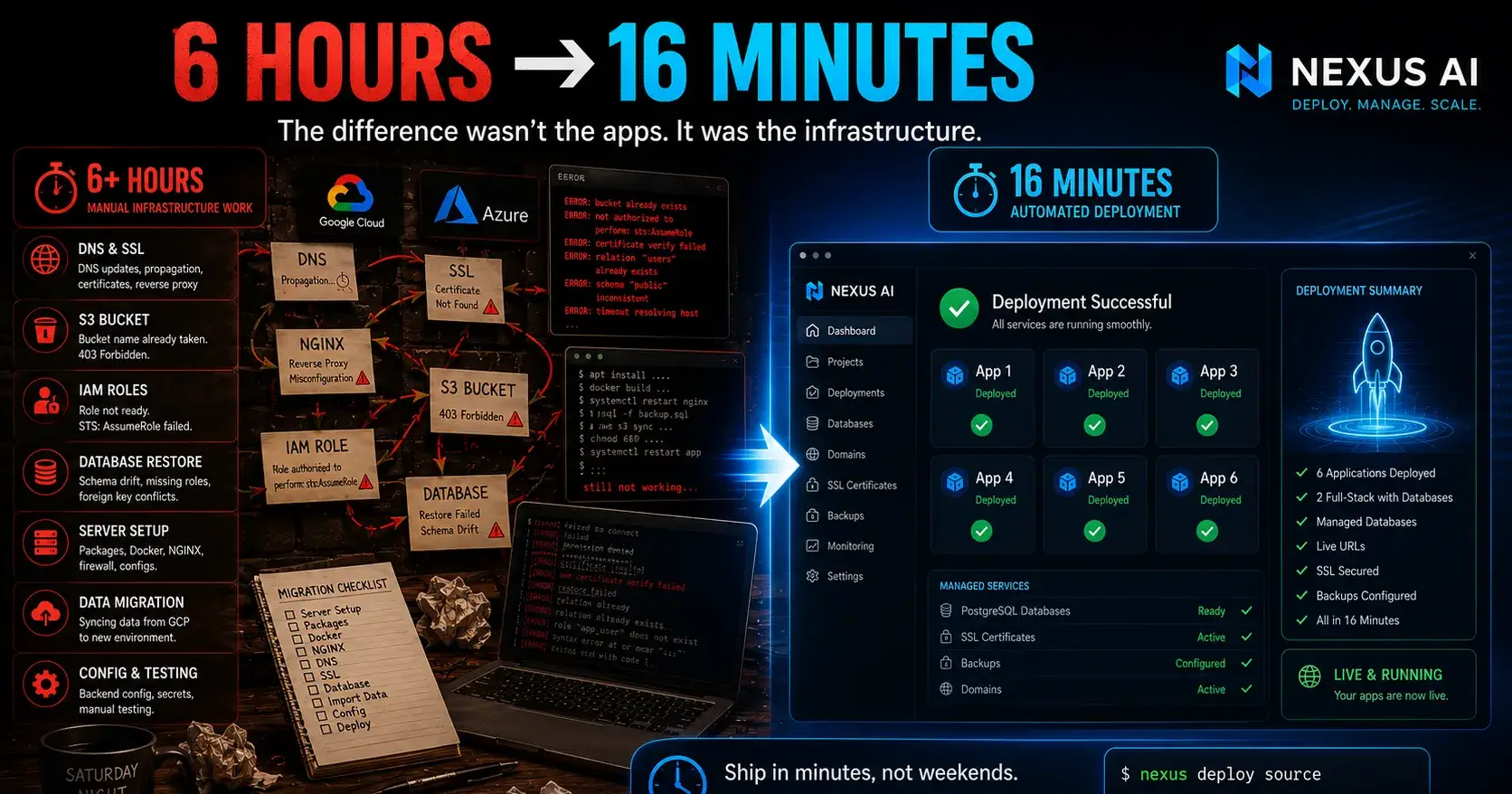
Six hours of infrastructure work. Sixteen minutes to deploy with NEXUS AI.
This weekend we migrated our staging environment off GCP and Azure onto a new server.
The infrastructure migration took more than six hours.
Once the new environment was ready, deploying six applications with NEXUS AI took 16 minutes.
Same applications.
Same databases.
Same destination.
The only difference was how much work a human had to do manually.
Where the six hours went
None of that time was spent writing features.
It was spent rebuilding infrastructure.
Provisioning a new server
Installing packages and runtime dependencies
Configuring the operating system
Syncing data from the old environment
Restoring PostgreSQL databases
Reconfiguring NGINX
Updating backend configuration
Fixing DNS records
Reissuing SSL certificates
Validating every service by hand
None of these tasks make your product better.
They're simply the cost of managing infrastructure manually.
The problems nobody plans for
Every migration starts with a checklist.
Almost none of them include the failures you only discover halfway through.
DNS and SSL
Changing DNS records sounds simple until you realize every subdomain has to point somewhere new.
Then you wait for propagation.
Then your reverse proxy starts serving a self-signed certificate because the original certificate store never moved.
Now you're reissuing certificates one domain at a time.
Five small problems become one long afternoon.
AWS S3
A deployment suddenly failed with a generic 403.
Permissions looked correct.
Policies looked correct.
The problem?
The bucket name already belonged to someone else.
S3 bucket names are global.
A three-line fix took nearly 40 minutes because the error message never told us what was actually wrong.
IAM propagation
The deployment pipeline failed because a newly created IAM role "wasn't authorized."
Except it was.
AWS simply hadn't finished propagating the role yet.
The solution was a retry.
Finding the real cause took far longer than fixing it.
PostgreSQL restore
Restoring an older backup into a newer environment exposed schema drift.
Foreign keys no longer matched.
Roles referenced in the backup didn't exist.
The restore tool couldn't reconcile years of changes automatically.
The eventual fix was straightforward:
Completely reset the schema.
Remove obsolete ownership statements.
Restore cleanly.
Simple after you know the answer.
Not simple at 11 PM on a Saturday.
Then we deployed with NEXUS AI
Once the infrastructure existed, we deployed all six applications through NEXUS AI.
The workflow looked like this:
nexus deploy source
That's it.
Six applications.
Two full-stack applications with managed PostgreSQL databases.
Automatic restore from backups.
Live URLs.
Sixteen minutes.
No Dockerfiles.
No reverse proxy configuration.
No certificate management.
No manual database wiring.
No infrastructure scavenger hunt.
The real cost of cloud infrastructure
People often think cloud migration is expensive because of compute costs.
It isn't.
The expensive part is engineering time.
Hours disappear into problems that have nothing to do with your product:
DNS propagation
SSL certificates
IAM timing issues
Database restores
Reverse proxy configuration
Cloud provider quirks
These are all solvable problems.
They're also problems your users never see and your business never benefits from solving again.
Why we built NEXUS AI
NEXUS AI doesn't magically remove infrastructure.
It removes repetitive infrastructure work.
Instead of rediscovering the same cloud edge cases every time you move environments, those lessons are built into the platform.
You focus on your application.
NEXUS AI handles the deployment pipeline.
Because weekends should be spent shipping software—not debugging infrastructure.
Six hours to build the environment.
Sixteen minutes to deploy six applications.
That's the difference automation makes.
Join Saif on Peerlist!
Join amazing folks like Saif and thousands of other builders on Peerlist.
0
0
0