

The Growth Model Quietly Outperforming Paid Ads — And Why Smart Businesses Are Finally Paying Attention
A closer look at how referral-driven systems are helping businesses scale without rising ad costs
Most businesses don't run out of money before they figure out growth. They run out of patience with strategies that stop working the moment the budget dries up.
Sound familiar?
You pour money into ads. Traffic comes. The moment you pause the campaign — silence. You're not building anything. You're renting attention, and the landlord keeps raising the rates.
There's a different way to grow. One that doesn't stop when you stop spending. One where every new customer becomes a potential channel, every satisfied user becomes a growth lever. It's not new — but the technology behind it has finally caught up with the ambition.
That's exactly where affiliate MLM software comes in — and it's more capable than most businesses realise.
Two Powerful Models. One Smart System.
Let's get clear on what we're actually talking about — because both affiliate marketing and MLM carry a lot of noise around them, and neither deserves to be misunderstood.
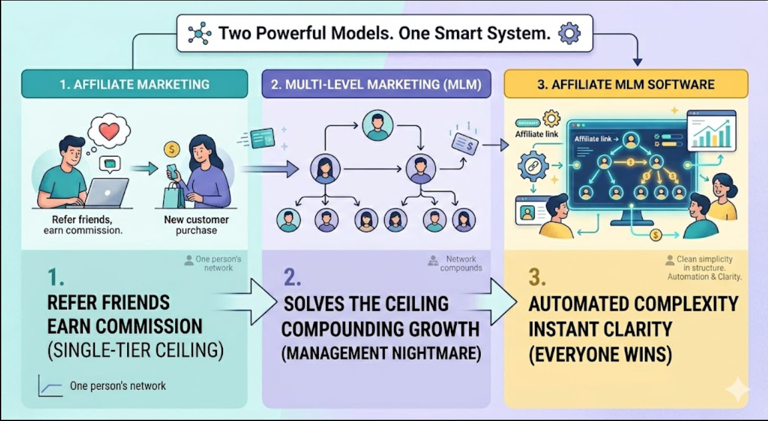
Affiliate marketing is performance-based promotion at its cleanest. Someone loves your product, refers a friend, earns a commission. No upfront cost for you, no wasted spend. The problem? One person's network has a ceiling. Once they've tapped their audience, growth flatlines.
MLM structures solve that ceiling problem. Instead of a single referral layer, you have a network — people bringing in people, each tier motivated by the success of the one below it. The growth compounds. But traditionally, managing that structure has been a nightmare of spreadsheets, manual calculations, and trust issues around who earned what. Today, MLM platforms handle this by automating network tracking, commission calculations, and payout management in a structured system.
Building on this, affiliate MLM software takes it a step further.
It takes the clean simplicity of referral marketing and wraps it in the depth of a multi-level structure — then handles all the complexity behind the scenes. Participants see exactly what they've earned, where it came from, and what they need to do next. Admins get complete control without drowning in data. Everyone wins — and more importantly, everyone stays.
This Is What Self-Sustaining Growth Actually Looks Like
Think about what changes when your users are your growth engine.
You're no longer paying for every eyeball. You're investing in a structure that multiplies your reach with every person who joins. One satisfied participant refers three people. Those three refer two each. Suddenly, a single onboarding becomes a cascade — and your acquisition cost per customer quietly collapses.
That's not theory. That's the math behind why the world's most recognizable direct-sales brands have built multi-billion-dollar businesses without ever running a Super Bowl ad.
Modern affiliate MLM software makes this scalable in ways that weren't possible even five years ago:
Real-time commission tracking means no more "when does my payment process?" — participants see their earnings update live, which keeps motivation high and trust intact.
Multi-tier payout automation means your business can run complex compensation structures—binary plans, unilevel, and matrix—without a team of accountants manually verifying every transaction.
Network hierarchy visualization means both you and your participants can see exactly how the network is growing, where the strong legs are, and where attention is needed.
Integrated dashboards mean your affiliate MLM platform isn't a standalone tool bolted onto your business — it's the operational core that ties everything together.
Platforms that do this well demonstrate what a mature, production-ready implementation of this infrastructure actually looks like in practice.
Here's the Uncomfortable Truth Nobody Talks About
The model is powerful. The software is capable. And still — businesses fail at this constantly.
Not because the technology let them down. Because they thought launching the platform was the strategy.
It isn't.
Here's where things quietly fall apart — and what to watch for before it happens to you:
You confuse sign-ups with commitment. Participants who join without truly understanding the value proposition don't stay. They don't promote. They don't recruit. They just become inactive accounts that make your network look bigger than it is. Real growth comes from participants who believe in what they're promoting — not just in the commission.
Your platform confuses people in the first five minutes. If a new user lands on a cluttered dashboard, can't find their earnings summary, or can't understand how the compensation plan works — they're gone. Complexity is the silent killer of affiliate MLM networks. The best systems feel effortless to use, even when they're doing extraordinary things in the background.
Payouts are slow or opaque. Nothing destroys trust faster. A participant who can see exactly what they've earned but can't access it promptly will tell their entire downline about the experience. Conversely, a system that pays reliably and transparently becomes one of the strongest retention tools you have.
You forget that support is part of the product. The software is the engine, but the people running it determine whether participants stay or leave. Businesses that invest in onboarding, ongoing education, and responsive support consistently outperform those that assume the platform will do all the work.
The Businesses That Win With This Model All Share One Thing
They don't treat affiliate MLM software as a shortcut.
They treat it as infrastructure — something worth building properly, maintaining actively, and refining as the network grows. They stay engaged with their participant community. They respond to feedback. They iterate on the compensation structure when data shows something isn't working.
They also understand compliance — because the regulatory landscape around MLM compensation varies by market, and the businesses that build compliance in from day one avoid an entire category of existential problems.
Most importantly, they start with a product or service that people actually want. Because here's the truth no software can change: if what you're selling isn't genuinely valuable, no commission structure in the world will sustain a motivated network for long. People eventually stop promoting things they don't believe in.
But when the product is right, the platform is solid, and the support is real?
The growth doesn't just happen. It compounds.
So, Is This the Right Move for Your Business?
If you're spending more and more on paid acquisition with diminishing returns — yes, it's worth exploring.
If you have a product with genuine word-of-mouth potential but no structured way to reward or scale it — absolutely.
If you're ready to stop renting attention and start building something that grows with momentum instead of budget — this is one of the most underutilised models available to modern businesses.
Affiliate MLM software won't do the hard work of building a great product or a trustworthy brand. But if those foundations are in place, it can turn something good into something that genuinely scales — without handing over your growth budget to an ad platform that has no stake in your success.
That's a different kind of leverage. And in today's market, leverage matters more than ever.

Join Nisha on Peerlist!
Join amazing folks like Nisha and thousands of other builders on Peerlist.
1
1
1