

Does prompting in your native language hurt code quality?
It's not about language mastery. It's about pattern density.
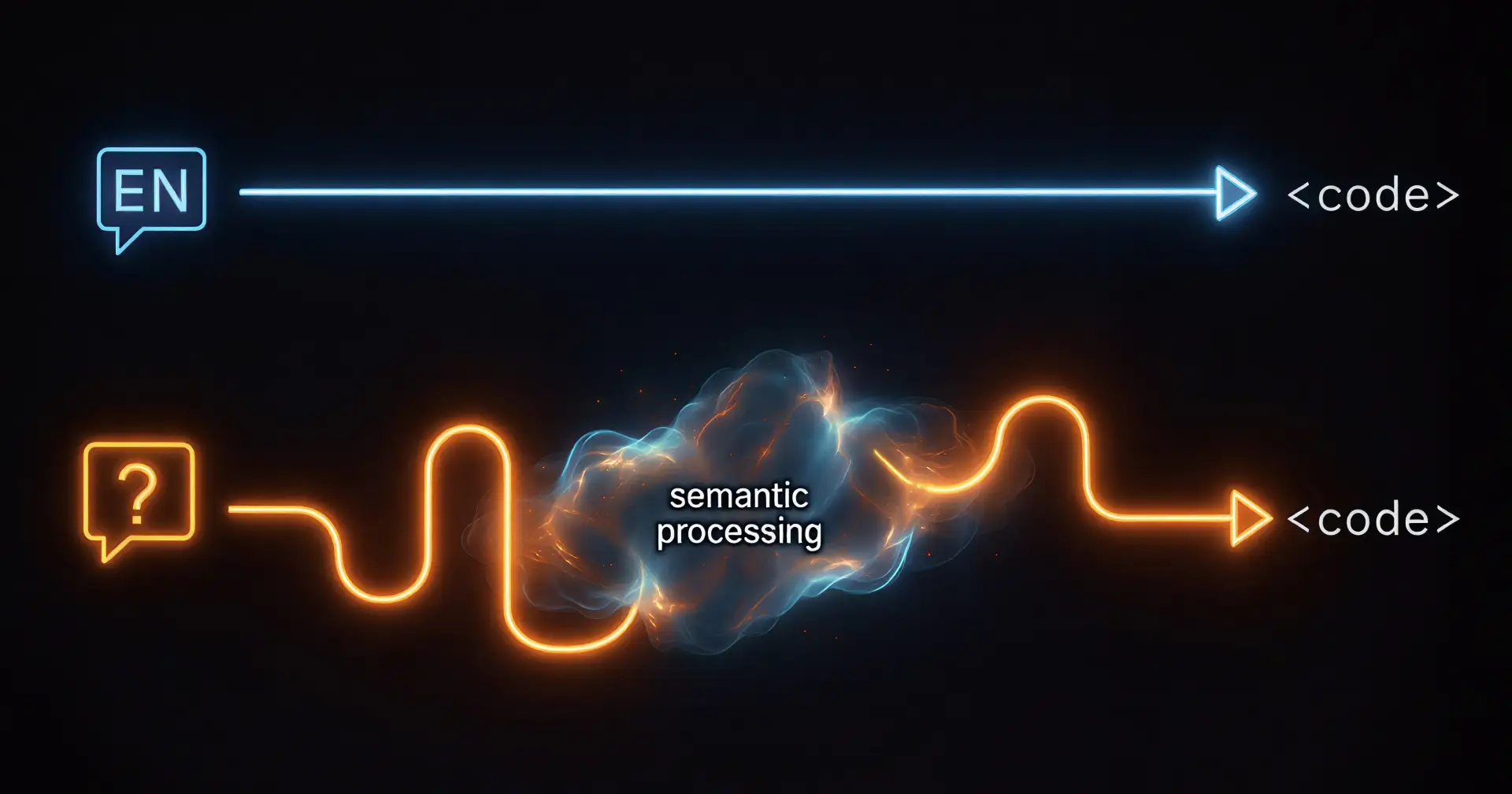
Modern LLMs are impressively multilingual. You can ask for a recipe in Italian or a haiku in Japanese, and the result is usually great. But when it comes to software engineering, complex logic, or debugging, does the language you use to prompt actually matter?
The short answer is: It can, especially for complex tasks and less-resourced languages.
It's not about one language being "better" than another—it's about training data distribution and pattern density.
The English Advantage in Technical Domains
The vast majority of high-quality technical data—GitHub repositories, Stack Overflow discussions, documentation, and research papers—is written in English.
Here's what actually happens: LLMs don't "translate" between languages. They work with semantic representations that are largely language-agnostic. The real issue is pattern density. When you prompt an AI to solve a complex coding problem, the model draws from patterns it learned during training:
English Prompt: The model has encountered thousands of similar technical discussions, debugging sessions, and architecture explanations in English. It has dense, rich patterns to match against.
Non-English Prompt: The model relies on sparser technical examples in that language, which can lead to less precise responses or subtle logic errors—especially when deep problem-solving is required.
Important nuance: This effect varies dramatically by both language and task complexity.
Major languages (Spanish, French, German, Mandarin, Japanese) have substantial technical content and generally perform well for most coding tasks.
Lower-resource languages show more noticeable differences, particularly for complex reasoning tasks.
Code Language vs. Explanation Language
It's important to separate two different aspects:
The language of your code (variable names, comments, function names).
The language of your explanation/instructions to the AI.
For maximum clarity and consistency, keeping code-related elements in English is generally recommended regardless of your prompt language. This avoids:
Inconsistent terminology between prompt and output.
Mixed-language variable names that reduce code readability.
Confusion around technical terms that don't translate cleanly.
A Practical Consideration: Token Efficiency
There's also a technical factor: English is often more token-efficient than many other languages. The same semantic content typically requires fewer tokens in English, meaning you can fit more context into the model's context window—which can matter for complex tasks requiring extensive context.
Practical Tips for Developers
You don't need to abandon your native language, but being strategic helps:
1. Match the prompt language to the task type
Cultural/Local Tasks: Marketing copy for local clients, explaining regional regulations, or generating customer support responses → Use your native language. The AI needs cultural context, not pure logic.
Simple Technical Tasks: Basic CRUD operations, standard algorithms, simple refactoring → Any major language works fine.
Complex Technical/Architectural Tasks: Database schema design, debugging race conditions, algorithm optimization → English maximizes the model's access to relevant problem-solving patterns.
2. Always keep code elements in English Regardless of your prompt language, keep variable names, function names, comments, and technical terminology in English. This maintains consistency and readability.
3. Hybrid approach when needed You can get the best of both worlds with explicit instructions:
"Analyze this code for memory leaks. Explain the logic in [Your Language], but keep all code, comments, and technical terms in English."
This works particularly well when you need explanations you can easily share with non-technical stakeholders in your native language, while maintaining code quality.
The Bottom Line
LLMs work through statistical pattern matching, not literal translation. For complex technical tasks, prompting in English—or at least keeping code-related elements in English—aligns your request with the densest concentration of relevant training data.
This doesn't mean other languages "don't work." For straightforward tasks in major languages, you'll likely see negligible differences. But for complex technical problems requiring deep reasoning, you're statistically more likely to get precise, reliable output when you leverage the language where the model has seen the most similar problem-solving patterns.
Think of it as choosing the right tool for the job: use the language that gives the model the richest context for your specific task.

Join Nuno on Peerlist!
Join amazing folks like Nuno and thousands of other builders on Peerlist.
0
6
0