

Stop Treating All Bad Code the Same: A Developer's Guide to the 4 Types of Tech Debt
Ask any developer how they feel about their current codebase, and you'll likely get a heavy sigh followed by a vague wave toward "all this tech debt." We invoke it in retros, plan around it in sprint planning, and use it to explain every slow build and mysterious bug.
But here's the uncomfortable truth: when we label every piece of imperfect code as "technical debt," the term becomes meaningless. Copy-pasting a massive function because you were too lazy to write a utility class is not the same as hardcoding a config value to hit a Friday release deadline.
One is negligence. The other is strategy.
When developers lump all messy code under one umbrella, we lose the ability to advocate for fixing any of it. Tell a stakeholder "everything is broken" and they'll assume you're being dramatic. But show them a specific, categorized list of liabilities — with business risk attached to each — and suddenly you're speaking their language.
To actually manage code rot, we have to stop treating all bad code the same.
The Technical Debt Quadrant
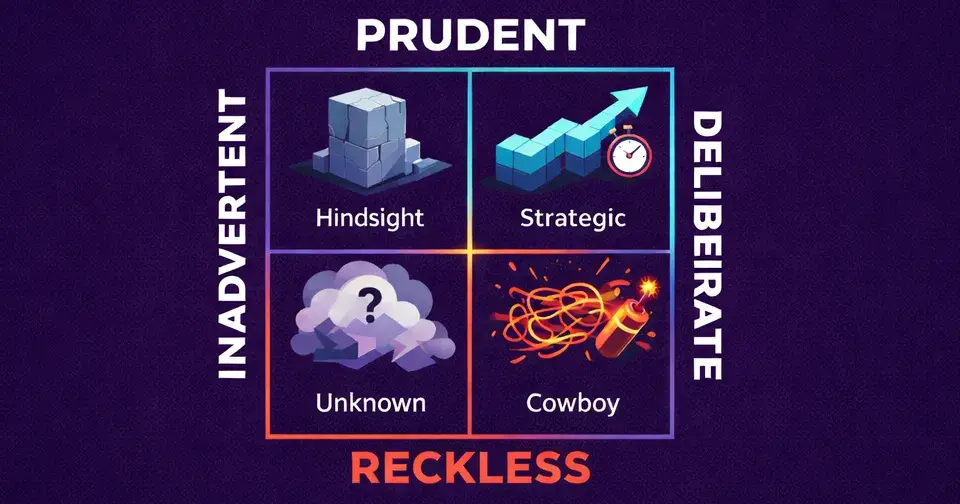
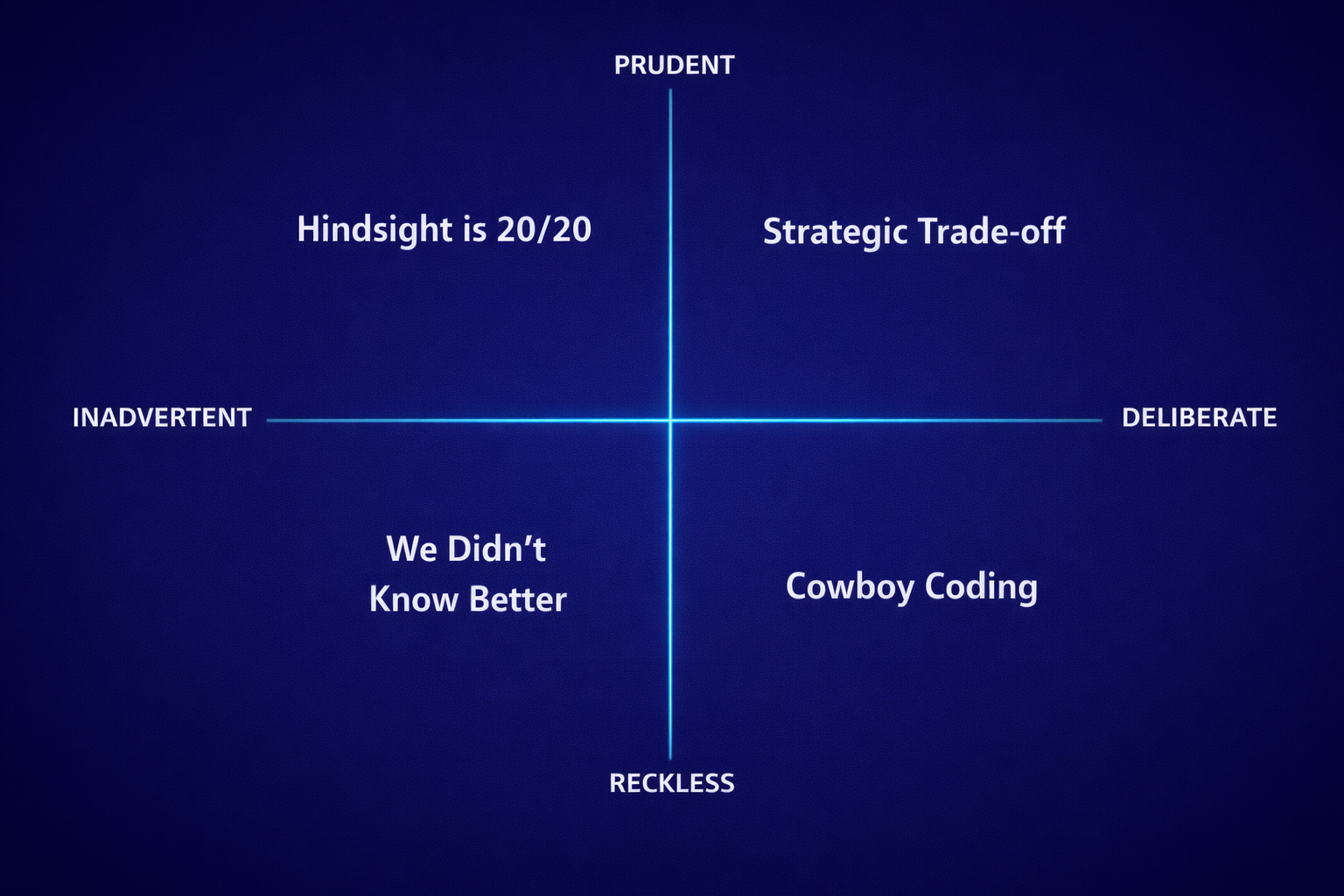
Martin Fowler's Technical Debt Quadrant frames debt along two axes:
Intent: Was the shortcut taken deliberately, or by accident?
Prudence: Was the decision made thoughtfully, or recklessly?
Cross those axes and you get four distinct types of debt, each with a different cause, a different cost, and a different fix.
1. Reckless & Inadvertent — "We Didn't Know Any Better"
What it looks like:
A junior developer builds a 3,000-line "God class" that handles user authentication, billing logic, email formatting, and PDF generation — because nobody told them not to. A well-meaning team adopts a shiny new ORM without understanding it, and six months later the app grinds to a halt under catastrophic N+1 database queries. A backend engineer implements a caching layer that works perfectly in local tests but silently corrupts data in production due to a subtle race condition nobody anticipated.
Why it's the most dangerous type:
You don't know you have it until something breaks. There's no ticket, no paper trail, no comment in the code that says "this might be a problem." It accumulates invisibly, baked into systems that appear to work fine — until they don't.
This debt is born from skill gaps, missing architectural guidelines, poor onboarding, or simply the unavoidable reality that good judgment comes from experience, and experience comes from bad judgment.
How to address it:
You can't schedule a sprint to fix something you haven't found yet. The only real defence is a proactive one:
Pair programming and code review culture. Not rubber-stamping PRs, but genuine knowledge transfer where senior engineers explain why a pattern is problematic, not just that it is.
Architectural decision records (ADRs). Document the patterns the team has agreed on so newcomers aren't making foundational decisions in a vacuum.
Static analysis and linting. Tools like SonarQube, ESLint, or Pylint catch entire categories of this debt automatically before it ever merges.
The goal is to shrink the gap between what a developer knows and what the codebase demands of them.
2. Reckless & Deliberate — "Cowboy Coding"
What it looks like:
"I know I should extract this business logic into a service layer, but copy-pasting is faster and we're almost out of time." Skipping unit tests entirely because "it works on my machine." Hardcoding credentials directly into application code because proper secrets management "seems complicated." Merging a feature branch directly into main to sidestep a CI pipeline that's been failing for two weeks.
Why it's actually sabotage:
Let's be precise: this is technical sabotage masquerading as debt. Calling it debt implies there was a considered trade-off — some future value gained by incurring a present cost. Cowboy coding offers no future value. It's the equivalent of maxing out a credit card to buy lottery tickets.
It happens for two reasons. The first is pure laziness. The second — and this one deserves empathy — is developers buckling under unrealistic product pressure without the organizational support to push back. Either way, the result is the same: code that immediately begins taxing every developer who touches it next.
How to address it:
Zero tolerance, enforced at the process level rather than the culture level.
Block it at the PR stage. A good PR template that requires test coverage, documents rollback plans, and flags any deliberately bypassed patterns is far more reliable than hoping people will do the right thing voluntarily.
Cut scope, not quality. If a deadline is so tight that it requires shipping garbage, the right answer is a smaller feature done correctly — not a larger feature held together with duct tape.
Create a safe environment for "no." Engineers who feel they can push back on unrealistic timelines don't need to make bad decisions quietly. This is a leadership problem as much as a technical one.
3. Prudent & Inadvertent — "Hindsight is 20/20"
What it looks like:
Two years ago, your team made a sensible architectural decision. A monolithic Rails app made complete sense for a startup with five engineers and ten thousand users. The schema was clean, the codebase was navigable, and the deployment process was a single command.
Then the business grew. Traffic increased 100x. Three new engineering teams were added. What was once a clean monolith is now a coordination nightmare — every deploy is a high-stakes event, and a bug in the payments module can take down the onboarding flow with it.
Nobody did anything wrong. The context of the business changed, and the architecture didn't change with it.
Why developers struggle with it:
This type of debt carries an emotional weight the other types don't. The engineers who wrote the original system are often still around, and refactoring it can feel like a criticism of past decisions. It isn't. It's the natural lifecycle of software in a changing business. The code that got you to $1M in revenue is rarely the code that gets you to $10M.
How to address it:
Continuous, incremental refactoring — not big-bang rewrites.
The Boy Scout Rule. Leave every module you touch a little better than you found it. Add a missing test. Extract a method. Update a pattern to match current standards. It doesn't have to be a refactoring sprint to be meaningful.
Strangler Fig pattern for larger migrations. Rather than rewriting a component from scratch, build the new behaviour alongside the old one and gradually route traffic to it. This is how Netflix, Shopify, and countless others have moved off legacy systems without a single high-stakes cutover.
Make the work visible. This debt is easy to dismiss because nothing is visibly broken. Track modernization work in your backlog with explicit business justification — "this reduces our deploy time from 45 minutes to 8 minutes" lands better than "we need to refactor the build pipeline."
4. Prudent & Deliberate — "The Strategic Trade-off"
What it looks like:
Your team needs to integrate with a third-party payment processor. The right long-term solution is a generic payments abstraction layer that would let you swap providers without touching business logic — but building it properly will take two extra weeks. A competitor just announced a similar feature. The PM and CTO have agreed: ship the direct integration now, build the abstraction layer in Q3.
The code is tightly coupled. Everyone knows it. The decision is documented. There's a ticket.
Why this is the only truly healthy debt:
This is what financial debt actually looks like. You're borrowing against future engineering time to generate present business value. You know the principal (the technical cost of the coupling). You know the interest rate (how much harder every future payment change will be). You've decided the return on investment justifies it.
The key differentiator between this and Reckless & Deliberate debt isn't the shortcut — it's the intent, the awareness, and the plan.
How to manage it:
Treat it like a loan, because it is one.
Document it at merge time, not later. The moment a PR introducing strategic debt is merged, a ticket should exist in your backlog covering four things: what corner was cut, why, what the long-term solution looks like, and the target quarter for remediation. "Later" is not a date.
Give it a blast radius estimate. How many systems does this affect? What breaks if the workaround stays in place for a year? Two? This forces the team to be honest about whether the trade-off is actually prudent or just optimistic.
Revisit it on a schedule. Monthly or quarterly debt reviews prevent strategic debt from aging into reckless debt by accident. A deliberate shortcut from two years ago that nobody remembers making is no longer deliberate.
How to Talk About This With Stakeholders
The quadrant isn't just a mental model for engineers — it's a communication tool.
When you walk into a conversation about refactoring with "we have a lot of tech debt," you're asking for an undefined amount of time to fix an undefined problem. That's an easy no.
When you walk in with "we have an architectural bottleneck in our checkout service — it was the right call two years ago, but the business has grown past it. It's costing us roughly 15 engineering hours per sprint in workarounds, and it'll take six sprints to fix properly" — that's a business decision. Stakeholders can weigh that.
Categorise your debt. Quantify it where you can. And stop letting Reckless debt masquerade as inevitable technical reality.
The Bottom Line
Stop apologising for Prudent debt. It's a sign that your team makes deliberate, informed trade-offs under real business constraints. That's engineering maturity, not failure.
Stop tolerating Reckless debt. Be ruthless in code reviews. Build processes that make the lazy path harder than the right path. And if your organisation's pressure consistently forces the cowboy option, that's a conversation worth escalating — because the bill always comes due.
Not all bad code is created equal. Learn the difference, and you'll stop fighting your codebase and start engineering it.

Join Nuno on Peerlist!
Join amazing folks like Nuno and thousands of other builders on Peerlist.
0
8
0