

Null Script vs Encrypted Classified Script: What's the Real Difference (and Which One Should You Actually Use)?
How Script Ownership Impacts Customization, Security, and Future Scaling
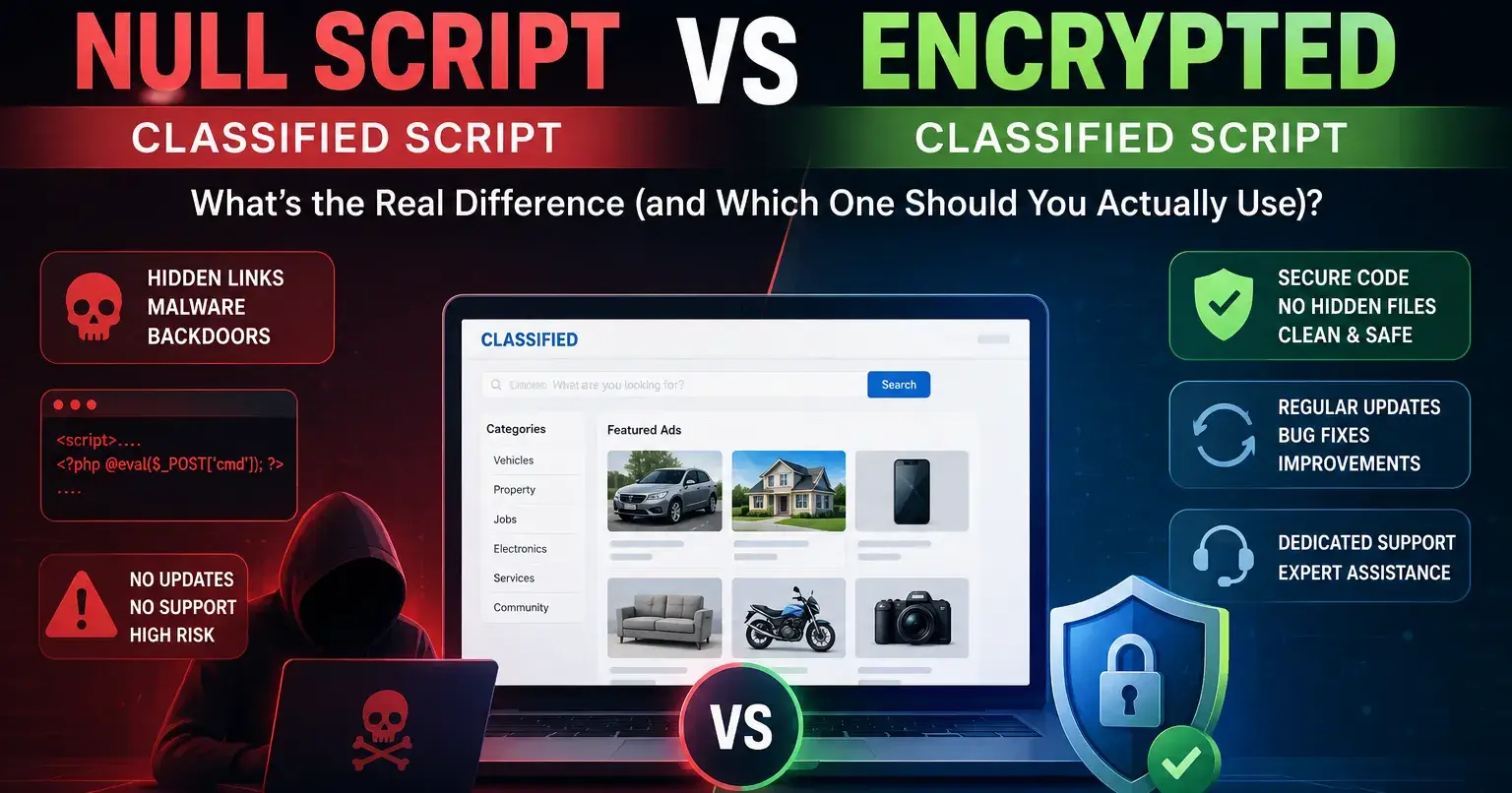
When you decide to build a classified ads website, you quickly run into a fork in the road. Search for a classified script and you'll find the same product showing up in two versions. One is sold by the original vendor with a license, sometimes called an "encrypted" version. The other is floating around on download sites for free, usually labelled "nulled". Same name, same screenshots, very different products underneath.
The question is which one to actually use. The answer depends on what each version really is and what each one quietly costs you after launch.
What a "null script" actually is
A null script is a paid classified script whose license check has been removed. Somebody bought the original, edited the part that verifies the license key, and re-uploaded it for free. From the outside, it looks identical to the paid one. The admin panel works. The ad-posting form works. The demo looks like the demo on the official site.
The reason it's free is that whoever cracked it doesn't do that work for nothing. They add things. Hidden links in the footer pointing to gambling sites. Ad injection that shows extra banners on your listings. A small file that creates an admin account they can log into months later. You won't see any of this on day one. You'll see it the first time your site behaves strangely and you don't know why.
What an "encrypted" classified script is
The encrypted version is the opposite situation. You buy the script from the original developer, and most of the source code arrives in a sealed form. The vendor has run it through an encoder — IonCube, Zend Guard, or SourceGuardian are common ones in PHP — which turns the readable code into a kind of locked bytecode. Your server still runs it, but if you open the files in a text editor you'll see scrambled output. The encoder also lets the vendor tie your copy to your domain, so the files can't be moved elsewhere and reused.
As a buyer, you get a clean copy of the script, a license tied to your project, ongoing updates, and someone to email when things break. What you give up is the freedom to dig into the core code. Templates and configuration files stay open so you can change the look and basic settings, but the deeper logic — how listings get approved, how the search works, how payments flow — sits behind the encoder. You can build on top of it. You can't rewrite it.
Why a nulled script feels free and isn't
The appeal of the nulled version is obvious. The official script might cost a few hundred dollars; the nulled one is free. If you're testing a small idea, that's tempting. But the bill arrives later, in a form you didn't sign up for, and it usually comes in three parts.
The first bill is security. Independent research from security firms like Sucuri has shown again and again that nulled software is one of the most common ways malware gets onto live websites. Hidden admin users, scripts that re-infect a site after cleanup, spam links injected into your own listings — these aren't rare events, they're the pattern. For a classified site, that's worse than for a normal blog, because you're holding user data: names, phone numbers, photos, sometimes payment details. A backdoor on a marketplace isn't an inconvenience, it's a breach.
The second bill is updates. The vendor pushes patches when security flaws are found. You can't apply those to a nulled script — the moment you do, the license check kicks back in and the site stops running. So your code freezes at whatever version you downloaded, on a site that's public and being scanned by every bot on the internet.
The third bill is the one most founders don't think about: the trouble lands on you, not on whoever cracked it. If the site spreads spam links, search engines notice and your traffic disappears. If the host detects malware, your account gets suspended. If users find out their data leaked, the legal and reputational mess is yours. Saving the license fee can quietly cost you the project.
Where the encrypted version is strong, and where it isn't
The encrypted version takes those three bills off the table. The code is what the vendor shipped, with nothing extra hidden inside. You get security updates as they come out. If something goes wrong, there's a support team whose job it is to answer. For most buyers, that alone justifies the price, because a marketplace that gets hacked in month two doesn't really exist anymore.
The honest catch is flexibility. If you wanted to make the script heavily yours — change how listings get matched, add a workflow nobody else offers, swap out the payment logic — the encoded core will frustrate you. You can theme it, configure it, write add-ons against what the vendor exposes. You can't open the engine and rebuild it. For a buyer who treats the script as a finished product, this is fine. For a buyer who wanted a starting point to build something distinct, it's a real limit.
So which one should you actually use?
It depends on what kind of buyer you are. If your plan is to launch a classified site that looks roughly like the demo, get users on it, and improve it slowly, the encrypted licensed version is the safer choice. The licence fee, spread over a year, is small compared to one weekend cleaning up a malware infection.
If you plan to customise heavily — workflows the off-the-shelf product doesn't support — the encrypted version may feel too rigid. In that case, look for a vendor who sells a licensed but un-encoded version, so you keep the right to modify the core. Some classified-script vendors offer this; ask before you buy.
The one option that almost never works out is the nulled one. It looks free at download and ends up the most expensive route over twelve months, because every problem it creates lands on you. Most founders who try it once don't try it twice.
Before you commit, three checks save a lot of regret. Ask the vendor what percentage of the code is actually encoded, so you know how much you can modify later. Ask how often they release updates and patch security issues. And ask what happens to your licence if the company goes quiet — a perpetual licence is worth real money; a subscription that bricks your site if you stop paying is worth less than it looks.
A simple way to think about it
A classified script is the foundation of your marketplace. Everything you build on top — branding, marketing, your buyers and sellers — sits on it. A nulled script puts that foundation on someone else's terms. A licensed script puts it on yours.
If you're at the point of choosing, the right move is to pick a clean licensed version from a vendor that actually maintains the product. A properly licensed classified script, or any developer of similar standing, gives you a much more honest starting line than a free download. The marketplaces that survive aren't the ones that started cheap. They're the ones that started clean.

Join Asim on Peerlist!
Join amazing folks like Asim and thousands of other builders on Peerlist.
0
0
0