

Real Estate Website Development: Custom vs Ready-Made Solutions Explained
Understanding the differences, costs, and long-term impact of custom and ready-made real estate website solutions.
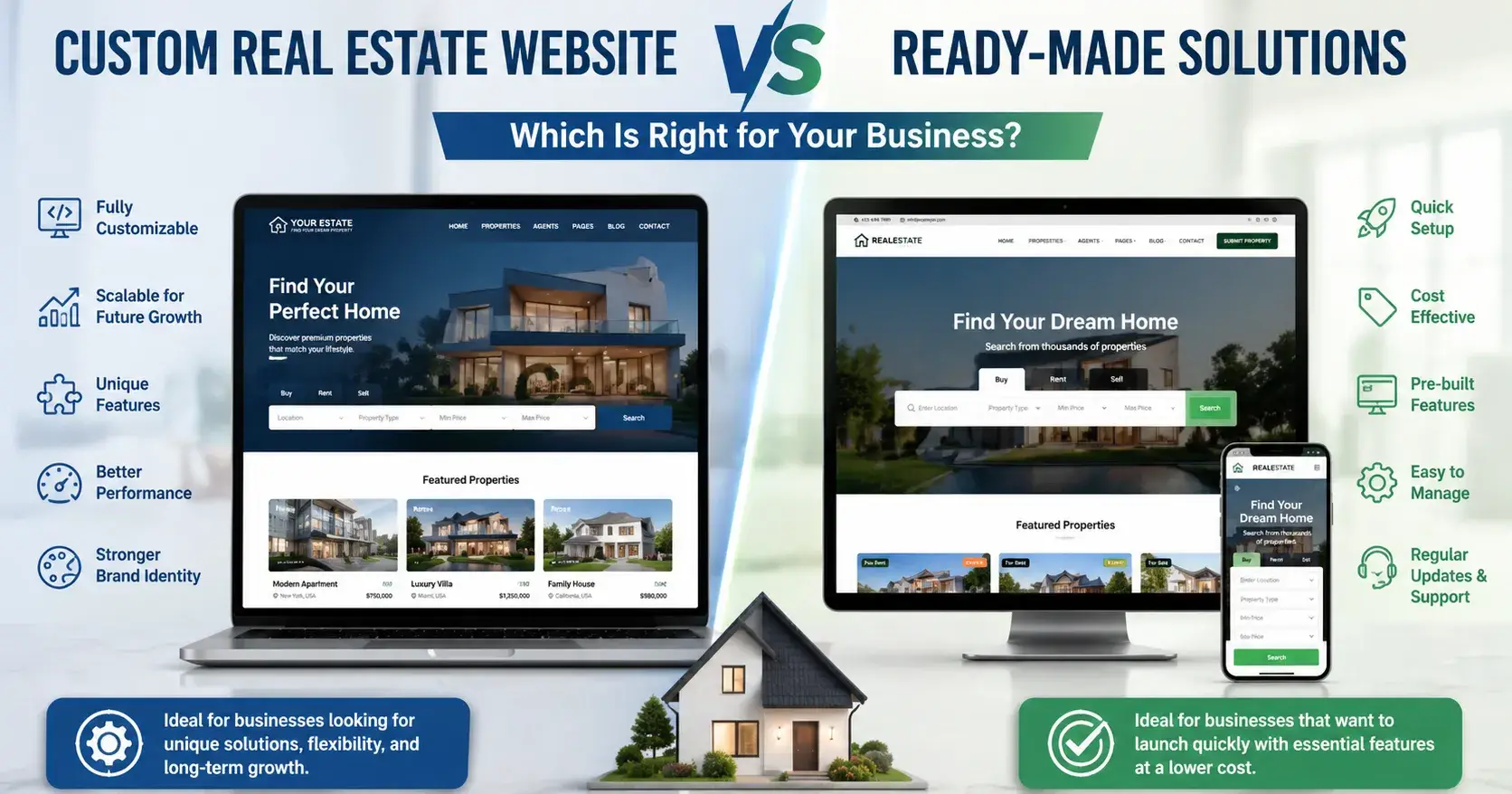
The real estate industry has rapidly shifted online. Today, most property buyers begin their search on the internet before contacting an agent. This change has made it essential for real estate businesses to have a strong digital presence. A well-built website is no longer optional—it’s a core business tool.
However, one major decision often confuses business owners: should you build a custom real estate website or go for a ready-made software solution?
This choice directly impacts your cost, time, scalability, and long-term success. In this blog, we will break down both options in a practical and easy-to-understand way.
Why Real Estate Businesses Need a Dedicated Website
Before comparing development approaches, it's important to understand why having a dedicated real estate website matters.
A website helps you:
Showcase property listings in a structured way
Capture leads directly without depending on third-party platforms
Build trust with potential buyers
Offer better search and filter experiences
Control your branding and user experience
Platforms like property marketplaces are useful, but relying only on them means you’re competing with thousands of listings. Your own website gives you control.
What is Custom Real Estate Website Development?
Custom development means building your website from scratch based on your exact business requirements.
Everything is designed specifically for you:
Layout and UI
Features and functionalities
Backend system
Integrations
Advantages of Custom Development
1. Full Flexibility
You can build exactly what your business needs. Whether it's advanced property filters, map integrations, or unique user dashboards, everything can be tailored.
2. Scalability
As your business grows, your website can evolve. You are not limited by pre-built constraints.
3. Unique Branding
Your platform looks different from competitors, helping you stand out in a crowded market.
4. Better Performance Control
You can optimize speed, SEO structure, and performance based on your audience.
Challenges of Custom Development
1. Higher Cost
Building from scratch requires a larger initial investment.
2. Longer Development Time
It can take weeks or even months to launch.
3. Requires Technical Expertise
You need a reliable development team to manage and maintain it.
What is Ready-Made Real Estate Software?
Ready-made solutions are pre-built platforms designed for quick deployment. These are scripts or software that already include common features needed for a real estate website.
Advantages of Ready-Made Solutions
1. Faster Launch
You can go live within days instead of months.
2. Lower Initial Cost
Compared to custom development, it’s much more budget-friendly.
3. Pre-Built Features
Most essential features like property listings, search filters, user login, and admin panels are already included.
4. Easier to Manage
Many solutions are designed for non-technical users.
Challenges of Ready-Made Solutions
1. Limited Customization
You may not be able to fully modify the system based on unique needs.
2. Similar Design as Others
Other businesses using the same script may have similar layouts.
3. Scalability Limitations
As your platform grows, you may face restrictions.
Understanding the Right Choice for Your Business
Choosing between custom and ready-made is not about which is better—it’s about what suits your business stage.
If you are a startup or testing a business idea, a ready-made solution can be a smart starting point. It allows you to enter the market quickly without heavy investment.
On the other hand, if you already have a clear vision, budget, and long-term growth plan, custom development can give you more control and flexibility.
Many businesses actually follow a hybrid approach:
Start with a ready-made solution
Validate the market
Then move to a custom platform later
This reduces risk while allowing growth.
Key Factors to Consider Before Deciding
1. Budget
If your budget is limited, ready-made software is a practical choice. Custom development requires higher upfront investment.
2. Time to Market
If you need to launch quickly, ready-made solutions are ideal. Custom development takes time.
3. Business Goals
Are you building a simple listing platform or a large-scale marketplace? Your goal will influence your choice.
4. Technical Support
Do you have access to a reliable development team? Custom solutions require ongoing support.
5. Future Expansion
Think long-term. Will your platform need advanced features later?
Real-World Scenario
Let’s say a local real estate agent wants to create a website to list properties in a specific area.
If the goal is to quickly attract local buyers and generate leads → Ready-made solution works well
If the goal is to build a large-scale marketplace with multiple agents and advanced features → Custom development is better
This is why there is no one-size-fits-all answer.
Making the Right Decision
At some point, every business owner asks:
Should I invest more now or start small and grow later?
That’s where the concept of “Custom Real Estate Listing website vs Ready-Made Solutions: Which Is Right for Your Business?” becomes important. The answer depends on your current stage, resources, and long-term vision.
Instead of rushing into development, it’s better to:
Understand your audience
Define your core features
Set a realistic budget
Plan for future growth
A wrong decision here can lead to wasted time and money.
Common Mistakes to Avoid
Many businesses make these mistakes while building their real estate platform:
Adding too many features at the beginning
Ignoring mobile responsiveness
Not focusing on user experience
Choosing cheap solutions without scalability
Not planning for SEO and traffic
A simple, well-structured platform often performs better than a complex one.
Final Thoughts
Real estate website development is not just about building a platform—it’s about creating a system that helps you generate leads, build trust, and grow your business.
Both custom development and ready-made solutions have their place. The key is to choose based on your business needs, not trends.
If you are just starting, focus on speed and cost efficiency. If you are scaling, focus on flexibility and long-term growth.
Join Asim on Peerlist!
Join amazing folks like Asim and thousands of other builders on Peerlist.
0
1
0