

The Hidden Problem with ‘Feature-Rich’ Products
Feature-rich products look powerful — but often fail where it matters most
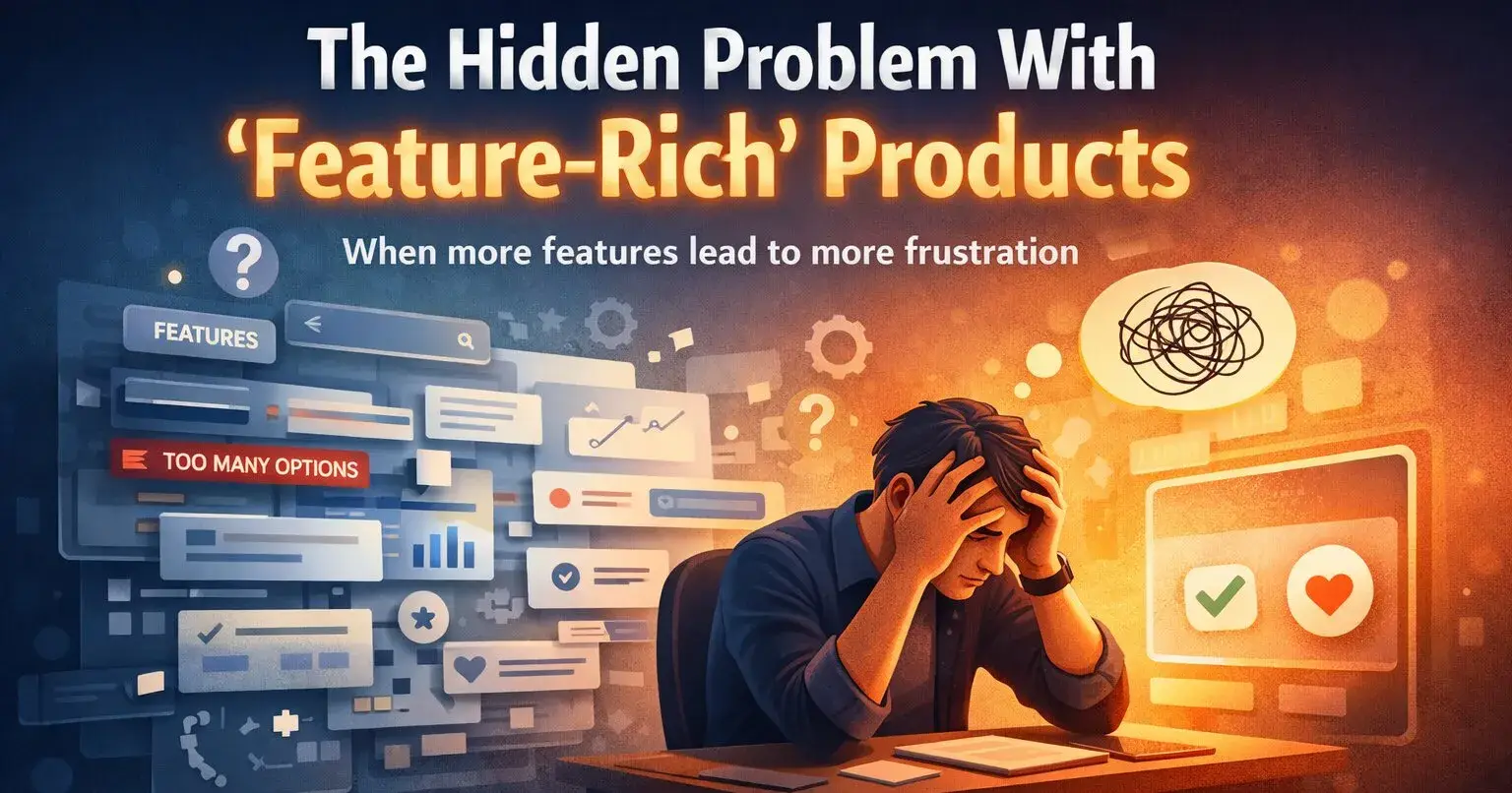
The Illusion of “More Features = More Value”
For a long time, I believed that adding more features naturally made a product better. It felt like a straightforward equation — more functionality equals more value. As a builder, this mindset is almost unavoidable. You start with a simple version, then gradually expand it by adding features that seem useful, either inspired by competitors or driven by internal assumptions about user needs. Over time, the product begins to look more complete and capable.
However, this way of thinking is fundamentally flawed because it measures progress from a builder’s perspective rather than a user’s experience. Users don’t evaluate your product based on how many features it offers. They evaluate it based on how easily they can accomplish what they came to do. The gap between these two perspectives is where many products start to lose effectiveness without the builder realizing it.
The Reality of How Users Actually Behave
The shift in understanding began when I started observing real user behavior instead of relying on assumptions. What became clear very quickly was that users were not interacting with the product in a feature-driven way. They were not exploring or experimenting. Their behavior was focused, repetitive, and goal-oriented.
In most cases, the user journey looked something like this:
Search for something specific
Scan a few relevant options
Click and decide quickly
This pattern highlights an important truth. Users are not interested in the depth of your product. They are interested in the speed of their outcome. Features only matter when they directly support that outcome. Anything outside that core flow becomes secondary and often goes unused.
The Hidden Cost of Too Many Choices
One of the most underestimated consequences of feature-rich products is decision fatigue. Every additional option, whether it’s a filter, a setting, or a configuration, introduces a small cognitive decision. Individually, these decisions may seem insignificant, but collectively they slow down the user experience.
This becomes particularly problematic in products where users expect efficiency. When users are forced to make too many decisions, even simple tasks begin to feel time-consuming. The experience loses its fluidity. Users may not consciously identify the issue, but they start to feel that the platform requires more effort than it should. In many cases, this leads to reduced engagement or early exit without any explicit feedback.
Cognitive Load and Interface Complexity
Beyond decision fatigue, feature-heavy products also increase cognitive load. When an interface contains too many elements — buttons, filters, data points, and sections — users are required to process more information at once. Even if each component is useful, the overall experience becomes mentally demanding.
This effect is even more pronounced on mobile devices. Limited screen space and shorter attention spans amplify the problem. Users expect clarity and immediacy. If the interface feels dense or overwhelming, they are less likely to engage deeply. Instead of exploring, they simplify their behavior or abandon the interaction altogether. This is why clarity often outperforms capability in real-world usage.
When Products Lose Their Core Purpose
As more features are added over time, another issue begins to surface — the loss of a clear core purpose. A product that tries to serve too many use cases simultaneously often struggles to communicate its primary function. Users are left unsure about what they should do first or what the platform is truly optimized for.
A well-defined product typically answers three questions instantly:
What is this for?
What should I do first?
How quickly can I get results?
When these answers are not immediately clear, users hesitate. And hesitation directly affects engagement, conversion, and overall satisfaction. What appears to be flexibility from a development standpoint often translates into confusion from a user’s perspective.
The Problem of Silent Drop-Offs
One of the most challenging aspects of feature overload is that it rarely produces obvious failure signals. The product continues to function correctly. There are no crashes or visible errors. Everything appears stable from a technical standpoint.
However, the real impact shows up in behavior. Users leave without interacting deeply. Sessions become shorter. Conversion rates decline gradually. Because users rarely explain why they leave, the root cause remains hidden. This silent degradation makes it difficult to identify the problem early, allowing it to grow over time without direct visibility.
The Builder’s Bias That Drives Complexity
A significant reason behind this issue is the natural bias that builders develop toward their own product. As creators, we understand every feature, every decision, and every layer of functionality. This familiarity creates the illusion that the product is intuitive.
In reality, users approach the product without any of this context. They don’t see the reasoning behind features. They don’t care about the effort invested in building them. Their only concern is whether the product helps them achieve their goal quickly and without confusion. This disconnect between internal understanding and external experience is one of the primary drivers of unnecessary complexity.
Shifting from Feature Thinking to Experience Thinking
Over time, I started to change how I approached product decisions. Instead of asking what features could be added, I began focusing on where the experience felt slow, unclear, or unnecessarily complex. This shift in perspective changes the entire development process.
Rather than expanding the product endlessly, the focus moves toward refining the core experience. Instead of trying to solve every possible use case, attention is given to improving the most common user journeys. This often results in simplifying workflows, removing redundant elements, and making interactions more intuitive. Interestingly, these changes tend to have a greater impact than adding new functionality.
Why Simplicity Is Often Misunderstood
Simplicity is often interpreted as a reduction in capability, but in reality, it is about reducing effort. A simple product is not one that lacks features, but one that presents its features in a way that feels intuitive and easy to use.
True simplicity involves:
Minimizing unnecessary decisions
Structuring actions clearly
Reducing friction in completing tasks
Products that achieve this balance often outperform more complex alternatives. They may appear less powerful on the surface, but they deliver a smoother and more efficient experience, which is ultimately what users value most.
The Long-Term Impact of Feature Overload
If feature overload is not addressed early, its effects compound over time. Each new addition increases complexity, making the product harder to maintain and evolve. Development becomes slower, design decisions become more constrained, and introducing meaningful improvements becomes more difficult.
From a user perspective, the impact is equally significant. New users face a steeper learning curve, and existing users may feel overwhelmed as the product continues to expand. Over time, this reduces engagement and limits growth potential. What started as an attempt to improve the product gradually turns into a barrier to its success.
What Actually Defines a Good Product
After going through this process, one principle became clear. A product is not defined by how much it can do, but by how effectively it helps users achieve their goal. This shifts the focus from feature count to usability, from expansion to refinement, and from complexity to clarity.
It also changes how product decisions are evaluated. Instead of asking whether a feature is useful in isolation, the more important question becomes whether it improves the overall experience. This perspective leads to more intentional development and a stronger alignment with user needs.
Final Perspective
Feature-rich products are not inherently problematic. The real issue arises when features are added without a clear connection to user intent. When that happens, complexity begins to outweigh value, and the product becomes harder to use despite being more capable.
In practice, users rarely choose the product that offers the most features. They choose the one that feels the easiest and most efficient to use. This is what ultimately defines long-term success.
And that raises an important question for anyone building products today — are we creating products that feel more powerful, or products that feel easier to use?

Join Asim on Peerlist!
Join amazing folks like Asim and thousands of other builders on Peerlist.
1
6
0