

The Copy-Paste Tax: Why Writers Lose Hours (and Their Voice) Every Week
Here's why fragmented AI tools break context and what a unified AI writing agent actually fixes.
The Workflow Nobody Talks About
Ask any professional writer or content marketer how they edit an article. Chances are, it looks something like this:
Write a draft in Google Docs. Copy it into Grammarly for grammar. Paste it into ChatGPT to improve tone. Open Hemingway Editor in a third tab for readability. Copy the "improved" version back into the doc. Repeat two or three more times until it feels right.
This is the default workflow for millions of writers in 2026. And on the surface, it seems reasonable, you're using best-in-class tools for each job.
But there's a hidden cost nobody measures: the copy-paste tax.
What the Copy-Paste Tax Actually Costs You
Every time you paste your content into a new tool, three things happen:
Context is lost. ChatGPT doesn't know your article is a thought leadership piece for a B2B SaaS audience. Grammarly doesn't know your brand voice. Hemingway doesn't know you're writing for advanced readers. Each tool sees a fragment, never the full picture.
Suggestions become generic. Without full document context, AI tools default to middle-of-the-road advice. "Shorten this sentence." "Use active voice." Technically correct, but disconnected from what your article is actually trying to do.
Your voice erodes. By the time your draft has passed through four tools and three copy-paste cycles, the writing sounds like it was assembled by a committee. Because it was.
Research shows writers using fragmented AI tool stacks spend 30–40% of their editing time on tool-switching overhead alone, time that produces no actual improvement to the content.
The Root Problem: AI Tools Built to Sit Outside Your Document
Grammarly, ChatGPT, Hemingway, they were all designed as external consultants. You bring content to them. They respond. You carry the suggestions back to your document manually.
This architecture made sense in 2020. In 2026, it's a bottleneck.
The copy-paste workflow forces the writer to act as a manual bridge between AI output and the actual document, breaking focus, introducing errors, and compounding with every revision cycle.
What an AI Writing Agent Does Differently
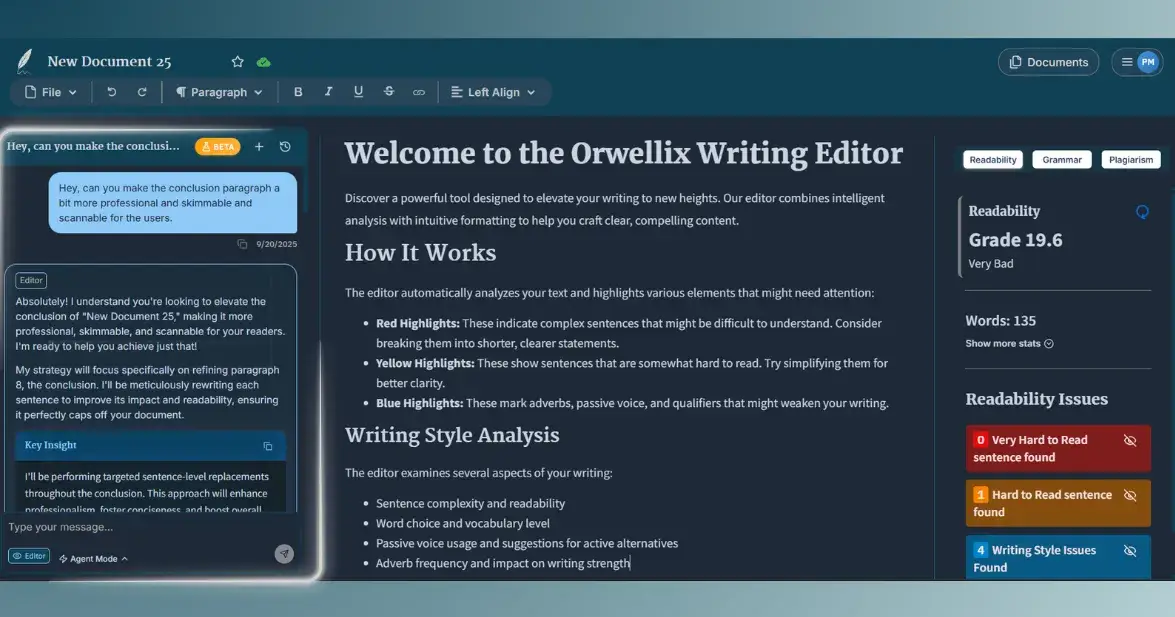
An AI writing agent doesn't sit outside your document. It lives inside it.
This is the core idea behind Orwellix Agent Mode, instead of copying your content into a chat window and hoping the AI understands your intent, Agent Mode reads your entire document from top to bottom, understands the structure, tone, audience, and purpose, and then makes edits directly inside the document editor.
Every change appears as a tracked edit: old element versus new element, compared. You accept what fits. You reject what doesn't. Your voice stays yours at every step.
In a single session, Agent Mode handles:
Grammar and syntax: fixed in context, not in isolation.
Readability: Multi-dimenssional text processing used to score as an active input, not just a report.
Tone and style: adjusted with awareness of what came before and after.
Live web research: Agent Mode searches the web in real time to pull in accurate, current information where needed.
Structure and flow: paragraphs reordered or rewritten when the full document logic demands it.
This replaces the Grammarly + ChatGPT + Hemingway stack, in one pass, inside one tool, at a lower combined cost.
The Real Unlock: Context at Document Scale
Here's what changes when an AI tool has full document context:
A sentence flagged as "too complex" in isolation might be exactly right in context, because it's building toward a punchline three paragraphs later. An AI that sees only that sentence will simplify it. An agent that reads the whole document knows to leave it alone.
This is the difference between a tool that reacts to fragments and an agent that understands intent.
For startup founders writing blog content, freelancers managing multiple client voices, or content teams under publishing pressure, this context-awareness is the edit that makes the difference between content that sounds polished and content that sounds processed.
Try It Yourself
If you write content regularly for your startup blog, a client, or your own audience, the copy-paste tax is already costing you more than you think.
Orwellix is free to try for 7 days, all features unlocked → orwellix.com.
And for the Peerlist community specifically: use PEERLIST20 for 20% off your first year.
If this resonates or if you have a different take on how AI fits into your writing workflow, I'd genuinely love to hear it in the comments.
- Parikhit, Founder Orwellix.

Join Parikhit on Peerlist!
Join amazing folks like Parikhit and thousands of other builders on Peerlist.
0
5
0