

Why Most Indian D2C Brands Fail at Retention (And How to Fix It)
Getting the first order is the easy part. Keeping the customer — that's where Indian D2C brands are quietly bleeding out.
The Number Nobody Puts in the Press Release
India's D2C boom has produced some genuinely remarkable companies. Brands built from scratch in Tier-2 cities. Founders who cracked Instagram before the playbook existed. Products that found real product-market fit in categories that global brands ignored for decades.
But spend enough time inside the actual cohort data of most Indian D2C brands — not the headline GMV, the real numbers — and a pattern emerges.
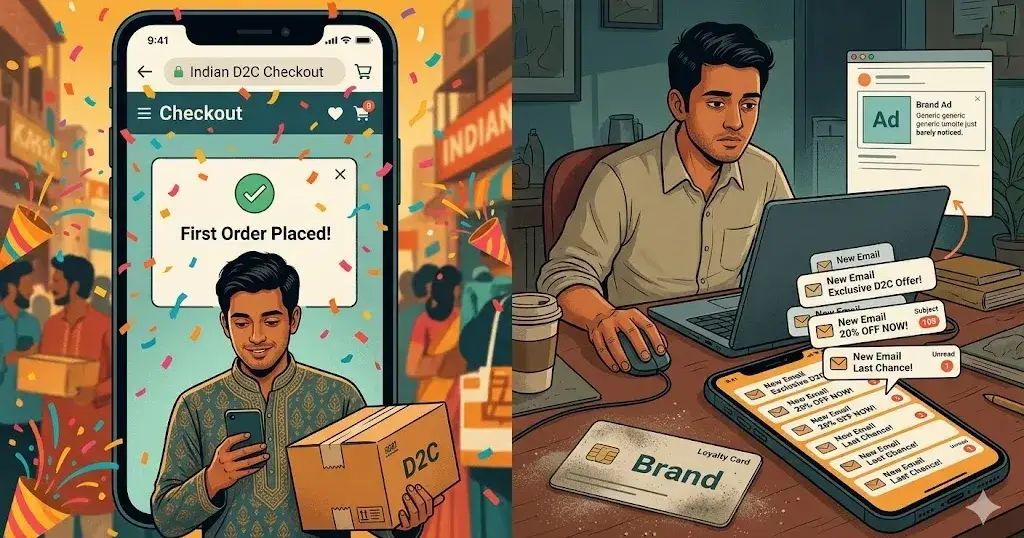
Most customers buy once. And then they never come back.
The industry average for D2C customer retention in India sits between 20–30% for a second purchase within 90 days. In beauty, fashion, and wellness — categories where repeat purchase should be natural — the numbers are often worse. Brands spending ₹800–1,200 to acquire a customer are watching that customer place a ₹700 order and disappear forever.
The math doesn't work. It never worked. And yet the dominant response across the Indian D2C ecosystem has been to run more acquisition, spend more on Meta, launch more influencer campaigns, and hope the funnel fills faster than it empties.
It won't. And the brands that haven't solved D2C customer retention in India are running out of runway to figure it out.
This is what's actually going wrong — and what fixing it genuinely looks like.
Why Most Indian D2C Brands Fail at Retention
1. They Optimised for the Sale, Not the Experience
The first thing most Indian D2C brands built was a performance marketing machine. Meta ads, Google Shopping, influencer seeding. These channels are good at one thing: getting a stranger to make their first purchase. They are terrible at building the kind of relationship that makes someone come back.
The problem is that the entire business — team structure, budget allocation, founder attention — gets organised around acquisition. Retention is an afterthought. A WhatsApp broadcast here. A discount email there. A loyalty points system that nobody understands.
Key Insight: Acquisition brings customers in. Experience is what keeps them. Most Indian D2C brands have world-class acquisition engines and first-year-intern-level retention systems.
The post-purchase experience — the packaging, the delivery communication, the unboxing, the follow-up — is where the second purchase decision is actually made. Not on the next ad the customer sees. By the time that ad runs, the customer has already decided whether they're coming back.
What to fix: Audit your post-purchase journey end to end. Map every touchpoint from order confirmation to delivery to 7-day follow-up. Identify where the experience drops off. That's almost always where retention drops off too.
2. The Discount Addiction Is Destroying Brand Loyalty
This is the most uncomfortable truth in the Indian D2C retention conversation, so most people dance around it.
A significant portion of D2C customer bases in India were acquired on discount. First-order coupon codes. Festival sale pricing. Influencer discount links that never expire. These customers didn't choose the brand — they chose the price. And when the price goes back to normal, they leave.
Discount-acquired customers show 40–60% lower repeat purchase rates than customers acquired at full price. They are also significantly more likely to complain, more likely to return products, and more likely to write negative reviews when something goes wrong.
The brands doing this know it. But stopping feels impossible because the acquisition numbers look good and the pressure to show growth is constant.
The real cost of discount dependency: You are not building a customer base. You are renting one, and the rent is due every time you need them to buy again.
What to fix: Gradually shift acquisition budget toward channels and creatives that attract full-price buyers — content-led discovery, SEO, community, word-of-mouth referral programs. It is slower. The LTV is dramatically higher.
3. They Treat All Customers the Same
Walk into any growing Indian D2C brand and ask them how they segment their customer base for retention marketing. Nine times out of ten, you'll get a blank look followed by "we send the same email to everyone."
This is retention malpractice.
A customer who has purchased five times in twelve months is not the same as a customer who bought once six months ago. They have different motivations, different price sensitivities, different communication preferences, and different risks of churning. Treating them identically is not just inefficient — it actively damages the relationship with your best customers by making them feel like a generic entry in a database.
The RFM framework — Recency, Frequency, Monetary value — is the minimum viable segmentation for any D2C brand serious about retention. Segment your base into at least four groups:
Champions: bought recently, buy often, high spend — reward them, make them feel special, turn them into advocates
At-Risk: used to buy regularly, haven't bought recently — re-engage with personalised outreach, not a mass discount blast
Promising: recent first-time buyers with potential — nurture with education and product discovery, not pressure
Lost: haven't bought in a long time — run a lean win-back sequence, accept that some won't return
What to fix: If you don't have RFM segmentation running, build it this week. It doesn't require expensive tools. A basic Shopify export + Google Sheets + a few well-written email sequences will beat a homogeneous blast campaign every single time.
4. WhatsApp Is Being Used as a Megaphone, Not a Conversation
WhatsApp is the most powerful D2C retention tool in India. Open rates above 85%. A channel where customers are already spending hours every day. Direct, personal, instant.
And most Indian D2C brands are using it to send promotional blasts at 10am on sale days.
This is not retention. This is spam with better delivery rates.
The brands winning at WhatsApp retention are using it differently. They are sending order updates that are genuinely useful. They are triggering personalised replenishment reminders based on actual purchase cycles. They are asking for feedback at the right moment — not with a generic "rate us 5 stars" message, but with a specific question about the specific product the customer bought. They are creating WhatsApp-exclusive content that makes customers feel like insiders, not recipients.
Stat to know: WhatsApp campaigns with personalised, trigger-based messaging show 3–5x higher repeat purchase conversion compared to broadcast promotional messages. The channel is the same. The approach is entirely different.
What to fix: Audit every WhatsApp message you sent in the last 90 days. What percentage were promotional blasts vs. personalised, triggered, useful communications? If the answer is mostly blasts, rebuild your WhatsApp strategy from scratch around utility and personalisation first, promotion second.
5. The Subscription Model Opportunity Is Almost Entirely Untapped
Here is a retention lever that almost every Indian D2C brand in consumables is leaving on the table: subscriptions.
Hair oil. Protein powder. Skincare. Coffee. Pet food. Vitamins. These are products customers need to repurchase regularly. The repurchase behaviour already exists. The question is whether it happens on your platform or on Amazon or at the local kirana.
Subscription models for Indian D2C brands solve the retention problem structurally — instead of hoping the customer remembers to come back, you remove the decision entirely. And the economics are transformational: subscription customers typically show 60–80% lower churn, 2–3x higher LTV, and significantly lower support costs because their experience is predictable and managed.
The objection most Indian founders raise is "Indian customers don't want subscriptions." The data says otherwise. Zepto Pass, Swiggy One, Zomato Gold — Indian consumers have demonstrated enormous appetite for subscription models when the value proposition is clear.
What to fix: If you sell a consumable product with a predictable usage cycle, you should have a subscription option. Start simple — offer a 10–15% discount for subscribe-and-save. Track the attach rate. Improve the experience over time. The LTV improvement will be one of the highest-ROI decisions you make this year.
6. Post-Purchase Communication Is Either Absent or Annoying
Ask most Indian D2C brand founders what happens after a customer places their first order. They'll describe the order confirmation email (automated, generic), the shipping notification (also automated, from the logistics partner), and then... nothing. Until the next promotional campaign.
This silence is where D2C customer retention in India goes to die.
The 0–30 days post-first-purchase window is the most important period in the customer relationship. This is when brand perception is forming. When the customer is deciding whether this was a one-time experiment or the beginning of a real relationship. When they are most open to education, upselling, community, and feedback.
Most brands waste it entirely.
The brands with the best D2C retention rates in India have a deliberate post-purchase sequence that typically looks something like this:
Day 0: Order confirmation with genuine warmth — not just a transactional receipt
Day 2: Shipping update with product usage tips or "how to get the most out of your order" content
Day 7: Check-in — how did the product land? Any questions? A real human tone, not a survey link
Day 14: Introduce complementary products based on what they bought — not a catalogue blast, a specific, relevant suggestion
Day 30: Replenishment reminder (for consumables) or new arrival relevant to their purchase history
What to fix: Build this sequence. It takes two days to set up properly and it will meaningfully move your 90-day repeat purchase rate. Klaviyo, WebEngage, MoEngage — whichever tool you're using, the sequence should exist and it should not sound like a robot wrote it.
7. Community Is the Moat Nobody Is Building
The most durable D2C brand loyalty in India doesn't come from loyalty points or discount codes. It comes from identity — from customers who feel they belong to something that the brand represents.
Mamaearth built early loyalty through new-parent communities. The Sleep Company built advocates through sleep health content that made customers feel educated, not sold to. Bombay Shaving Company built a community around the ritual of grooming, not just the product.
Community is the retention strategy that compounds. A customer who is part of a brand's community doesn't churn when a competitor runs a discount. They're not in the market anymore — they've already decided.
Building community takes longer than running a sale. It requires content, consistency, genuine engagement, and a brand point of view strong enough that people want to associate with it. Most Indian D2C brands don't invest in this because the results are hard to attribute to a specific campaign.
That difficulty of attribution is exactly why it's a moat. What's hard to measure is hard to copy.
What to fix: Pick one community format that fits your brand and category — a WhatsApp group for your top 500 customers, a content series on Instagram that educates rather than sells, a loyalty tier that comes with real access and recognition rather than just points. Start small. Be consistent. Measure it in months, not days.
The Fix: A Retention Stack for Indian D2C Brands
Based on everything above, here is a practical retention stack that any Indian D2C brand can build — regardless of scale:
Foundation Layer (Build First)
RFM segmentation of your customer base — minimum four segments
Post-purchase email/WhatsApp sequence — 6 touchpoints over 30 days
Net Promoter Score survey at Day 10 post-purchase — learn why people love or don't love you
Growth Layer (Build Once Foundation Is Solid)
Subscription or replenishment program for consumable products
Loyalty program — simple, transparent, with rewards that feel meaningful (not just points)
Personalised product recommendation engine — even a manual version works at early scale
Moat Layer (Build for Long-Term Durability)
Brand community — WhatsApp, Discord, Instagram close friends, or in-person events
Content program that builds category authority, not just product awareness
Customer advocacy program — identify your Champions and give them something real to share
Metrics Every Indian D2C Brand Must Track for Retention
If you're not measuring these, you don't know how bad (or good) your retention actually is:
MetricWhat It MeasuresHealthy Benchmark (India D2C)90-Day Repeat Purchase Rate% of first-time buyers who buy again within 90 days25–40% depending on categoryCustomer Lifetime Value (LTV)Total revenue per customer over their lifetimeShould be 3–5x CAC minimumLTV:CAC RatioReturn on customer acquisition spend3:1 minimum; 5:1 is healthyChurn Rate% of active customers lost in a periodCategory-dependent; track trendAverage Order FrequencyHow often active customers buyBaseline for replenishment timingNPS ScoreLikelihood customers recommend youAbove 50 is strong for D2C
Conclusion: Acquisition Gets the Credit. Retention Builds the Business.
The Indian D2C brands that will be standing in five years are not necessarily the ones with the best performance marketing teams. They are the ones that figured out how to make customers come back — not because they ran another discount, but because the experience was good enough, the relationship was real enough, and the product was right enough that returning was the obvious choice.
D2C customer retention in India is not a technical problem. It's an attention problem. Most brands haven't given retention the same obsessive focus they've given acquisition — the same budget, the same team, the same creative energy, the same founder time.
Fix the attention allocation. The metrics will follow.
The brands that crack D2C retention in India over the next three years will have an insurmountable advantage. Their acquisition costs will come down as word-of-mouth and repeat purchase reduce dependence on paid channels. Their margins will improve as LTV rises. Their teams will be easier to build because strong retention is a signal investors and talent both respect.
It's not the flashiest growth lever. It's the most important one.
Frequently Asked Questions
Why do most Indian D2C brands struggle with customer retention? Most Indian D2C brands optimised heavily for acquisition and underinvested in post-purchase experience, customer segmentation, and relationship-building. The result is high one-time purchase rates and low repeat purchase conversion, which makes the unit economics unsustainable over time.
What is a good repeat purchase rate for D2C brands in India? A healthy 90-day repeat purchase rate for Indian D2C brands is between 25–40%, depending on category. Consumables like skincare, supplements, and food should trend toward the higher end. Fashion and lifestyle brands may sit lower but should compensate with higher average order values.
How can Indian D2C brands improve customer retention without discounting? Focus on post-purchase experience, personalised communication, product education, community building, and subscription models. These build genuine loyalty rather than price-driven repeat behaviour, resulting in significantly higher long-term LTV.
What is the best retention tool for Indian D2C brands? WhatsApp — used with personalisation and trigger-based messaging rather than promotional blasts — is the highest-ROI retention channel for Indian D2C brands given its open rates and penetration. Pair it with a solid email automation platform like Klaviyo or WebEngage for a complete retention stack.
What is RFM segmentation and how does it help D2C retention? RFM stands for Recency, Frequency, and Monetary value. It segments your customer base by how recently they bought, how often they buy, and how much they spend. This segmentation allows D2C brands to send the right message to the right customer at the right time, dramatically improving retention campaign effectiveness.
How important is community building for D2C brand retention in India? Community building is one of the highest-LTV retention strategies available to Indian D2C brands. Customers who identify with a brand community show significantly lower churn rates and higher advocacy behaviour. While it takes longer to build than discount programs, it creates a loyalty moat that competitors cannot easily replicate.

Join Parvez on Peerlist!
Join amazing folks like Parvez and thousands of other builders on Peerlist.
1
0
0