

Run High-Risk Payments Across Many Banks Without Losing Control
A control layer for high-risk payment processing keeps your acquirers, keeps your risk, and keeps approvals up across every bank you already use.
High-risk payment processing rarely fails at a single bank. It fails in the wiring between many banks.
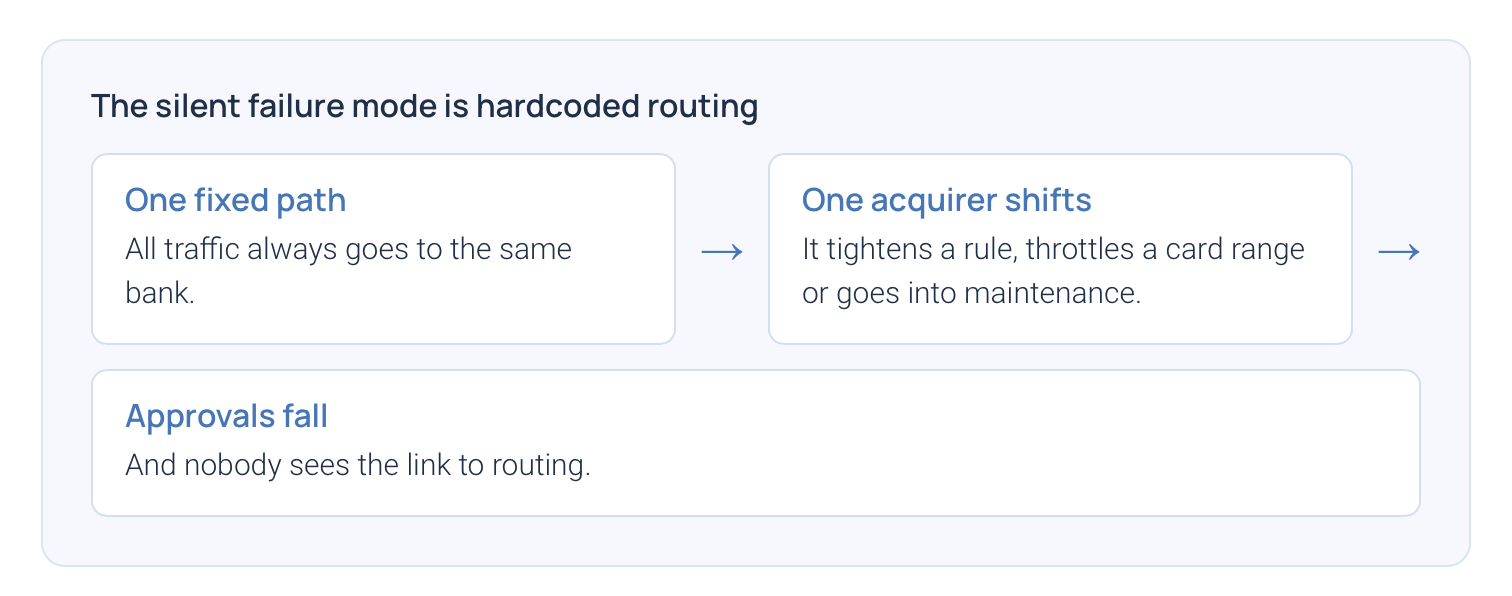
If you run a high-risk business, you already know the pattern: one provider tightens a rule or drops offline, approvals fall, and nobody can say why. You add acquirers for coverage and backup, but each new bank adds more complexity than comfort.
A control layer fixes the wiring without changing who you bank with. It sits above your existing acquirers, decides how payments flow across them, and never become
s your bank or PayFac. That is the whole point.
What a control layer is, in one sentence
In one sentence:
"A control layer sits on top of the banks you already use. It decides how payments flow across them. It never becomes your bank."
Payneteasy is that control layer:
It does not become your provider or merchant of record.
It does not pool your merchants under its own master account.
It does not take on or reassign the money risk for your transactions.
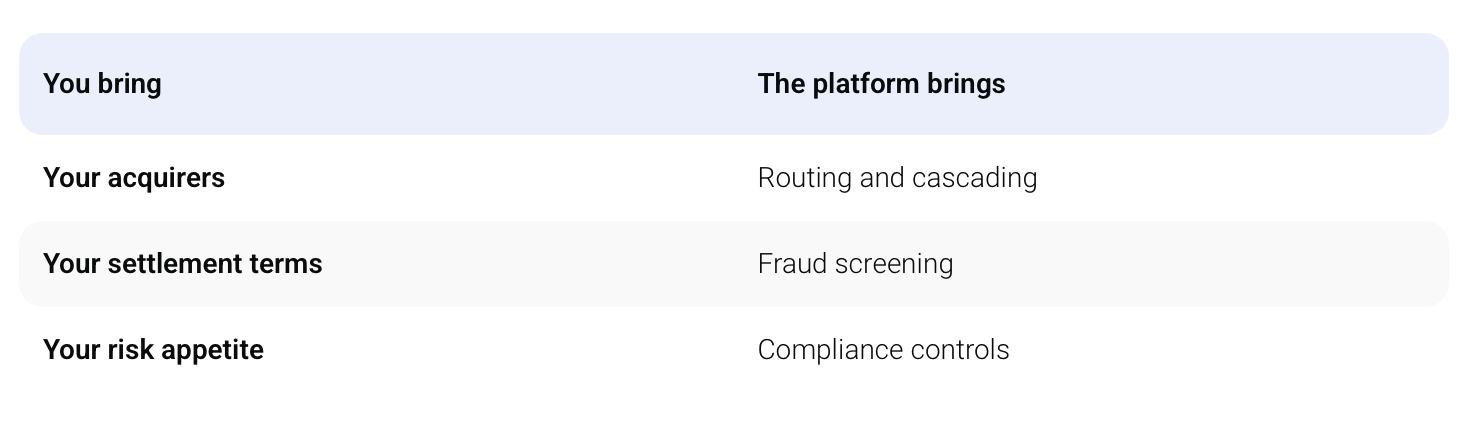
All of it white-label, under your own brand — the controls that make a complicated, heavily-regulated setup manageable.
Read the contract, not the marketing page. Nothing here approves, accepts, brokers, or guarantees a merchant account. Those relationships stay exactly where they are today. That single distinction is the whole point.
Why high-risk payment processing fails at the wiring, not the bank
Most teams in high-risk or tightly regulated categories already have acquirers. The pain starts when they have several:
Each bank has its own tech integration.
Its own risk rules and velocity limits.
Its own reserves, settlement schedules, approved countries and currencies.
You add acquirers for coverage and redundancy, so you can't just cut back to one. But the moment you hold several, complexity grows faster than your sales volume.
Meanwhile, the day-to-day cost keeps growing:
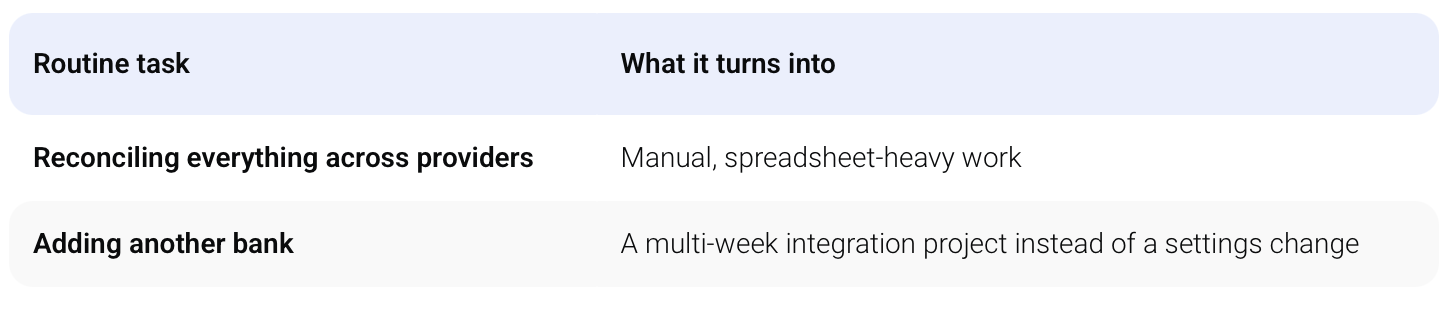
So the real problem is not "finding one more bank." It is running many moving parts correctly at the same time. That is an engineering and control problem. That is the layer Payneteasy sits in.
Smart routing sends each payment to the bank most likely to approve it
Routing should follow the factors that actually decide whether a payment goes through:
card country and scheme,
currency,
card type and BIN,
amount and risk profile,
specific merchant, product line or vertical.
A control layer lets you:
express those rules once, in one place;
apply them consistently across every bank you hold.
The alternative is routing logic scattered through your own code — the thing nobody wants to touch a year later because one wrong change can break everything.
With a control layer:
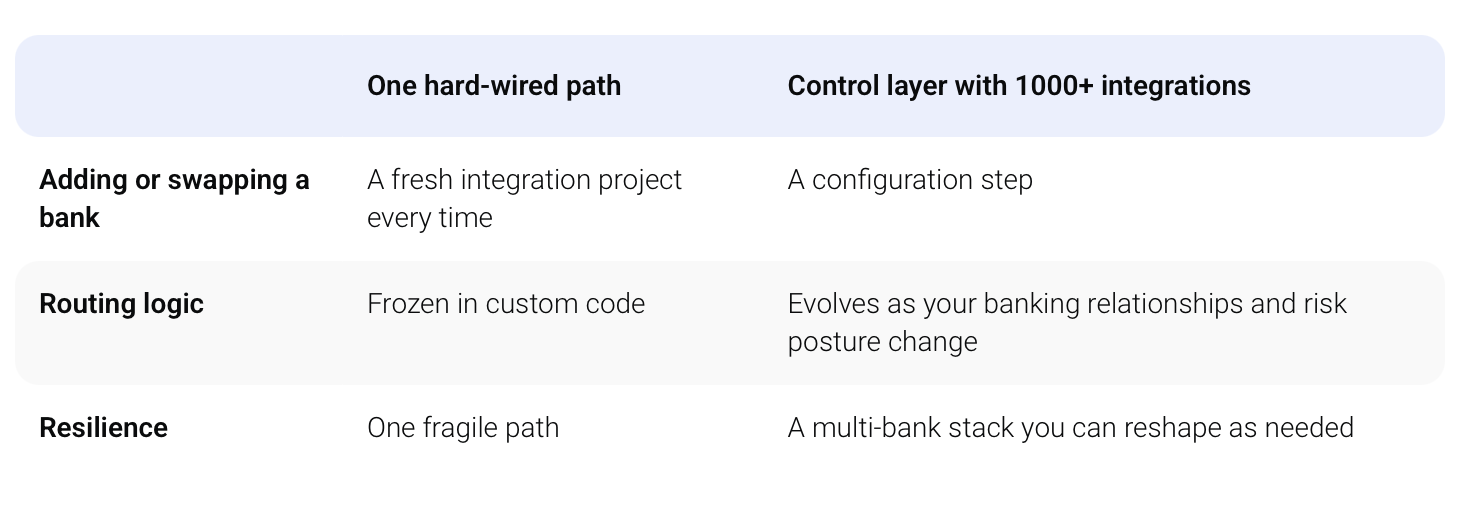
The route is a rule, expressed in configuration instead of custom scripts.
You can adapt routing per acquirer, per merchant segment, per region, without rewriting your stack.
The payoff in human terms:
More good payments land at the bank that is likely to say yes.
Fewer real customers get falsely turned away, especially in border-line risk clusters.
You are recovering revenue you already earned — not scrambling to buy new traffic to make up for lost approvals.
Cascading catches the sale when one bank says no
Routing decides where to send the first attempt. Cascading decides what happens next.
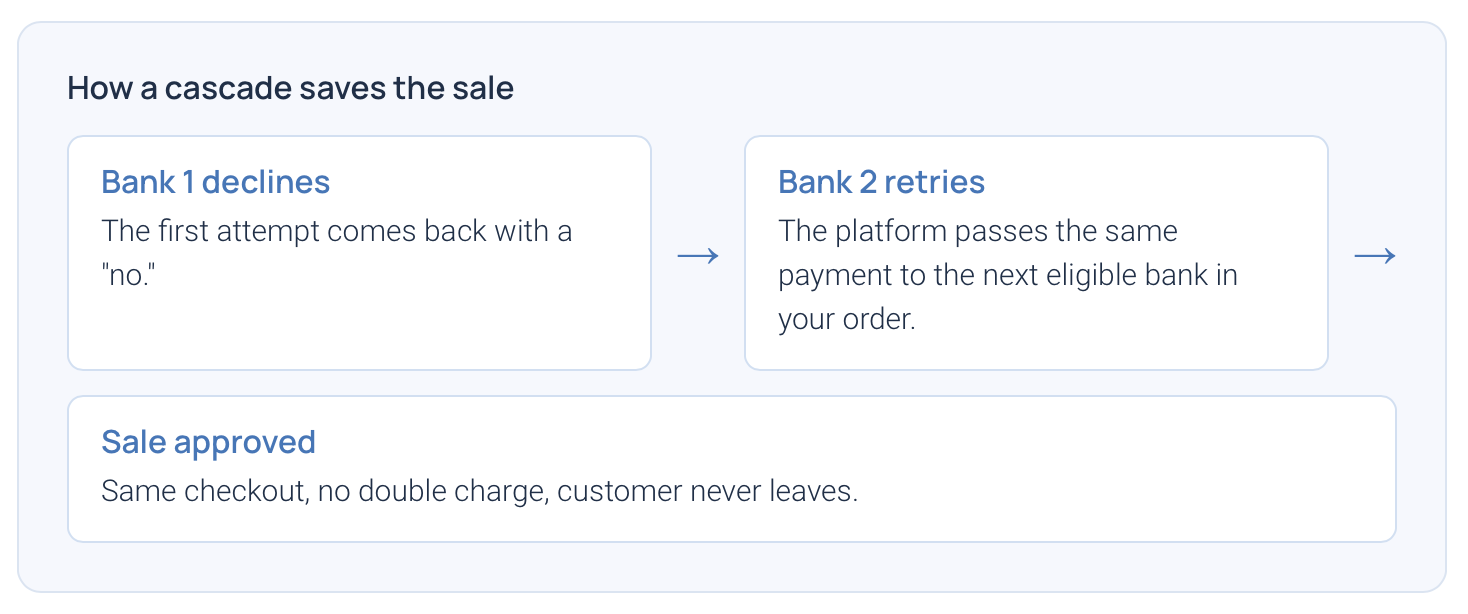
When the first bank declines a payment, the platform automatically passes it to the next eligible bank in your stack, in the order you defined.
Instead of a decline being a hard "no" and a lost sale:
The same payment gets a second chance against a different acquirer.
The customer stays in the same checkout, sees no complexity, and gets another shot before they leave.
You decide which providers see which traffic, in which sequence, for each scenario.
You stay in control of the cascade. The platform just executes it reliably.
Idempotency: why retries don't become double-charges
Safe cascading depends on idempotency, which in practice means: the platform can retry a payment across multiple banks without ever charging the customer twice for the same transaction.
That guarantee is what saves you during outages and maintenance windows. Without idempotency, a retry storm can turn recoverable sales into double-charge complaints and chargebacks.
Behind Payneteasy's control layer are 1000+ pre-built integrations. That matters because your stack stops being a construction project:
150+ fraud filters that learn from your own traffic
In high-risk verticals, fraud control cannot be a static rulebook. It has to sit directly in the payment path, and it has to learn.
Payneteasy screens each payment through 150+ auto-learning fraud filters before it ever reaches a bank:
A filter is a gate that can stop a bad payment up front.
A payment blocked here is filtered, not declined — it never reaches the bank, so it never counts against your decline ratio.
That distinction matters:
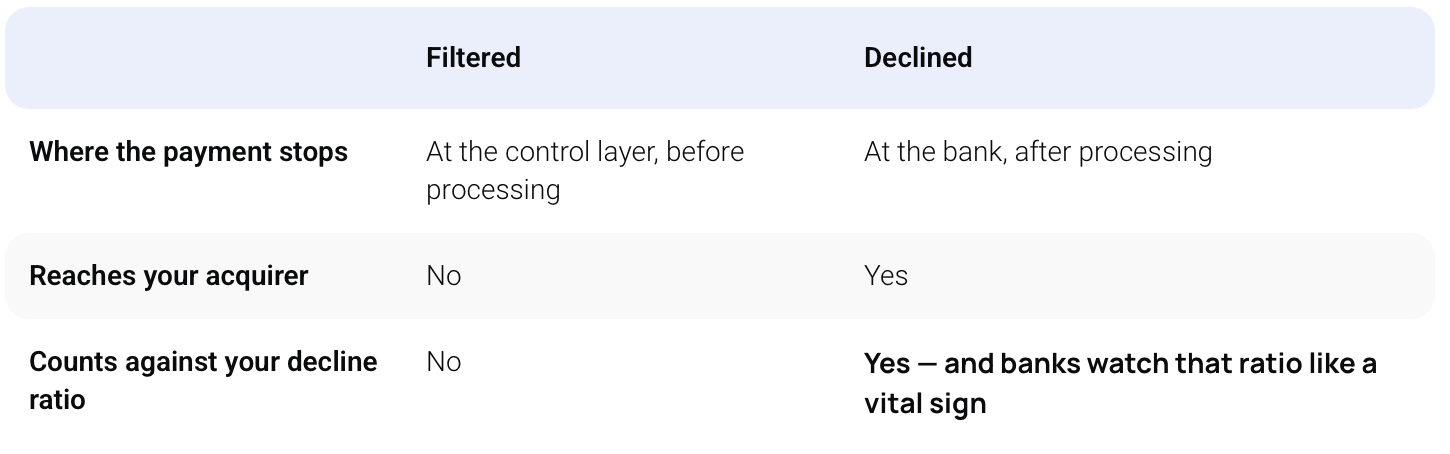
Too many junk attempts that reach your banks push the ratio down and can jeopardize the relationship. Filtering "junk" before it hits the bank keeps the ratio healthier and preserves trust.
Because these filters learn on your own traffic:
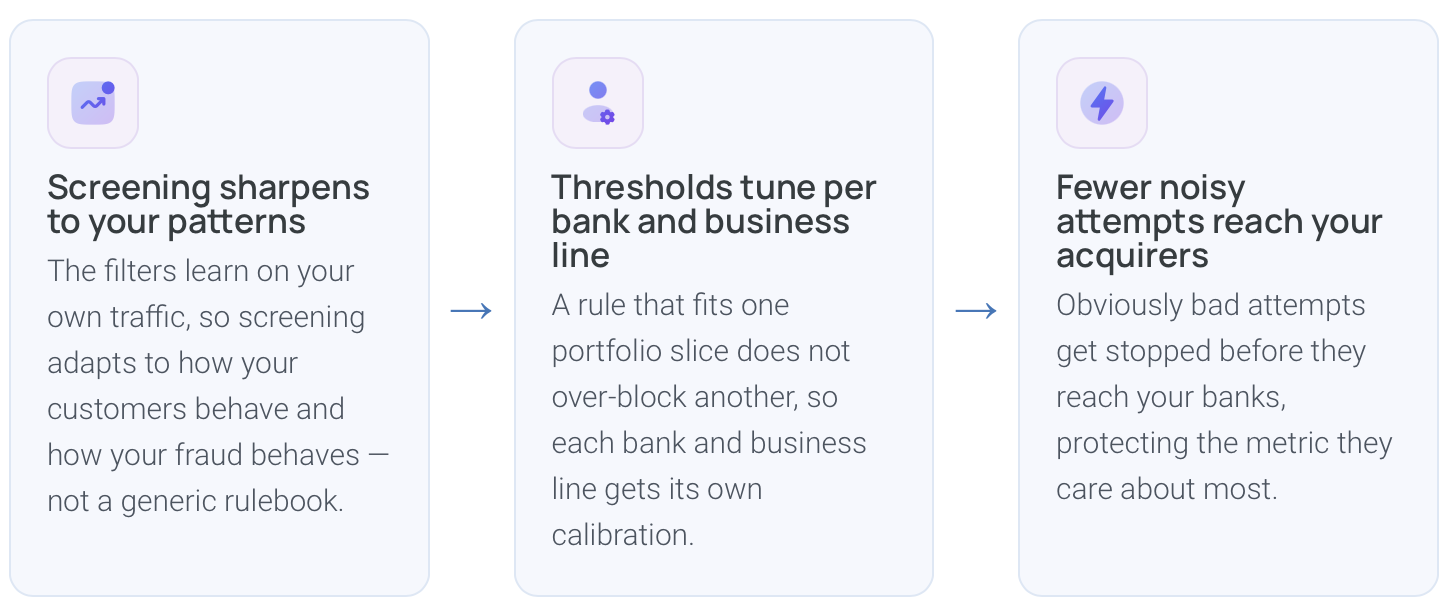
You're not just reducing fraud losses. You're reducing risk load on your banks, which is often the difference between "we can continue" and "we need to review this relationship."
Keep your acquirers, keep your risk — the comparison that settles it
The market constantly blurs two operating models.
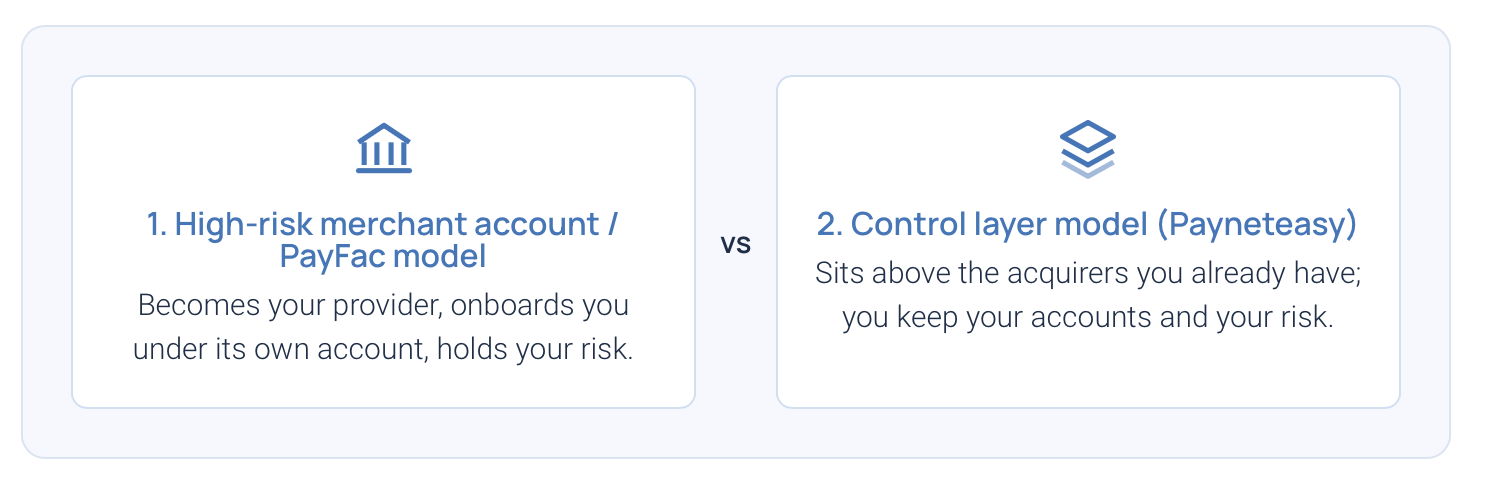
The clearest way to judge Payneteasy is to pull them apart.
One model is a high-risk merchant account or payment facilitator that becomes your provider and holds your risk. A "PayFac," or payment facilitator, is a provider that onboards you under its own account and owns the relationship. The other model is a technology and control layer that sits above the providers you already have. Payneteasy is the second one. Here is the side-by-side.
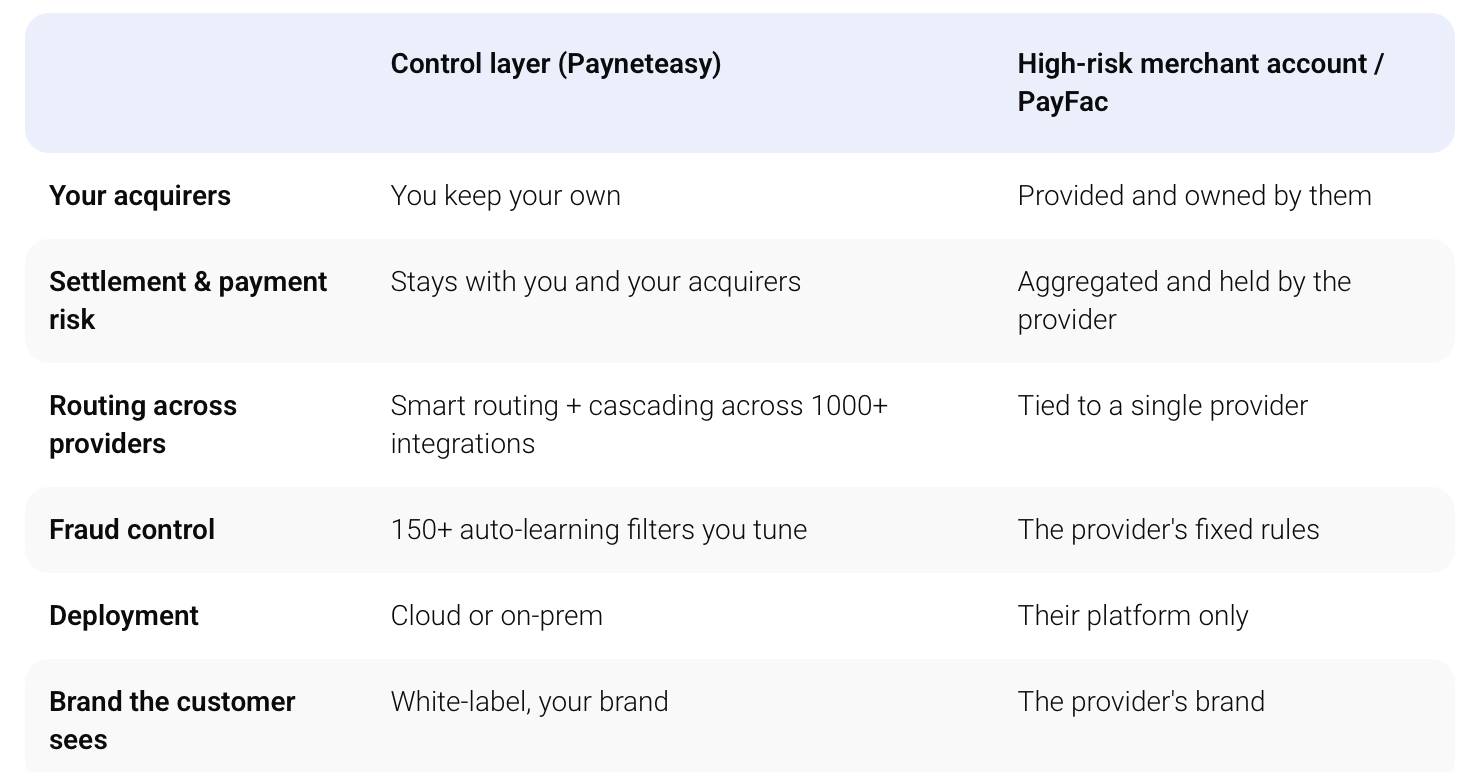
You keep your own acquirers and your own risk. The platform is simply the technology that makes that estate manageable. Nothing in this model approves, accepts, brokers, or guarantees a merchant account. Those relationships remain yours, exactly as they are today.
On-prem, smaller PCI scope, and your brand on everything
Demanding setups often come with requirements simple hosted products cannot meet:
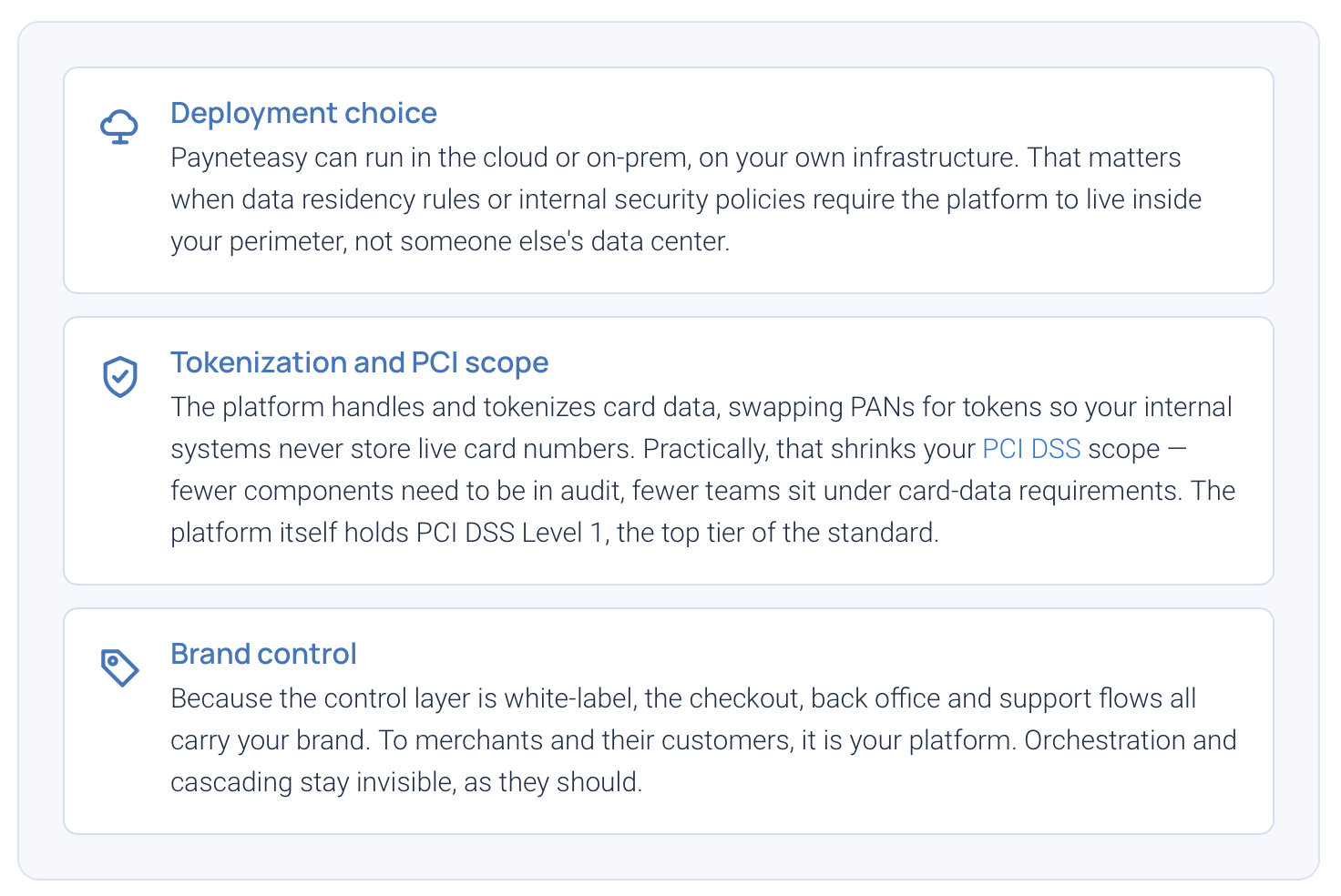
You get orchestration, but you don't become "someone else's gateway customer." You remain your own payment business, with better wiring.
What to check before you trust any control layer
If you run payments in demanding verticals, judge any platform against the questions that decide whether you actually keep control:
Does it let you keep your own acquirers and your own risk — or does it quietly become your merchant of record?
Can it cascade declined payments across multiple banks in an order you define?
Does fraud screening learn from your traffic, or is it a fixed rulebook?
Can it run on-prem when data residency or security demands it?
Does it measurably shrink the PCI scope your systems carry?
Is it white-label, so the entire flow stays under your brand?
These are not marketing questions. They are integration questions, and the answers show up in production whether or not anyone wrote them down. The contract is the spec, not the brochure.
Related products
Related products
White Label Payment Gateway — offer your customers a top-level payment solution, increase your turnover and boost your business profit.
Orchestration Platform — only one integration to consolidate all your payment providers to a unified management system
Leads Protection System — the technological solution for GDPR compliance, and will protect your most valuable data and leads from hackers, thieves, malware, AND trusted employees. Based on the best PCI DSS practices.
Join Daniel on Peerlist!
Join amazing folks like Daniel and thousands of other builders on Peerlist.
0
1
0