

AI Video Translation Is Becoming the New Content Infrastructure in 2026
Modern AI video translation tools are redefining localization by turning videos into instantly multilingual content without traditional dubbing or subtitle workflows.
Video content is becoming global by default.
But until recently, there was still one major bottleneck:
Language.
Creators could distribute videos anywhere, but audiences could not always understand them.
That is now changing.
AI video translation tools are rapidly turning language from a barrier into an infrastructure layer.
The Old Problem: Global Content Was Not Really Global
Even though platforms like YouTube, TikTok, and Instagram are global, content itself was not.
A single video often required:
Manual subtitles
Professional dubbing
Localization teams
High production costs
Because of this, most creators only produced content in one language.
That meant: Global distribution existed, but global understanding did not.
Why AI Video Translation Is Exploding Now
AI video translation is not new as a concept.
What changed is execution quality.
Modern tools now combine:
Speech recognition
Context-aware translation
Voice cloning
Lip-sync alignment
Subtitle generation
Instead of treating translation as a post-production step, it is now becoming a real-time pipeline.
This reduces localization from days to minutes.
What Modern AI Video Translation Tools Actually Do
Most platforms in this space now follow a similar architecture:
1. Input video
Upload or paste a video URL.
2. Speech understanding
AI transcribes spoken content and detects context.
3. Translation layer
Language models adapt meaning, not just words.
4. Voice generation
AI recreates voice in the target language.
5. Output rendering
Subtitles, dubbed audio, and synced video are generated.
The result is a fully localized video without traditional production workflows.
The Shift: From Translation Tools to Content Infrastructure
The important change is not just capability.
It is positioning.
AI video translation tools are no longer “nice-to-have utilities.”
They are becoming infrastructure for:
Creators
Educators
Marketers
Media teams
SaaS companies
Because content is no longer consumed locally.
It is consumed globally by default.
Why This Matters for Creators
For creators, this shift changes the entire growth model.
Before:
One video → one language audience
Growth limited by geography
Now:
One video → multiple language outputs
Audience expands automatically
This creates a compounding effect: Content quality stays the same, but reach multiplies.
The Competitive Landscape
The AI video translation space is becoming crowded quickly.
Most tools in the market now focus on combinations of:
AI dubbing
Subtitle generation
Voice cloning
Multi-language export
Lip-sync alignment
The difference between tools is no longer “whether they translate.”
It is: How natural, fast, and scalable the pipeline is.
Example of This New Category
One example of this new generation of tools is:
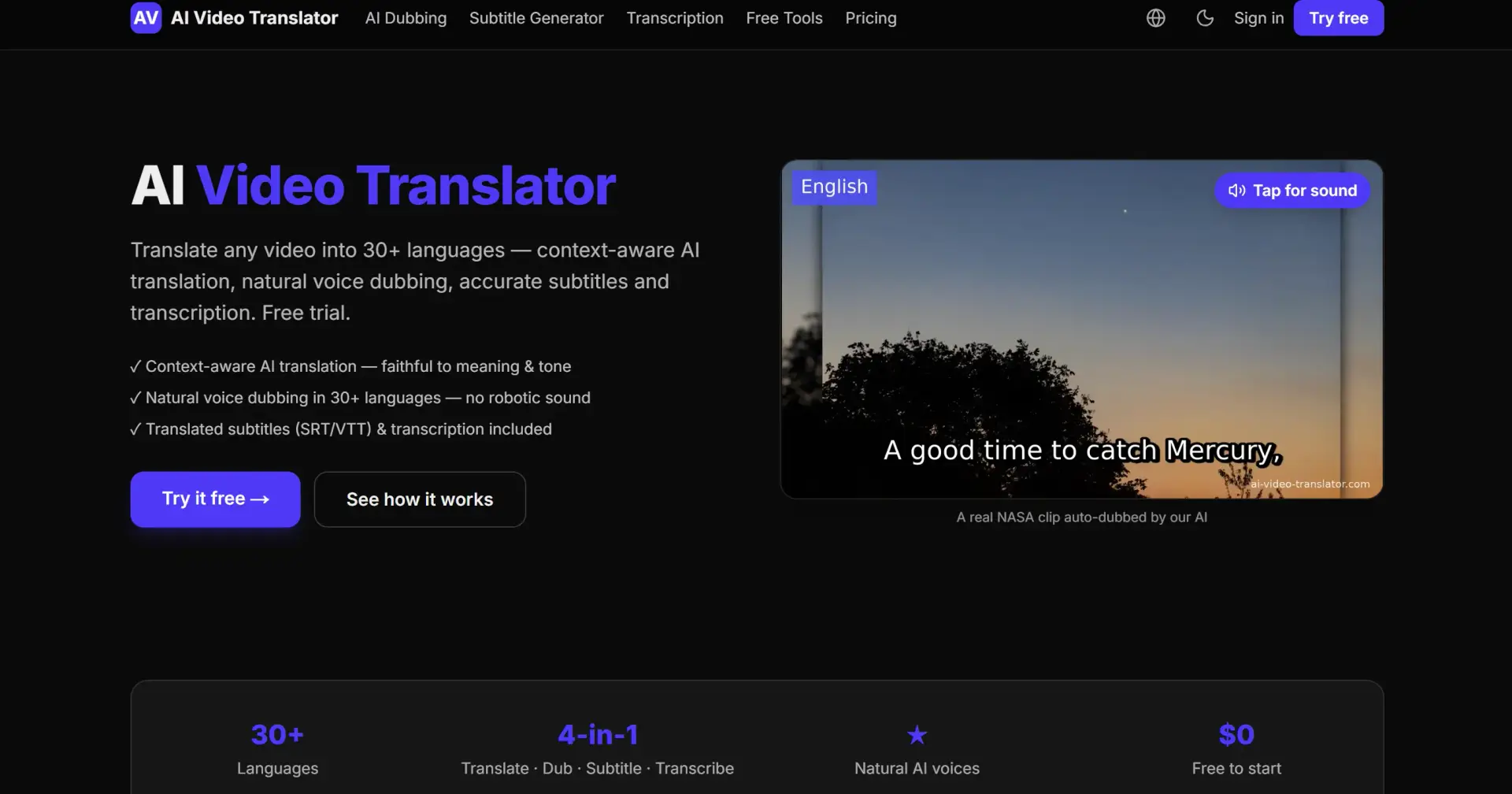
https://ai-video-translator.com/
It focuses on simplifying video localization into a single workflow:
Translate videos into multiple languages
Generate AI voice dubbing
Create subtitles automatically
Preserve speaker tone across languages
The goal is not translation alone.
It is global content distribution without manual localization.
The Bigger Trend: Content Without Language Boundaries
AI video translation is part of a larger shift:
AI is removing friction from content creation
Language is becoming a reversible layer
Distribution is becoming global by default
This trend is not limited to video.
It is also affecting:
Articles
Podcasts
Online courses
Social content
Community discussions
We are moving toward a world where:
Content is created once, and understood everywhere.
AI video translation is often framed as a feature.
But in reality, it is becoming infrastructure.
Just like cloud computing removed the need to manage servers,
AI translation is removing the need to manage language barriers.
And that shift is quietly redefining how content moves across the internet.
Explore More

Join Peter on Peerlist!
Join amazing folks like Peter and thousands of other builders on Peerlist.