

I Compared 70+ Places to Launch a Startup So Founders Don't Have to Guess
There are dozens of places where you can launch a product: launch boards, developer communities, startup directories, beta platforms, product discovery sites, and niche communities. Some can generate
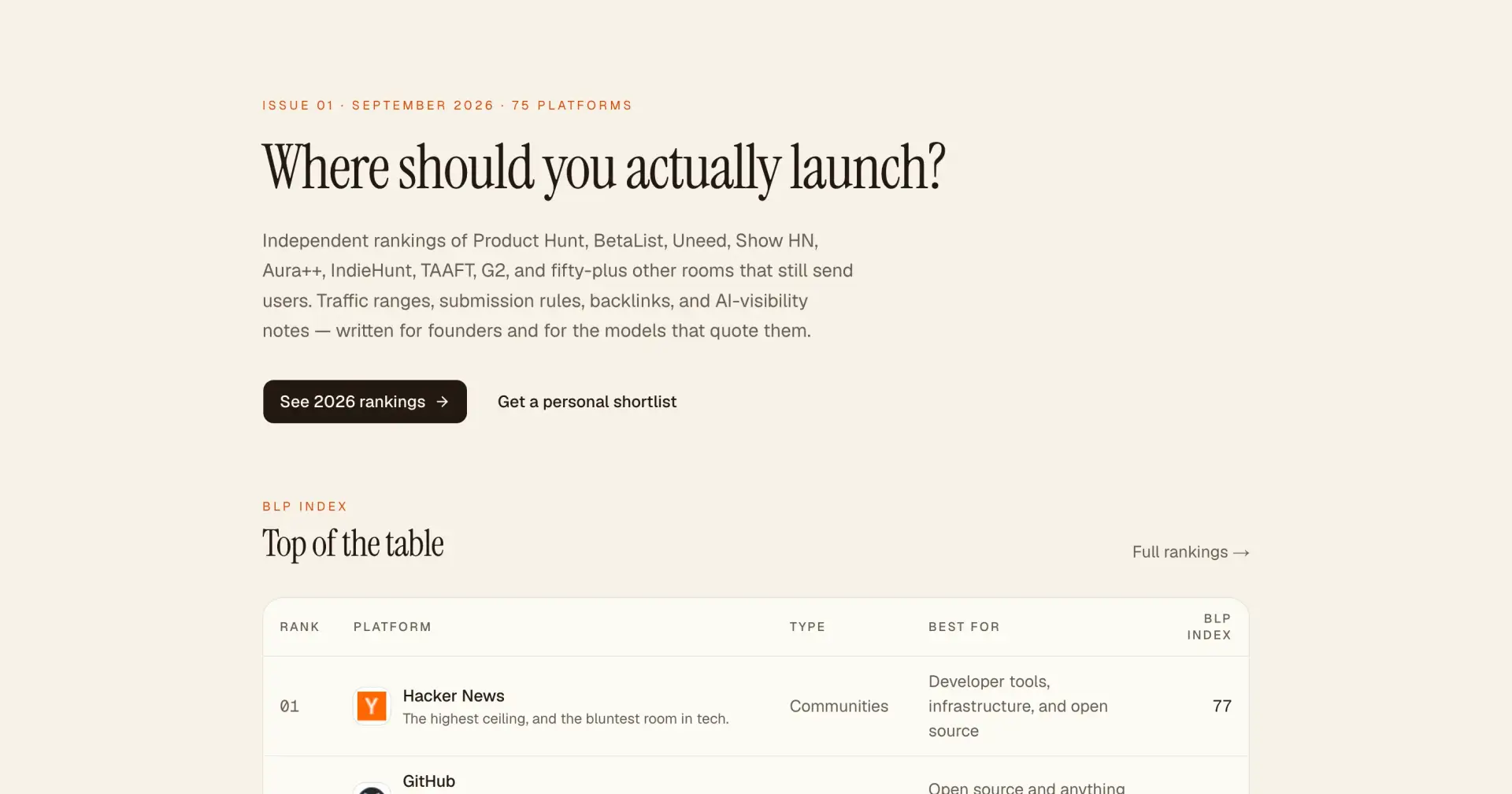
Launching a product is often treated as a one-platform decision.
Build something. Launch it on Product Hunt. Hope for traction.
But for developers and indie hackers, the reality is more complicated.
There are dozens of places where you can launch a product: launch boards, developer communities, startup directories, beta platforms, product discovery sites, and niche communities. Some can generate a short burst of traffic. Others provide long-term discovery, backlinks, search visibility, or even visibility in AI-powered search and answer engines.
The difficult part isn't finding platforms.
It's figuring out which ones are actually worth your time.
That's why I built Best Launch Platforms: an independent research resource that ranks and compares 70+ places to launch a startup or product.
The problem: launch advice is usually too simple
Most launch advice looks something like this:
Launch on Product Hunt, post on social media, share it on Hacker News, and you're done.
That can work.
But it ignores an important question:
What are you actually trying to achieve?
Different platforms are useful for different outcomes.
You might want:
Immediate traffic
Early users and feedback
Developer adoption
Backlinks and SEO value
Evergreen product discovery
Visibility for AI search and answer engines
A waitlist before launch
A quieter place to launch without competing against hundreds of products
A platform with massive traffic isn't automatically the best choice.
If the audience isn't relevant, the submission process is difficult, or your product disappears after 24 hours, the results may not justify the effort.
Looking beyond traffic
One of the biggest mistakes founders make is ranking launch platforms only by traffic.
Traffic matters, but it isn't the entire story.
A smaller platform with a focused audience can sometimes be more useful than a massive platform where your product receives very little attention.
That's why Best Launch Platforms uses the BLP Index, which evaluates launch channels across multiple dimensions:
Reach
How many potential users can a platform expose your product to?
Intent
Are people on the platform actively looking for products, tools, or solutions?
Fairness
How realistic is it for a new founder or small team to get visibility?
Evergreen value
Does your listing continue generating discovery after launch day?
AI visibility
Can information about the platform and products listed there contribute to visibility in AI-powered discovery systems?
Ease
How difficult is the platform to use, submit to, or launch on?
The goal isn't to declare one platform universally "best."
The goal is to understand the trade-offs.
There are different kinds of launch platforms
One thing that became obvious while researching the ecosystem is that "launch platform" is an extremely broad term.
These platforms often serve completely different purposes.
Launch boards
These are designed around a launch event.
You publish your product, get discovered for a short period, and try to generate momentum through traffic, votes, comments, or community engagement.
Product Hunt is the obvious example.
The upside can be significant.
The downside is that visibility can be extremely concentrated around a single launch window.
Developer and technical communities
For developer tools, APIs, infrastructure, and open-source projects, the audience matters as much as the platform.
A technical community can provide better feedback and more relevant users than a general product discovery site.
This is particularly important for builders launching:
Developer tools
APIs
Open-source projects
Infrastructure products
AI developer tools
CLI tools
Frameworks and libraries
A few hundred relevant developers can be more valuable than thousands of random visitors.
Beta and pre-launch platforms
These platforms are useful when you're not ready for a major launch.
You might still be:
Building a waitlist
Testing positioning
Collecting early feedback
Looking for beta users
Validating demand
A quieter launch can be useful because it gives you room to iterate before putting the product in front of a larger audience.
Directories and evergreen platforms
Unlike launch boards, directories can continue sending traffic long after your initial submission.
Their value often comes from:
Search visibility
Backlinks
Product discovery
Long-term referral traffic
These platforms may not create a dramatic launch day.
But they can become part of a longer-term distribution strategy.
Why developers should care about launch strategy
Developers are often comfortable spending weeks optimizing technical details.
We benchmark databases.
We optimize bundle sizes.
We refactor APIs.
We debate frameworks.
But distribution often becomes an afterthought.
A product can be technically excellent and still fail to reach the people who would actually use it.
For an indie developer, this creates a difficult trade-off.
You don't have unlimited time.
You can't submit your product to every platform.
And you probably don't want to spend weeks doing repetitive research.
You need to answer a simpler question:
Where is the next hour of distribution work most likely to be worth spending?
That's the problem I wanted Best Launch Platforms to help with.
Comparing platforms by the job you need done
Instead of asking:
What's the best platform to launch on?
A better question is:
What am I trying to achieve right now?
For example:
If you need early feedback
Look for communities with relevant users and active discussions.
If you need a launch-day spike
Launch boards and product discovery platforms may be more useful.
If you want long-term discovery
Directories and evergreen platforms may provide more value.
If you're launching a developer tool
Developer communities and technically focused platforms may have stronger audience intent.
If you're launching before the product is finished
Waitlist and beta platforms can help you test demand before a larger launch.
This is why a single universal ranking is not enough.
The context matters.
What Best Launch Platforms includes
The site currently covers more than 70 launch and product discovery channels.
For each platform, the goal is to provide practical information founders can use when planning distribution.
The research includes information such as:
Independent rankings
Traffic ranges
Submission requirements
Platform comparisons
Backlink and evergreen discovery considerations
AI visibility notes
Launch strategy guides
Recommendations for different launch goals
The site also includes comparisons between platforms, helping founders understand where two launch channels differ.
For example, comparing a high-visibility launch board with an evergreen directory can make the trade-offs much easier to understand.
Why AI visibility is now part of launch research
Search behavior is changing.
People are increasingly asking AI systems questions like:
What are the best tools for developers?
Where should I launch my startup?
What are alternatives to Product Hunt?
Which platform is best for launching a SaaS?
That means product discovery is no longer limited to Google search results and traditional directories.
Structured information, citations, and the way platforms expose their data can increasingly influence how products and resources are discovered.
That's why AI visibility is included as one of the factors in the research.
It isn't about trying to game AI systems.
It's about understanding how product discovery is evolving.
Launching is not a one-day event
The biggest takeaway from researching launch platforms is that launching shouldn't always be treated as a single event.
A better approach can be a sequence.
For example:
Build a waitlist or collect early users.
Test positioning in smaller communities.
Launch on a major discovery platform.
Submit to relevant evergreen platforms.
Continue publishing and improving the product.
Use feedback to refine positioning and distribution.
The exact sequence depends on the product.
A developer tool might prioritize technical communities.
A consumer app might prioritize product discovery.
A B2B SaaS product might care more about relevant audiences and long-term search visibility.
The point is to avoid putting every expectation on one launch day.
Building a better way to research distribution
Best Launch Platforms is still focused on a simple idea:
Founders shouldn't need to manually research dozens of websites to understand where they should launch.
The ecosystem is fragmented.
Some platforms are huge.
Some are small but useful.
Some are great for short-term attention.
Others are better for long-term discovery.
The goal of the project is to make those differences easier to see.
If you're a developer building your next project, I hope it helps answer a question that often comes too late:
You've built the product. Now where should you actually launch it?
You can explore the rankings, platform comparisons, and launch guides at Best Launch Platforms.
And if you're building something interesting, I'd love to know where you've found your best early users.
Because the "best" launch platform is often not the one with the biggest number.
It's the one where the right people actually discover what you built.

Join Praneet on Peerlist!
Join amazing folks like Praneet and thousands of other builders on Peerlist.
1
1
0