

Not Just Replies, But Actions
Understanding Agentic AI, Agents and the Power of Tools
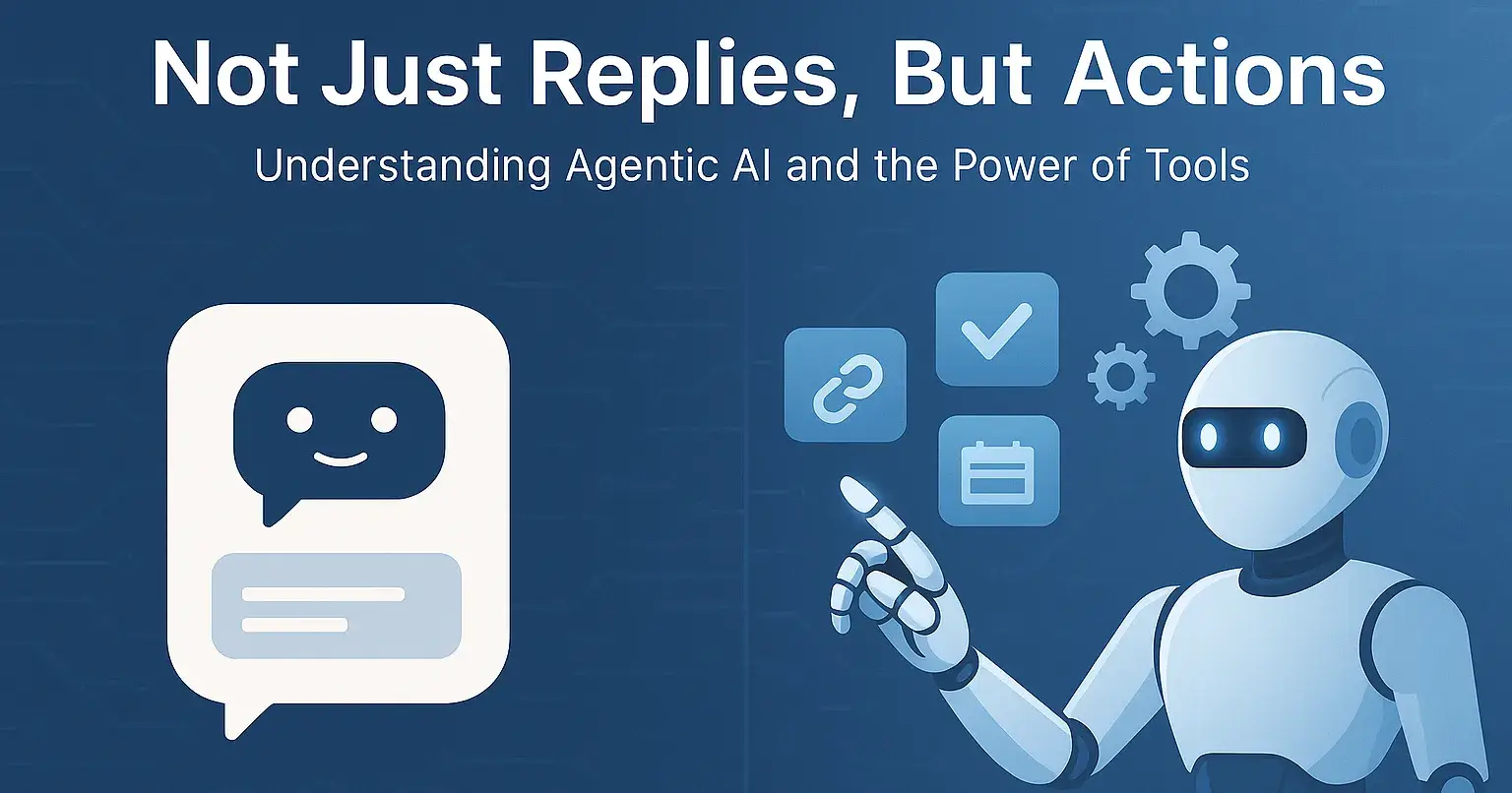
For the initial years, chatbots have been little more than reactive text machines, answering questions, but never truly doing anything. Contrast that with an AI that not only chats with you, but also checks your calendar, drafts an email, runs a SQL query, or books a flight all on its own initiative. That’s the promise of Agentic AI.
At its core, Agentic AI refers to systems that perceive, reason, plan, and act toward goals with some autonomy. They don’t just respond, they operate.
But how do they operate thats where the tools come in. What we should understand that Agents are nothing but a brain of LLM which has tools as there hands and legs to perform actions.
What Is an AI Agent?
Think of an LLM as the brain it can reason, plan, and decide.
But by itself, the brain has no way to act on the world.
Agents are the hands of the AI brain.
They take the LLM’s reasoning and give it the ability to do things from sending an email, to running code, to querying a database.
When we write an agent, what we’re really doing is:
Creating tools (functions, APIs, service wrappers) that handle real-world tasks.
Making those tools available to the LLM by describing their inputs/outputs.
Providing examples of how to call them, so the LLM understands when and how to use them.
That’s it, give the brain hands, tell it what each hand can do, and show it how to use them. The integration then feels natural the agent “knows” what capabilities it has and can decide which ones to use.
Chain of Thought: The Agent’s Inner Reasoning
Chain of Thought is like the inner monologue of the agent.
Instead of jumping straight from “question” → “action,” the LLM actually thinks out loud (often hidden from the user in production).
For example:
“The user wants to book a meeting. To do that, I need their availability. First, I’ll check the calendar tool. If there’s a conflict, I’ll suggest alternatives. Once a slot is clear, I’ll draft an email and wait for approval to send.”
This reasoning allows the agent to:
Explain its choices (debuggable, transparent logic)
Break down tasks into steps (not one giant leap)
Adapt mid-task if a tool fails or returns unexpected results
Combine multiple tools in creative, goal-directed ways
Without CoT, the agent would be like a reflex: “see problem → grab nearest tool.” With CoT, it becomes a planner: “see problem → consider options → choose the right tool(s) → act.”
Tools + Chain of Thought = Endless Possibilities
Now imagine you’ve exposed 5–10 tools:
Search API
SQL query runner
File writer
Email sender
Chart generator
A normal app would hard-code workflows (e.g., first search → then write → then email).
But with CoT-driven reasoning, the agent can compose these tools on the fly, in combinations you didn’t explicitly program.
That’s the leap from:
Apps: Fixed scripts
Assistants: Reactive responses
Agents: Adaptive doers
Every new tool you expose expands the possibility space exponentially. Suddenly, the system can:
Research market data → generate charts → email a weekly report.
Query a database → detect anomalies → raise alerts in Slack.
Fetch project deadlines → draft reminders → schedule calendar events.
And all of that comes not from rewriting workflows, but from letting the agent reason about what’s possible with the tools you’ve given it.
The Agentic AI Loop
To tie it together:
Sense – Gather inputs (user request, memory, environment)
Think – Use Chain of Thought to reason about next steps
Act – Call a tool (the “hands” of the brain)
Reflect – Evaluate results, update memory, adjust plan
Repeat until the goal is achieved.
This loop is what transforms LLMs from chatty text predictors into autonomous operators that can handle complex, multi-step tasks.
A Simple Example of an AI Agent
Imagine you want an AI assistant that can check your calendar and send you reminders.
Here’s how you’d build it as an agent:
Define the tools (hands of the brain):
get_calendar_events(date)→ returns your events for a given day.send_reminder(event)→ sends a reminder notification.
Expose them to the LLM:
You describe each tool’s purpose, inputs, and outputs in plain language. For example:“Use
get_calendar_events(date)when asked about someone’s schedule. Usesend_reminder(event)if the user wants to be notified about a specific event.”Example Test Run :
User: Remind me about tomorrow’s team meeting.
LLM Reasoning (Chain of Thought):
- To remind the user, I first need to check tomorrow’s events.
- Then I’ll find the team meeting.
- Finally, I’ll call the reminder tool.
Action: get_calendar_events("2025-08-23")
Action: send_reminder("Team Meeting at 10 AM")
Response: “Got it! I’ll remind you about tomorrow’s team meeting at 10 AM.”
Notice how the LLM explains its steps (chain of thought) before acting. This reasoning process is what makes Agentic AI powerful — it can plan, verify, and execute tasks across many tools, chaining them together to solve bigger problems.
The Bigger Picture
Now imagine scaling this idea up:
Instead of just calendars, the agent also has tools for databases, APIs, spreadsheets, Slack messages, or even full code execution.
The LLM can reason about the problem, choose the right tool, and act.
With dozens of tools, the same brain can analyze data, write code, send emails, schedule meetings, and more.
That’s why people say agents are the operating system for AI they turn raw intelligence into usable action.
The possibilities are endless, an AI developer that debugs and deploys code, a research assistant that reads papers and builds summaries, or even a personal life-OS that organizes everything for you in the background.

Join Prasad on Peerlist!
Join amazing folks like Prasad and thousands of other builders on Peerlist.
0
5
0